01
Home Feng Shui
Return to the room-by-room guide.
Explore Home Feng Shui →
The bedroom has a different purpose from almost every other room in the home.
It is where activity gives way to rest, where the outside world is temporarily put aside, and where we spend some of the quietest hours of the day.
For that reason, traditional Feng Shui approaches the bedroom with particular care.
The aim is not to fill the room with auspicious objects or follow a rigid list of rules. It is to create an environment that feels supported, settled and appropriate for rest.
Begin with the bed.
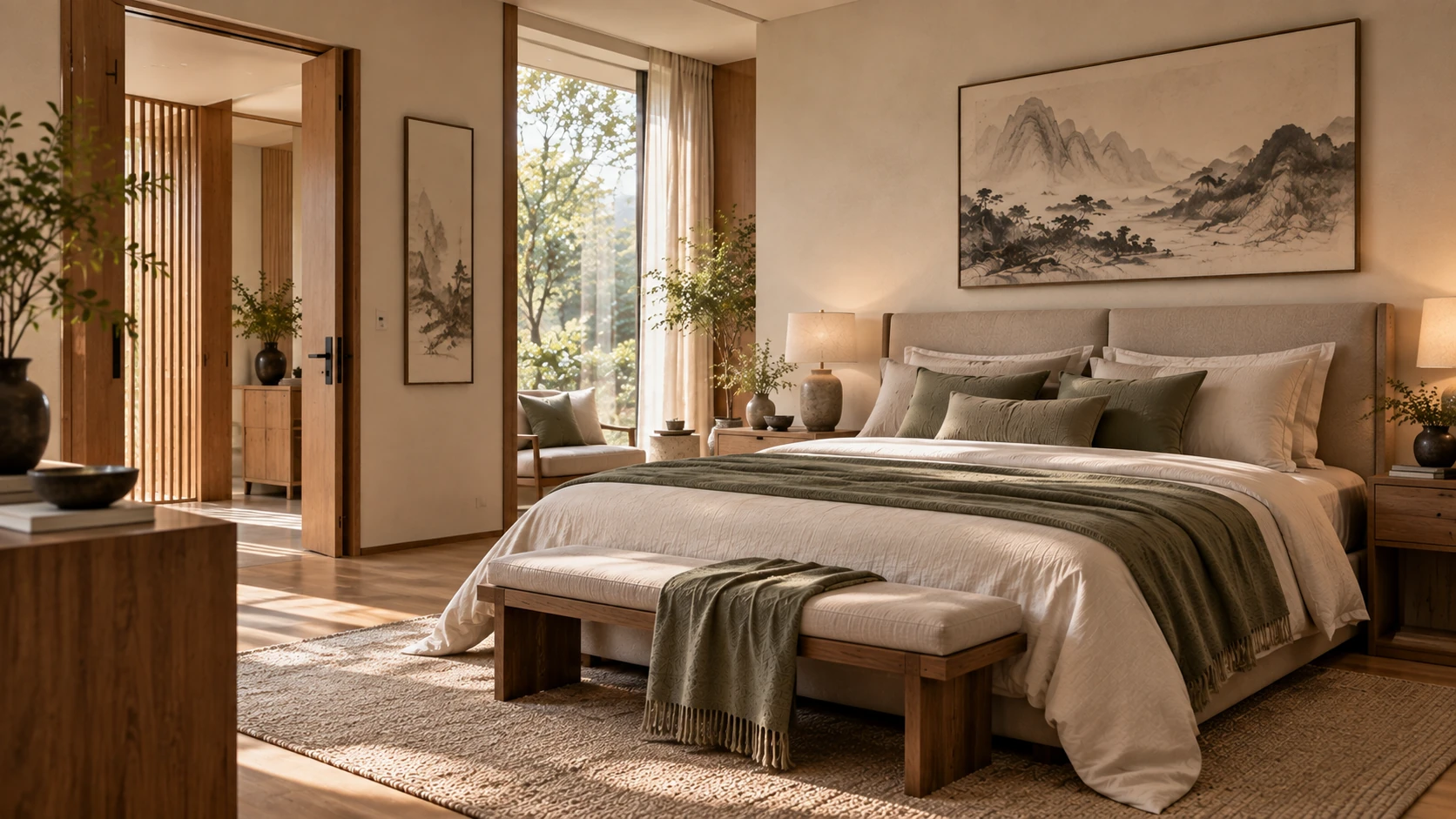
In most bedrooms, the bed is the dominant piece of furniture. Its position therefore has an unusually large effect on how the entire room is experienced.
Many traditional Feng Shui approaches favour placing the head of the bed against a solid wall.
The principle is one of support.
A substantial wall behind the headboard creates a clear boundary around the sleeping position and can make the bed feel visually anchored within the room.
Where possible, Feng Shui also commonly favours a position from which the entrance can be perceived without placing the bed directly in line with the doorway.
This is sometimes described as a commanding position.
The idea is not that every bedroom must conform to one perfect diagram. Real homes have windows, radiators, wardrobes, unusual proportions and architectural limitations.
Think of the principle before the rule: Support behind you. Awareness around you. Rest in front of you.
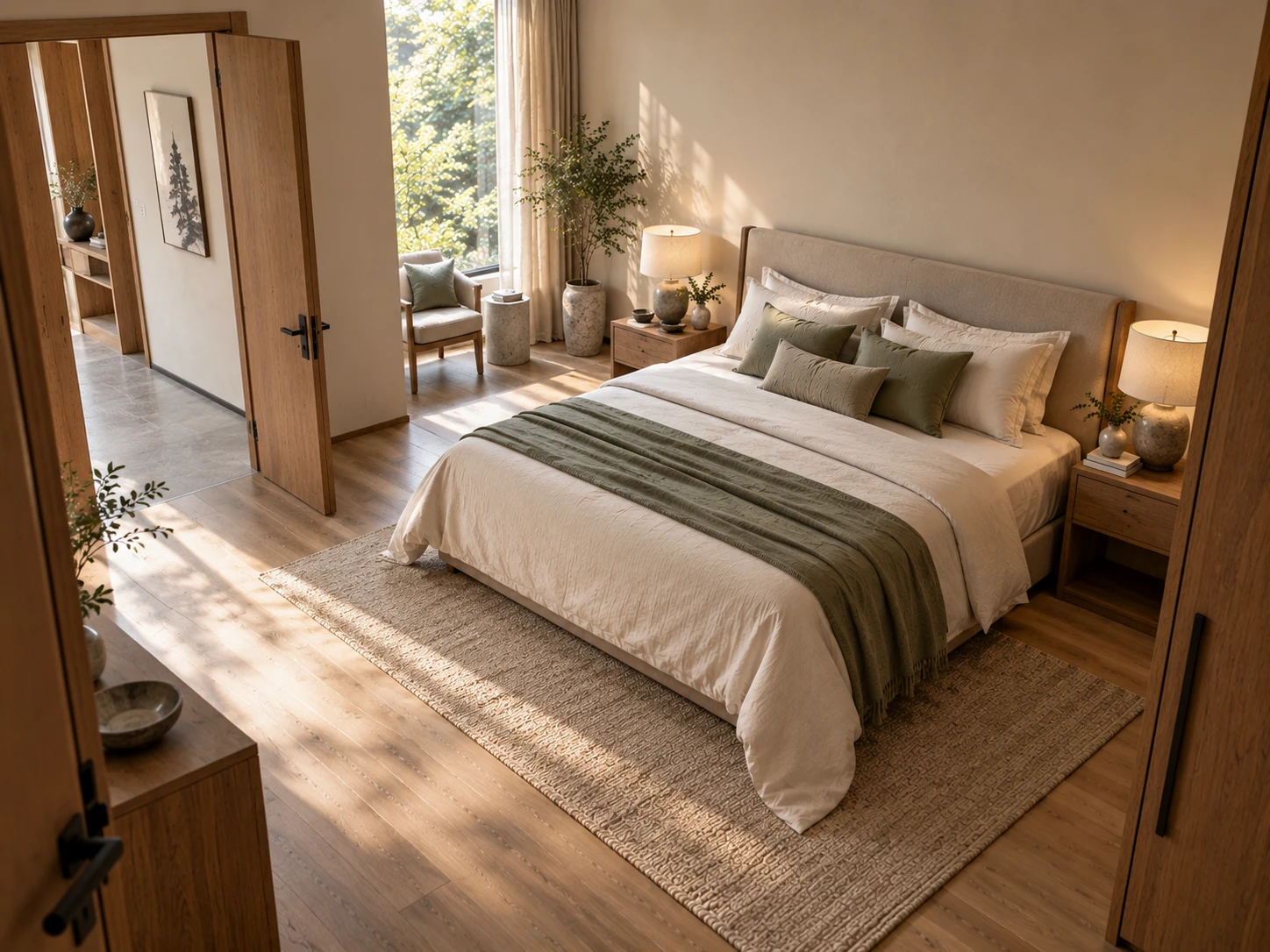
Lie on the bed and look around the room.
What do you actually see?
A bedroom may be beautifully decorated and still feel visually busy from the sleeping position.
An overflowing desk, an open wardrobe, a large television, piles of clothes or a mirror reflecting the bed can all become dominant parts of the visual field.
Traditional Feng Shui pays attention to these relationships because the bedroom is not simply another living space.
Its primary purpose is rest.
That makes visual restraint particularly valuable here.
The goal is not to remove every object. It is to decide which objects deserve to occupy the space around the bed.
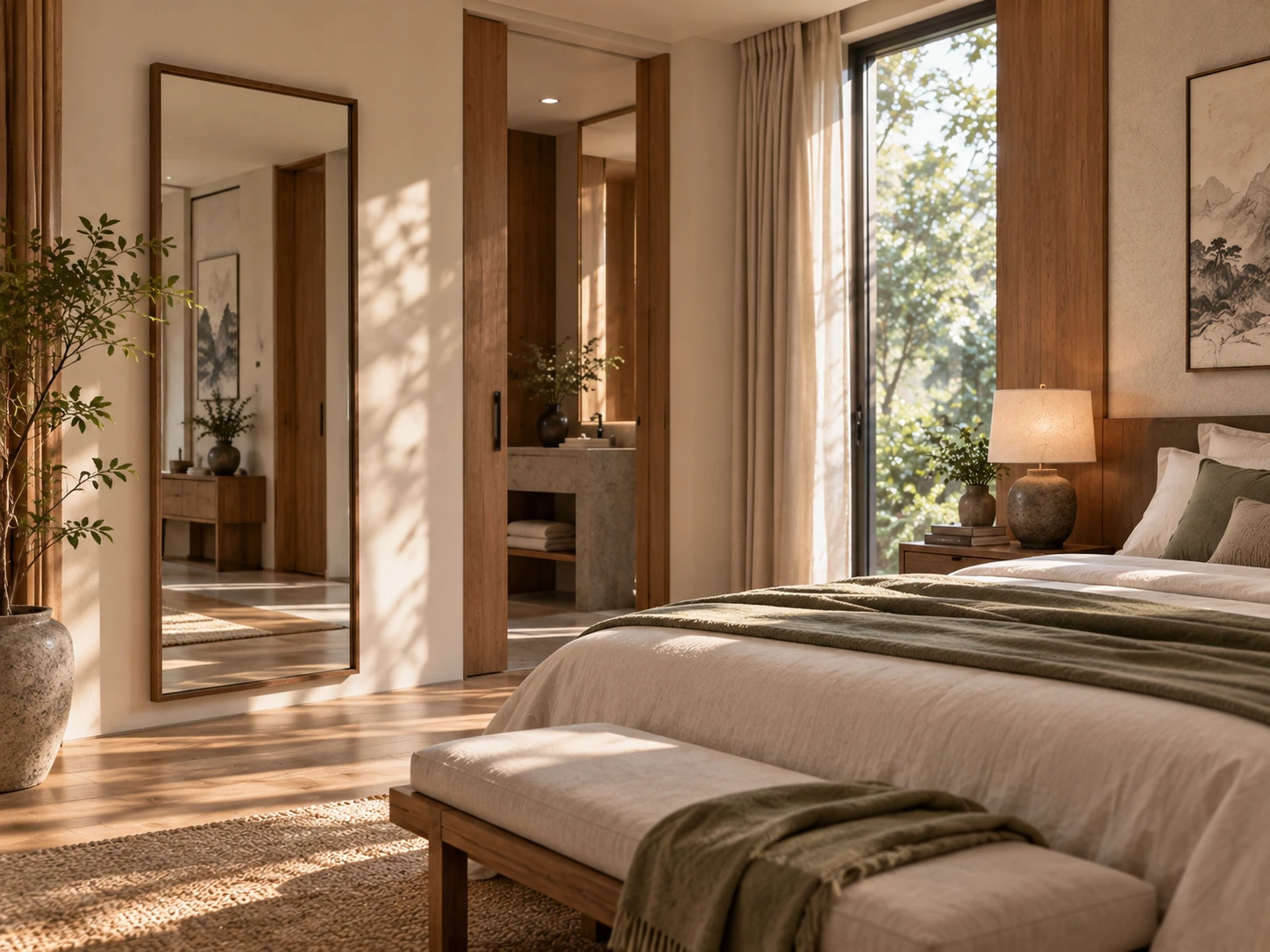
One of the most familiar Feng Shui cautions concerns a mirror directly reflecting the bed.
This is sometimes surrounded by dramatic explanations, but the underlying spatial idea is much simpler.
Mirrors introduce reflection, light and movement. When a large mirror directly reflects the sleeping position, it can become an unusually active visual element in a room intended to feel quiet.
Traditional Feng Shui therefore commonly recommends avoiding a mirror that directly reflects the bed.
That does not mean mirrors must disappear from bedrooms.
A mirror positioned on another wall, within a wardrobe or elsewhere outside the direct sleeping view can remain completely functional without dominating the bed.
The distinction is useful: The question is not whether you own a mirror. It is what the mirror reflects.
Feng Shui also pays attention to the space immediately above the sleeping position.
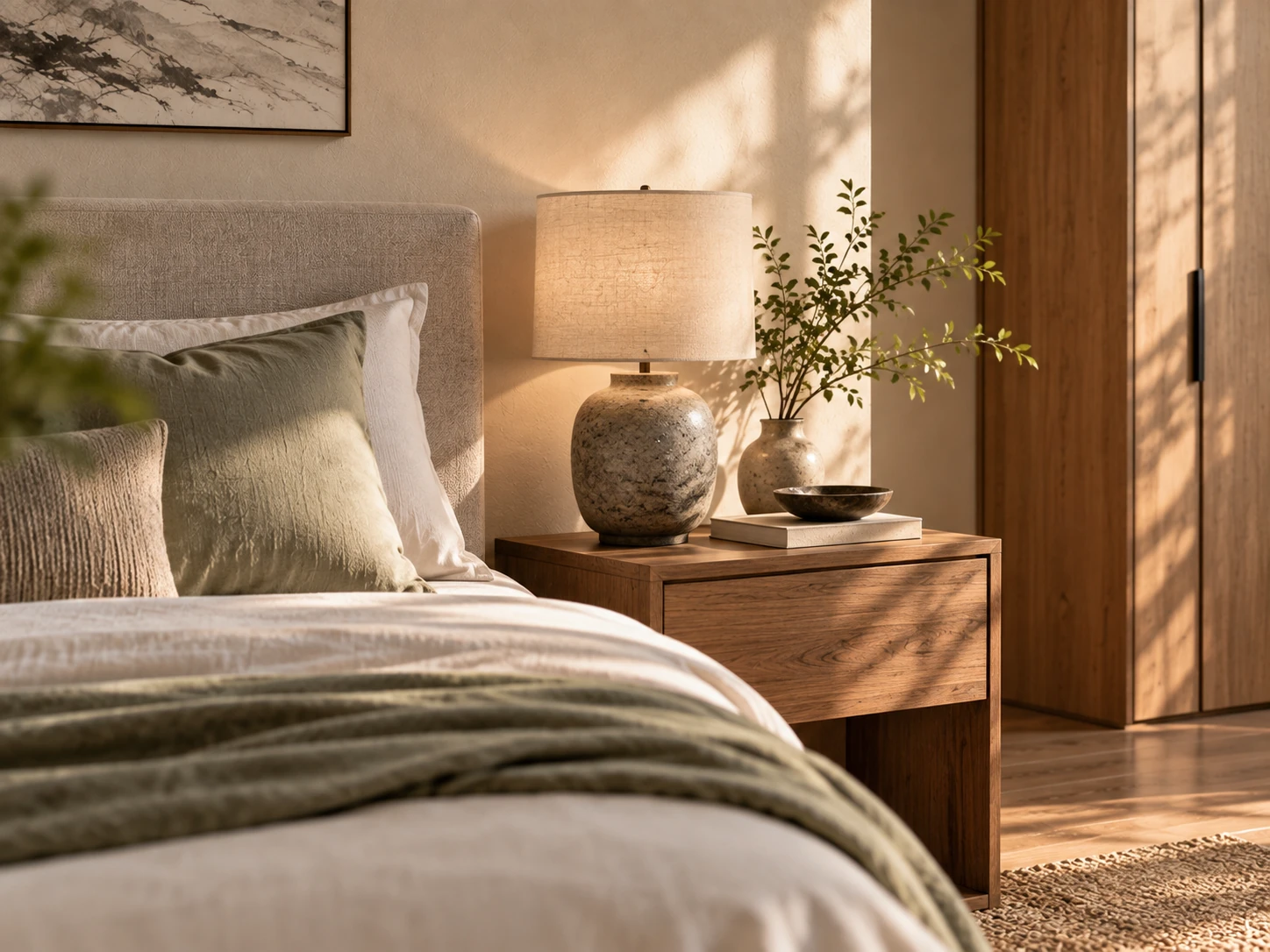
A substantial exposed beam directly crossing the bed is traditionally treated with caution, particularly when it creates a strong visual sense of weight above the person sleeping beneath it.
The same principle can be applied more broadly.
Large suspended objects, visually heavy shelving or oversized decorative pieces immediately above the headboard can change the psychological character of the sleeping area.
A bedroom does not need to be bare.
But around the bed, visual stability is often more valuable than spectacle.
Modern bedrooms often perform several jobs at once.
They may be bedrooms, offices, entertainment spaces, dressing rooms and places for scrolling through a phone late into the night.
Not all of this can be avoided, particularly in smaller homes.
But Feng Shui encourages us to notice when the active functions of a room begin to overwhelm its quieter purpose.
If a desk must remain in the bedroom, can the working area feel visually separate from the bed?
Can cables and electronics become less dominant?
Can clothing be stored rather than accumulating around the sleeping area?
Can lighting become softer as the day ends?
These are modest interventions, but together they can change the character of a room.
The bedroom does not need more.
Often, it needs less competing for attention.
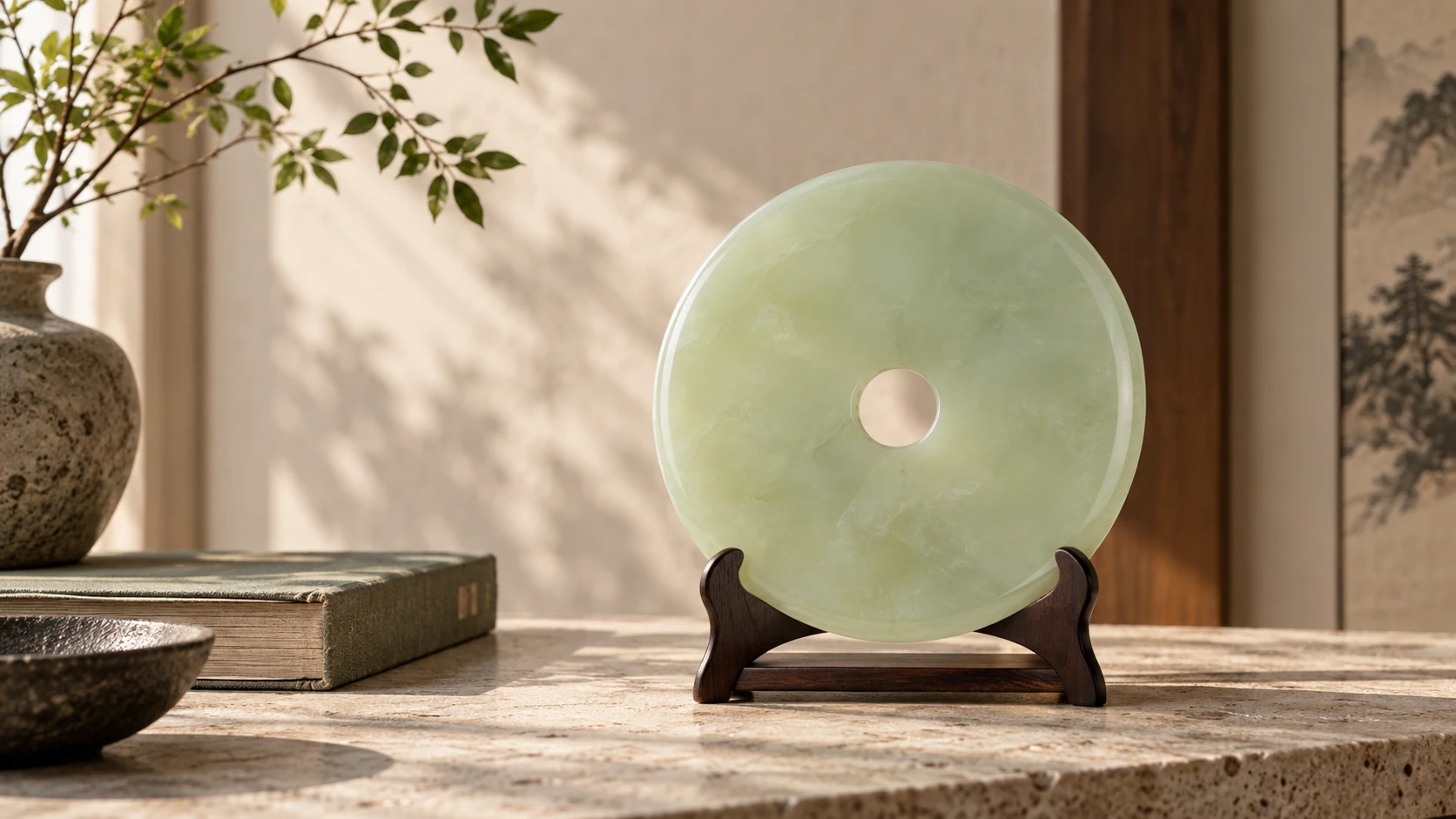
Among traditional Chinese forms, few are as restrained as the Ping An Kou, 平安扣.
Its shape is remarkably simple: a smooth circular disc surrounding an open centre.
The name itself carries its meaning. Ping An, 平安, expresses the idea of peace, safety and well-being, while Kou, 扣, refers to the button-like circular form.
The Ping An Kou is widely encountered in jade jewellery, but the same form can also exist as a larger decorative object within the home.
Its simplicity is particularly appropriate for a bedroom.
Unlike more assertive Feng Shui symbols, the Ping An Kou does not need an elaborate mythical creature or complex ornamentation to communicate its cultural identity. The circle itself gives the object a feeling of continuity and completeness.
For YukDao, a large Ping An Kou carved from Qing Yu, 青玉, allows that traditional form to become a quiet object for the contemporary home.
The muted green stone sits naturally alongside wood, linen, ivory and other materials already associated with the YukDao interior language.
Green Jade Ping An Kou
青玉平安扣
Traditionally associated with peace, harmony and protection.
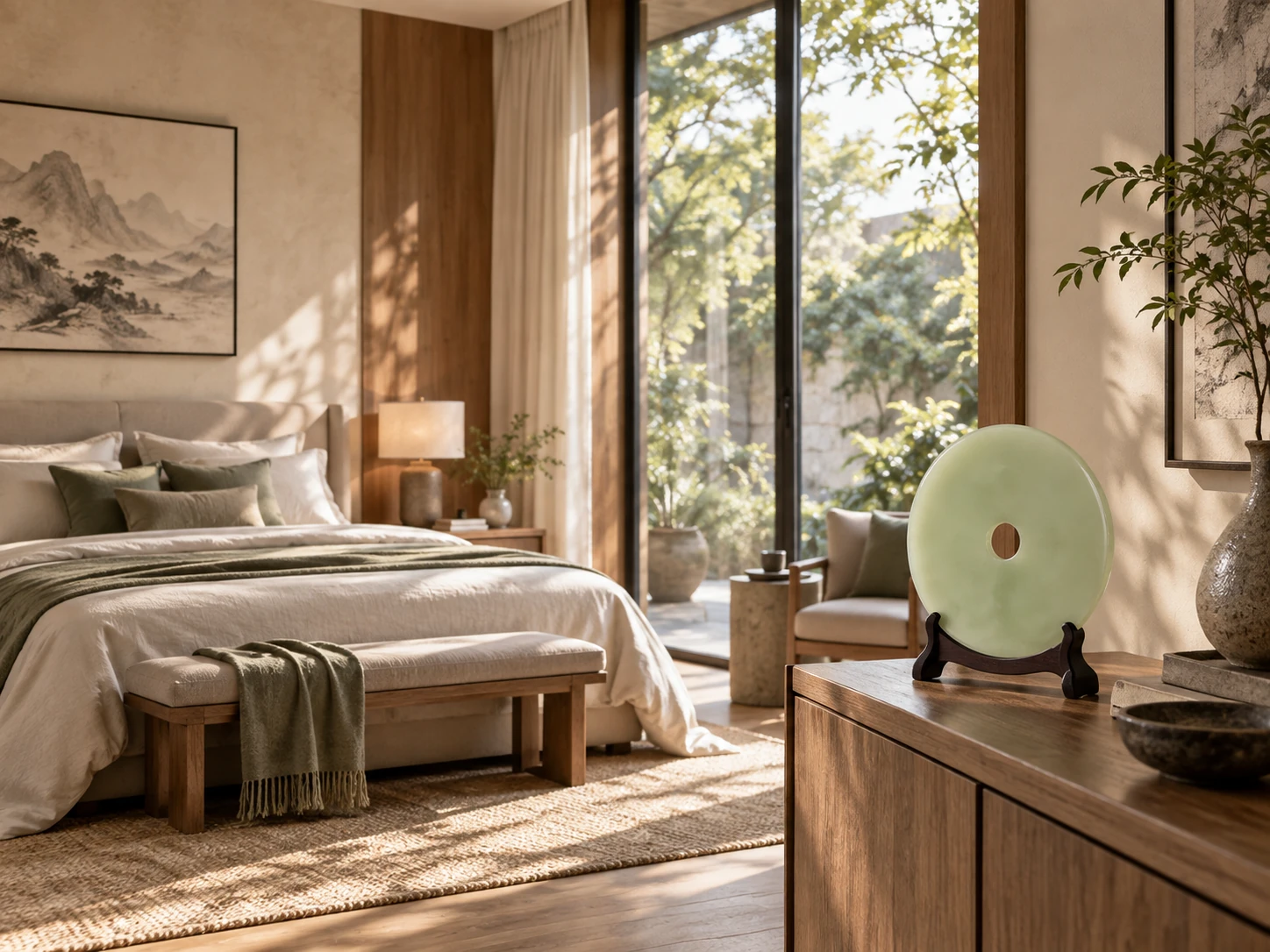
There is no need for the Ping An Kou to dominate the bedroom.
A large stone version can sit on a console, cabinet or dedicated stand where its circular form can be appreciated without becoming another visually demanding object around the bed.
The exact position should respond to the architecture and use of the room rather than a universal formula.
That approach reflects a broader YukDao principle: The object should belong to the space, not overwhelm it.
For a bedroom, restraint matters.
One meaningful object, thoughtfully positioned, can have greater presence than a collection of competing symbols.
Intention · Harmony & Rest
Does the bed have a sense of support behind it?
Is the bed directly in line with the door?
Does a mirror directly reflect the sleeping position?
Is there anything visually heavy directly above the bed?
Does the room feel primarily like a place to rest, or like several rooms competing with one another?
You do not need a perfect bedroom to practise Feng Shui.
The purpose of these questions is simply to see the room more clearly.
Feng Shui should not turn a personal room into a formula.
Your books, photographs, textiles and objects are part of what makes a bedroom yours.
The aim is not to erase personality in pursuit of an idealised minimalist space.
Instead, consider the relationship between those things and the purpose of the room.
Keep what carries meaning.
Notice what creates unnecessary visual noise.
Give the bed a sense of support.
And allow the room to become quieter as the day ends.
A bedroom designed for rest does not need to announce that it follows Feng Shui. It simply needs to feel like a place where activity can stop.
01
Return to the room-by-room guide.
Explore Home Feng Shui →02
Explore the relationship between position, focus and the working environment.
Explore Work & Desk Feng Shui →03
Understand how materials and elemental relationships can be considered throughout the home.
Feng Shui considers the environment around you. BaZi explores the elemental pattern associated with the moment you were born.
Explore Your BaZi →