01
Home Feng Shui
Explore the home room by room.
Explore Home Feng Shui →
A desk may occupy only a small part of a room, but it is where many of our most concentrated hours are spent.
We read, write, study, make decisions and build ideas there.
Traditional Feng Shui therefore looks beyond how a workspace is decorated. It considers where the desk sits, what lies behind it, what appears in front of it, and how movement through the room relates to the person working there.
The aim is not to create a perfect desk.
It is to create a place where attention has somewhere to settle.
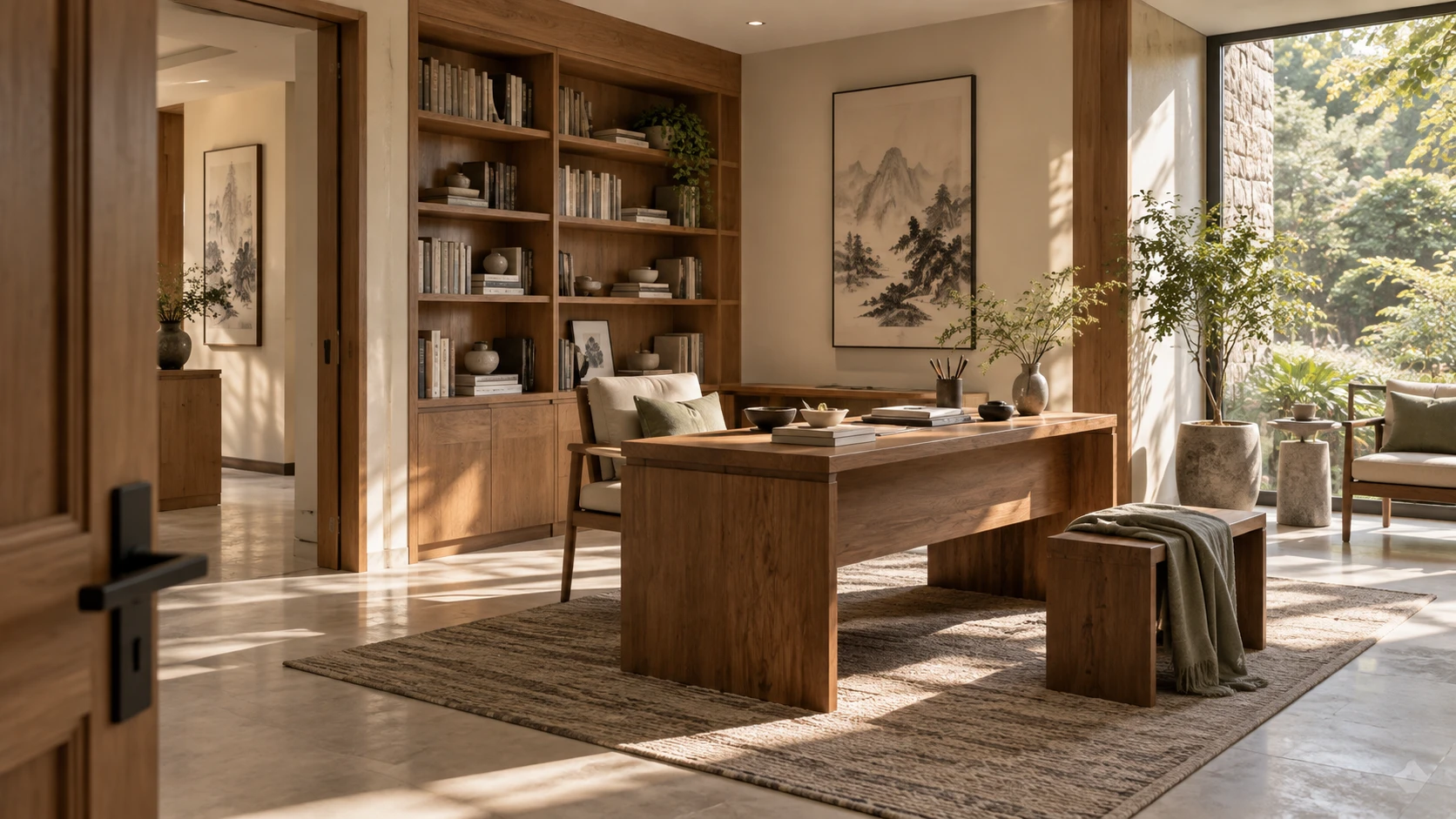
Start with the relationship between the desk and the entrance.
Where possible, many Feng Shui approaches favour a working position where the entrance can be perceived without placing the desk directly in the path of the doorway.
This is often discussed as part of the commanding position.
The practical spatial idea is straightforward: you are not working with your back completely unaware of the room, but neither are you sitting directly within its main line of movement.
A desk does not have to face the door.
What matters is the relationship.
Awareness without interruption.
For a dedicated study, this may influence the entire layout. In a bedroom or living space where the desk is only one function among several, even a modest adjustment in angle can create a clearer working zone.
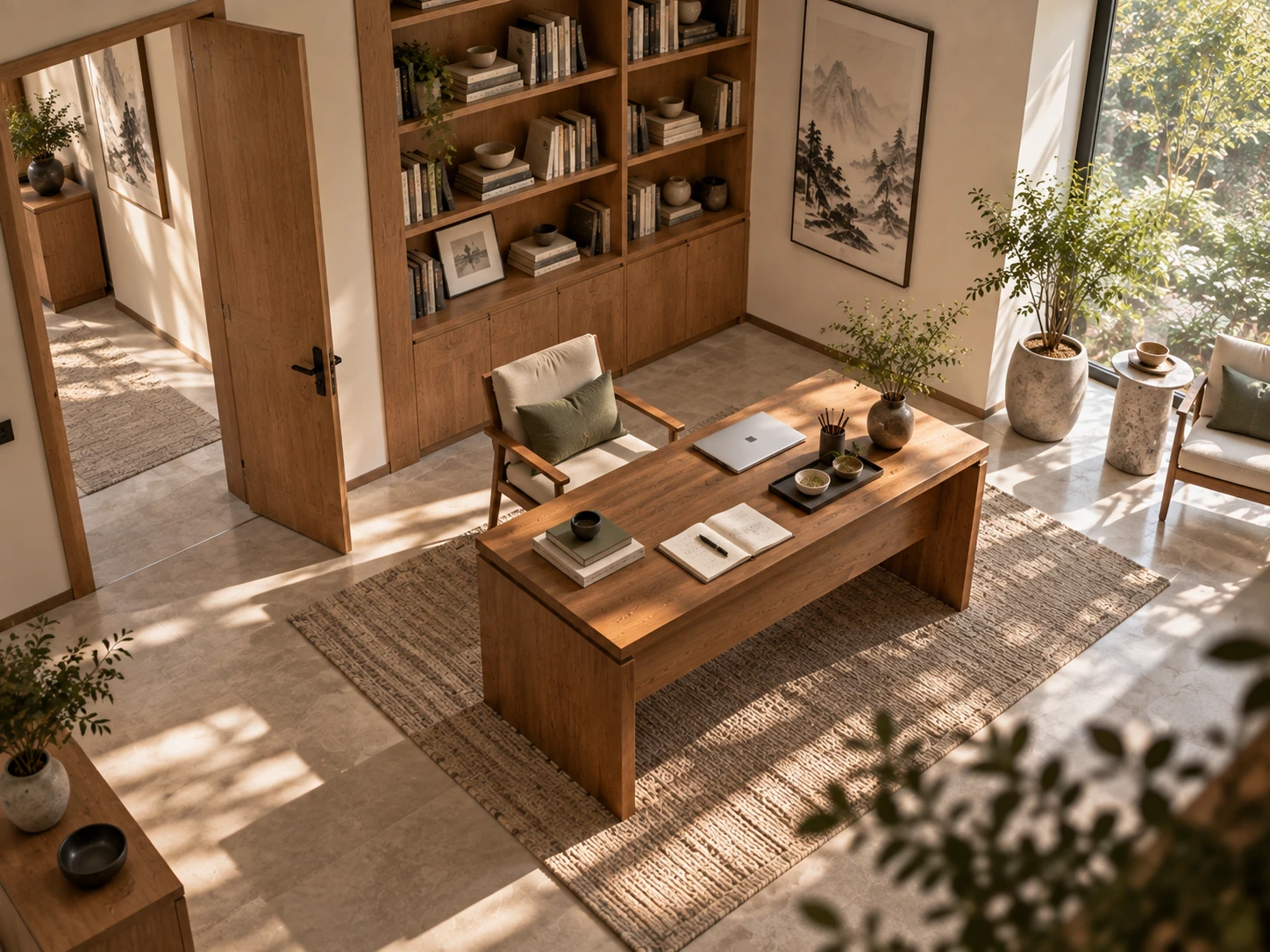
Just as the head of the bed is important in Bedroom Feng Shui, the space behind the chair deserves attention at a desk.
Traditional Feng Shui commonly favours a sense of solidity behind the working position.
A wall, substantial cabinet or other visually stable background can create a more anchored working environment than sitting with a busy circulation route immediately behind you.
This should not become an absolute rule.
Architecture comes first. Some of the most beautiful contemporary workspaces sit beside windows or within open-plan rooms.
The useful question is simpler:
When you sit down to work, does the position feel settled or exposed?
The visual field around a desk matters.
A desk facing an overflowing shelf, tangled cables, stacks of unfinished paperwork and unrelated objects continually presents the eye with things demanding attention.
At the opposite extreme, a workspace does not need to become sterile.
A window, a piece of art, a few books or a restrained object can give the eye somewhere to rest between periods of concentration.
Think less about creating an empty desk and more about establishing visual hierarchy.
The things you need should be accessible.
The things you value can remain visible.
Everything else does not have to compete for your attention.
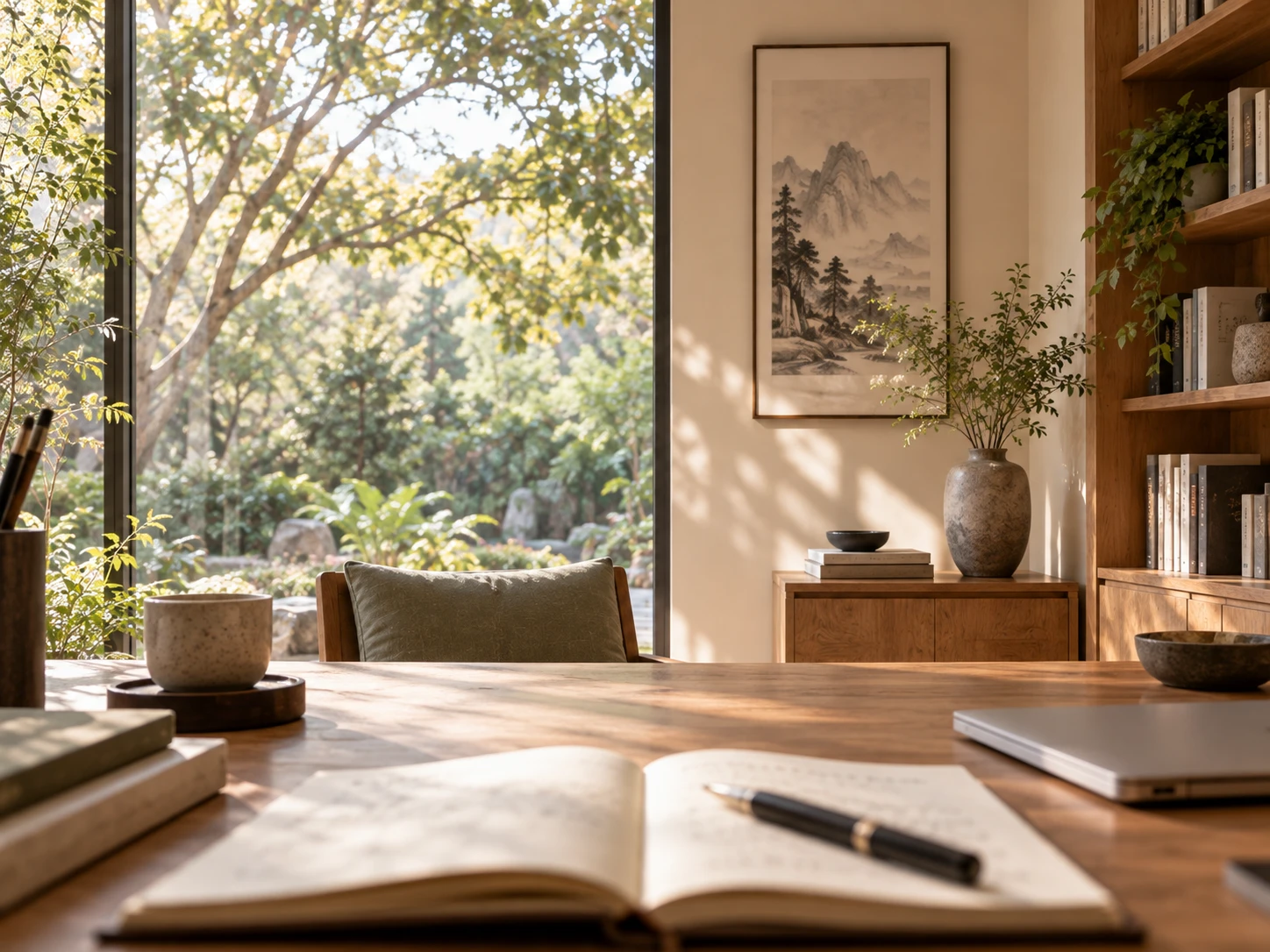
A desk that works beautifully in the morning may feel entirely different after sunset.
Natural light can make a workspace more comfortable during the day, but glare across a monitor or strong light directly in the eyes can become distracting.
Artificial lighting should support the task without turning the desk into the brightest, harshest point in the room.
Movement matters too.
If people repeatedly cross immediately behind the chair, if a door opens into the working area, or if the desk interrupts the room's main circulation path, the workspace can feel less settled.
Good Work & Desk Feng Shui is therefore not simply about where an object sits.
It is about how the space behaves while it is being used.
A perfectly empty desk is neither realistic nor necessary.
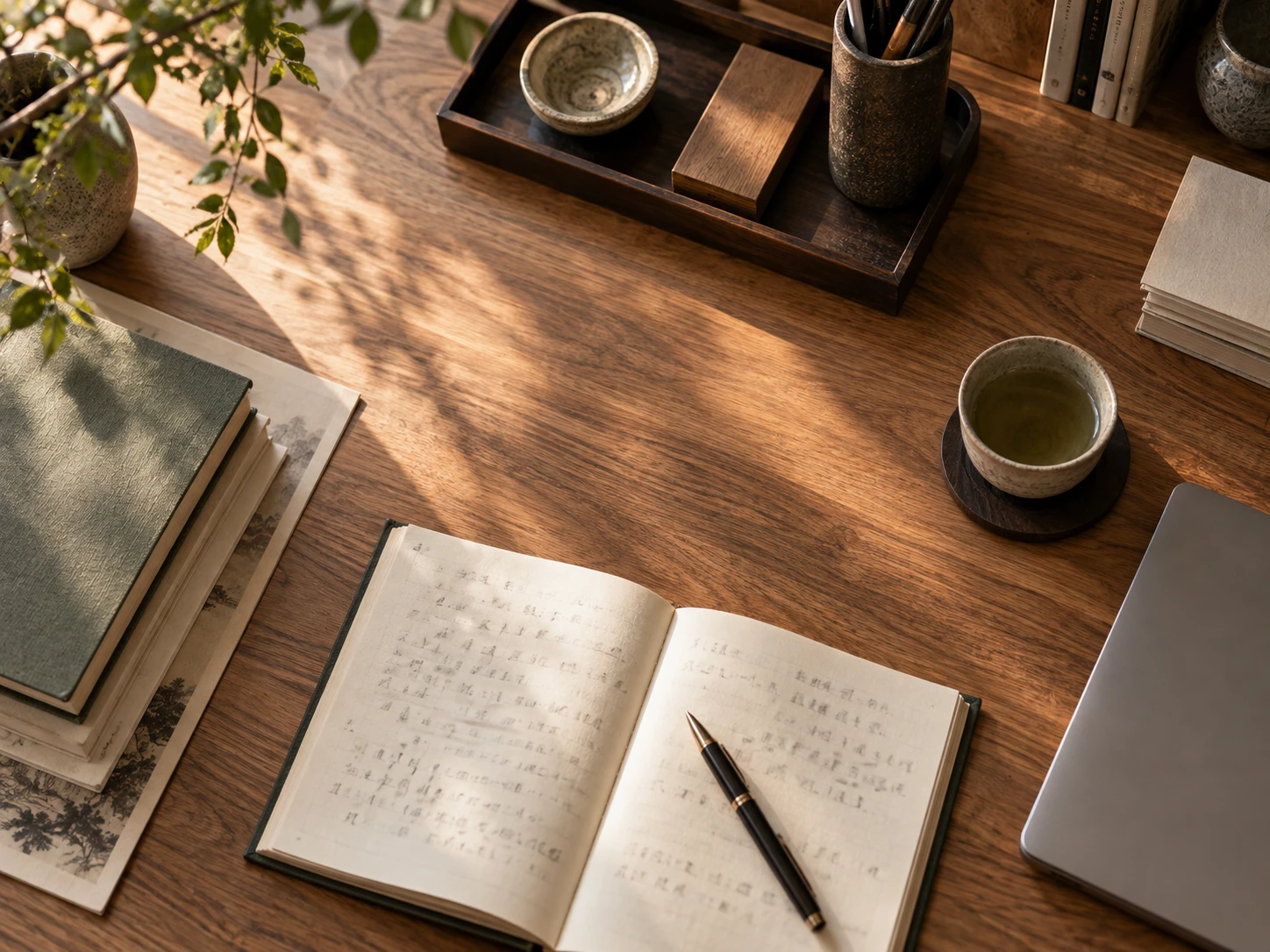
Books belong on desks. So do notebooks, pens, computers and the evidence of actual work.
The distinction is between useful presence and accumulated distraction.
At the end of a working session, consider what needs to remain within reach and what can return to a drawer, shelf or cabinet.
This is especially useful when a desk shares space with another part of the home.
A small ritual of resetting the working surface can help the room transition from one purpose to another.
Feng Shui does not require the absence of things.
It asks us to notice their relationship.
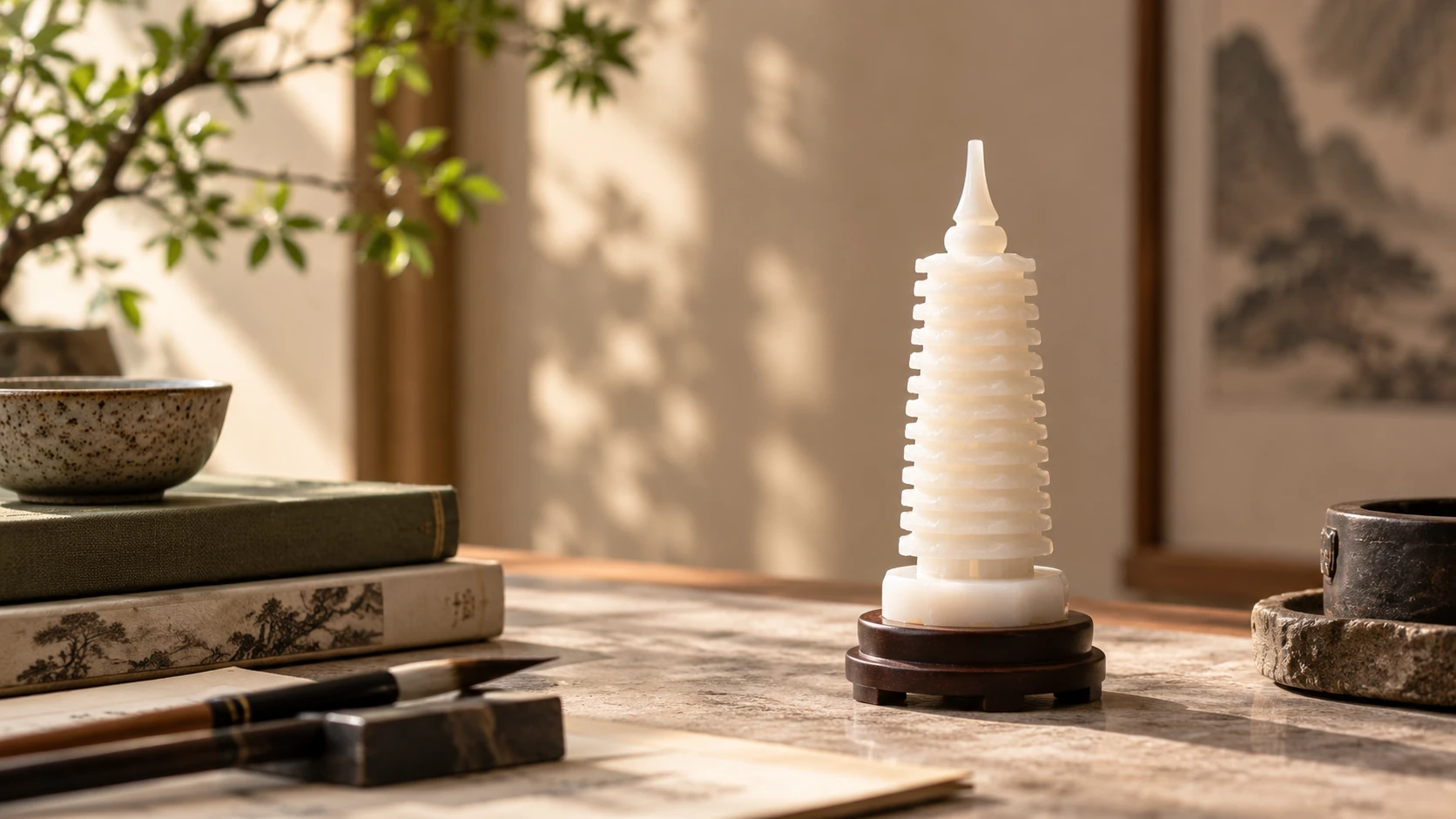
Among objects associated with the Chinese scholarly tradition, the Wenchang Pagoda, 文昌塔, has a particularly natural relationship with the study.
Wenchang, 文昌, is traditionally associated with literature, scholarship and learning. Over time, the pagoda form became an object associated with study, education and intellectual achievement.
Its architecture also makes it visually distinctive.
Tier rises above tier toward a narrow point, creating a strong vertical form that can sit quietly among books, writing tools and other objects of study.
For YukDao, the form is particularly interesting when interpreted in white jade or pale natural stone.
Rather than the ornate metallic versions often encountered in commercial Feng Shui objects, a restrained stone Wenchang Pagoda can retain the traditional form while belonging naturally within a contemporary study.
White Jade Wenchang Pagoda
白玉文昌塔
Intention · Study & Achievement
Traditionally associated with study, scholarship and intellectual achievement.
Wenchang Pagodas appear in different proportions and numbers of tiers.
What remains recognisable is the ascending architectural form: a broad base rising through repeated levels toward a narrow summit.
In a contemporary interior, that vertical silhouette gives the object presence without requiring elaborate ornamentation.
The YukDao object shown here uses a thirteen-tier form carved in pale white stone.
The emphasis is on the traditional architectural form itself rather than promising a particular outcome from the number of tiers.
For a contemporary home, the most natural setting for a Wenchang Pagoda is a space associated with study or concentrated work.
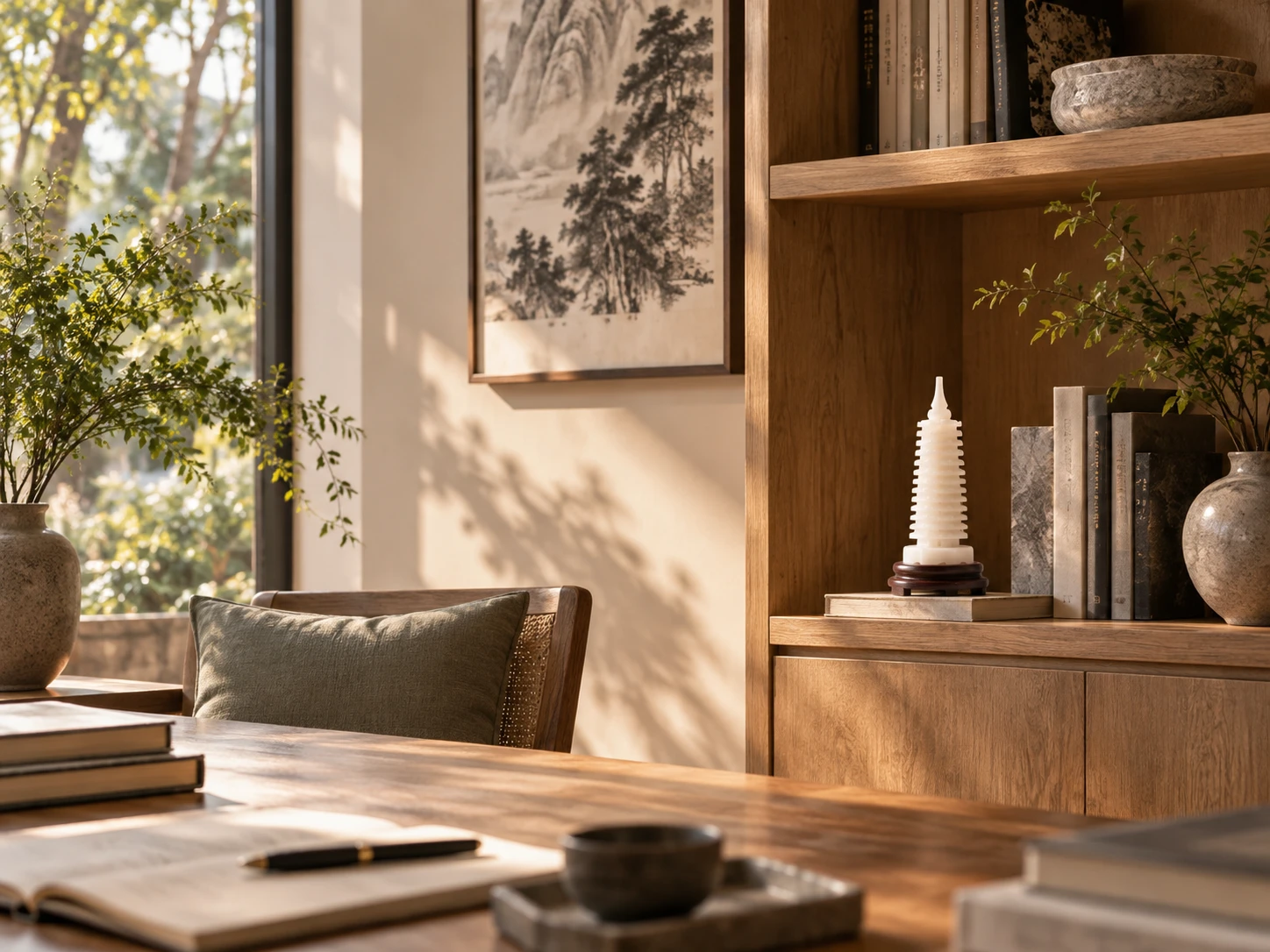
That might be a dedicated study, a bookshelf beside a desk, a cabinet within a home office, or a restrained area of the working surface itself.
It does not need to dominate the desk.
A smaller stone pagoda can sit among books and writing materials as a symbolic object connected to the purpose of the space.
Its placement should still respect practical considerations.
Do not sacrifice useful working space simply to accommodate an object.
The desk must work before it becomes symbolic.
Before rearranging your workspace, sit in your normal working position and ask:
Can I perceive the entrance without sitting directly in its path?
Does the space behind me feel supported or exposed?
What occupies my visual field when I look up from my work?
Does clutter have a defined place to go?
Can the workspace become quieter when concentrated work begins?
You do not need a dedicated study or a large home office to consider these questions.
A desk in the corner of a bedroom, living room or small apartment still has relationships with the space around it.
Begin there.
A Feng Shui workspace should not look untouched.
Books can remain open. Notes can accumulate during a project. Pens, papers and tools belong wherever real work happens.
The aim is not visual perfection.
It is to distinguish between the things supporting your attention and the things continually taking it away.
Position the desk thoughtfully.
Give the working position support.
Make room for the tools you actually use.
And allow meaningful objects to earn their place.
A good workspace should make it easier to begin.
01
Explore the home room by room.
Explore Home Feng Shui →02
Create a quieter environment around rest.
Explore Bedroom Feng Shui →03
Explore materials and elemental relationships throughout the home.
Feng Shui considers the environment around you. BaZi explores the elemental pattern associated with the moment you were born.
Explore Your BaZi →