Back
Home Feng Shui · 居家風水

Home Feng Shui: A Room-by-Room Guide to Balance & Placement

A home is more than a collection of rooms.

In traditional Feng Shui, 風水, the relationship between spaces matters as much as the objects placed within them. Where we enter, where we rest, how we move through a room and what surrounds us all contribute to the character of a home.

This is why Feng Shui is difficult to reduce to a list of lucky objects or universal rules.

Instead, begin with the space itself.

Walk through your home from the entrance to the places where you gather, sleep and work, and some of the principles behind Feng Shui become easier to understand in everyday life.

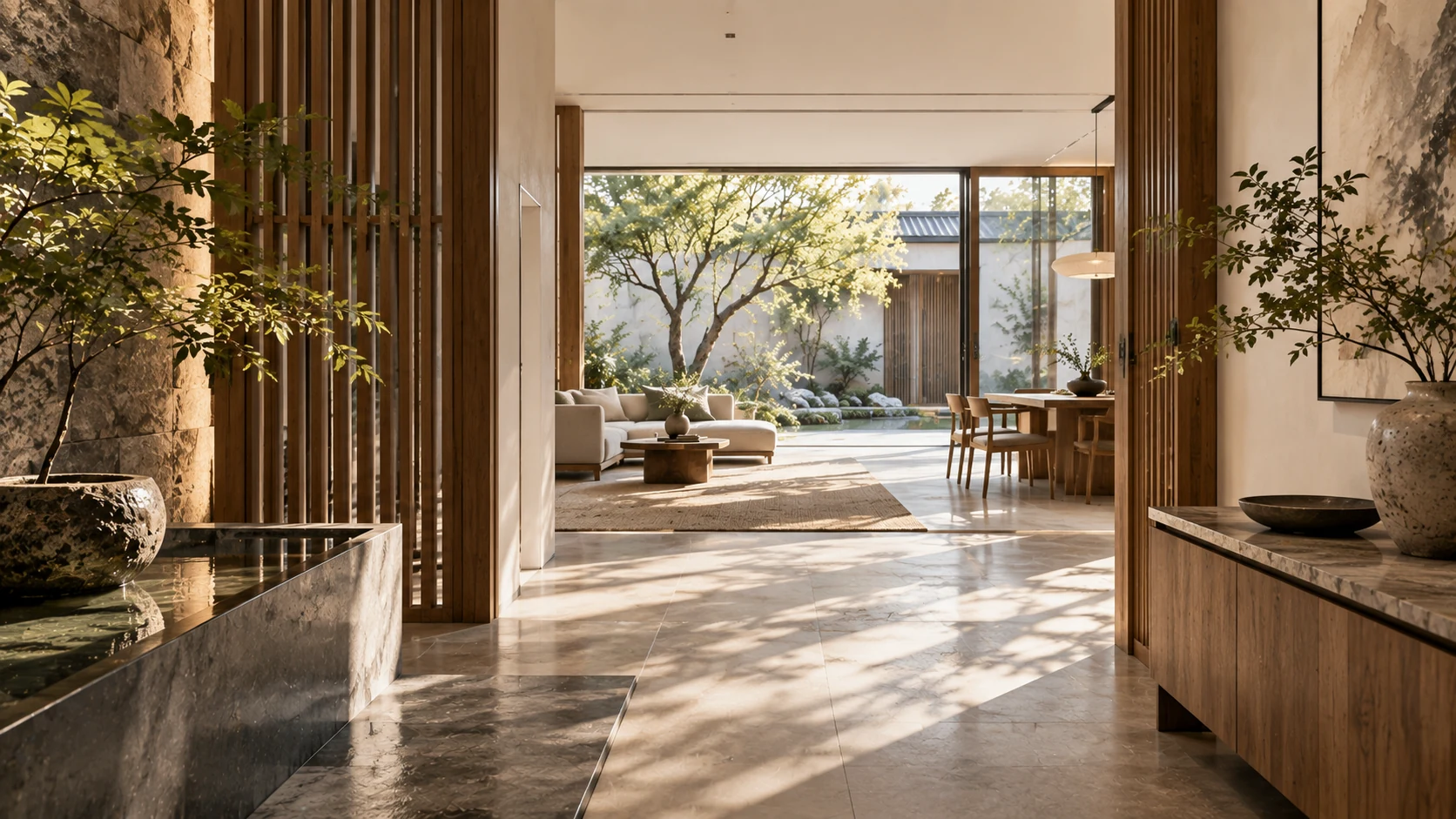
Contemporary home interior viewed from the entrance toward a sunlit living space and garden
01 · Entrance

The Entrance · 玄關

Where the Home Meets the Outside World

The entrance is the point where the outside world becomes the home. In Feng Shui, that transition makes it one of the first places worth observing.

Before adding anything symbolic, look at what is already there.

Can the front door open comfortably? Is the route into the home clear, or does the eye immediately meet shoes, boxes, coats and other accumulated objects? Is the entrance sufficiently lit? And once you step inside, where does your attention naturally go?

A good entrance does not need to be empty, but it should feel intentional.

Keeping the immediate pathway reasonably clear can make the transition into the home feel calmer and more considered. Lighting can help define the threshold, while a small number of carefully chosen objects will usually have greater presence than a collection of competing symbols.

Feng Shui does not require every entrance to look the same. The architecture of the home, the position of the door and the way the household actually uses the space all matter.

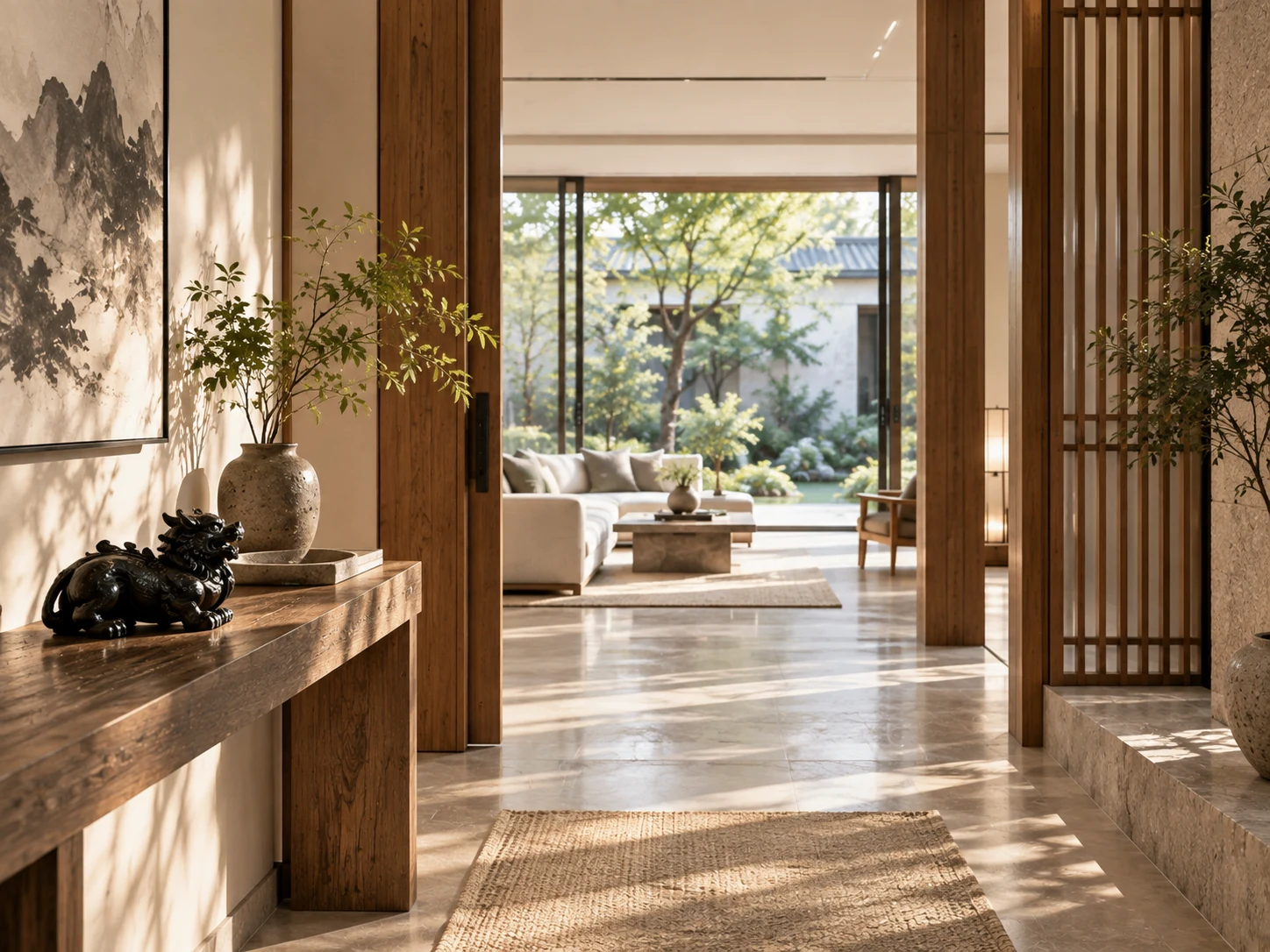
Black Pi Xiu displayed in a contemporary home entrance

Pi Xiu · 貔貅

Among the objects associated with entrances in contemporary Feng Shui, Pi Xiu, 貔貅, is one of the most recognisable.

Pi Xiu is a mythical Chinese creature whose symbolism developed over a long cultural history. In popular tradition and contemporary Feng Shui practice, it has become particularly associated with prosperity, protection and the safeguarding of resources.

This is why Pi Xiu figures are often encountered near entrances, in businesses and in spaces symbolically connected with wealth.

That does not mean placing a Pi Xiu beside a door automatically changes someone's financial fortune. Its significance comes from the tradition surrounding the creature and the context in which the object is understood and placed.

For YukDao, this traditional form becomes especially interesting when expressed through natural stone rather than the bright metallic decoration often associated with contemporary Feng Shui merchandise.

A Pi Xiu carved in polished black obsidian, 黑曜石, has a quieter presence. The deep black mineral surface allows the mythical creature to remain recognisable while sitting naturally within a contemporary home.

Editorial object

Black Obsidian Pi Xiu

黑曜石貔貅

02 · Living Room

The Living Room · 客廳

A Space for Gathering

If the bedroom is primarily a place of rest, the living room usually has a more active role.

It is where people gather, talk, receive guests and move between different parts of daily life. For that reason, the Feng Shui of a living room begins less with finding a supposed universal “wealth corner” and more with understanding how the room actually works.

Look at the relationship between the furniture rather than each piece individually.

Can people move through the room comfortably? Do the seats encourage conversation, or does the arrangement create unnecessary barriers? Does the room feel open without becoming exposed? Is there visual coherence, or are too many objects competing for attention?

The aim is not perfect symmetry. It is a sense that the different parts of the room belong together.

And importantly, a home does not have to look traditionally Chinese in order to engage with Feng Shui.

A Scandinavian apartment in New York, a Victorian house in London or a contemporary home in Hong Kong does not need red lanterns, calligraphy or traditional Chinese furniture. Feng Shui concerns the relationship between people and space, not the creation of a particular decorative style.

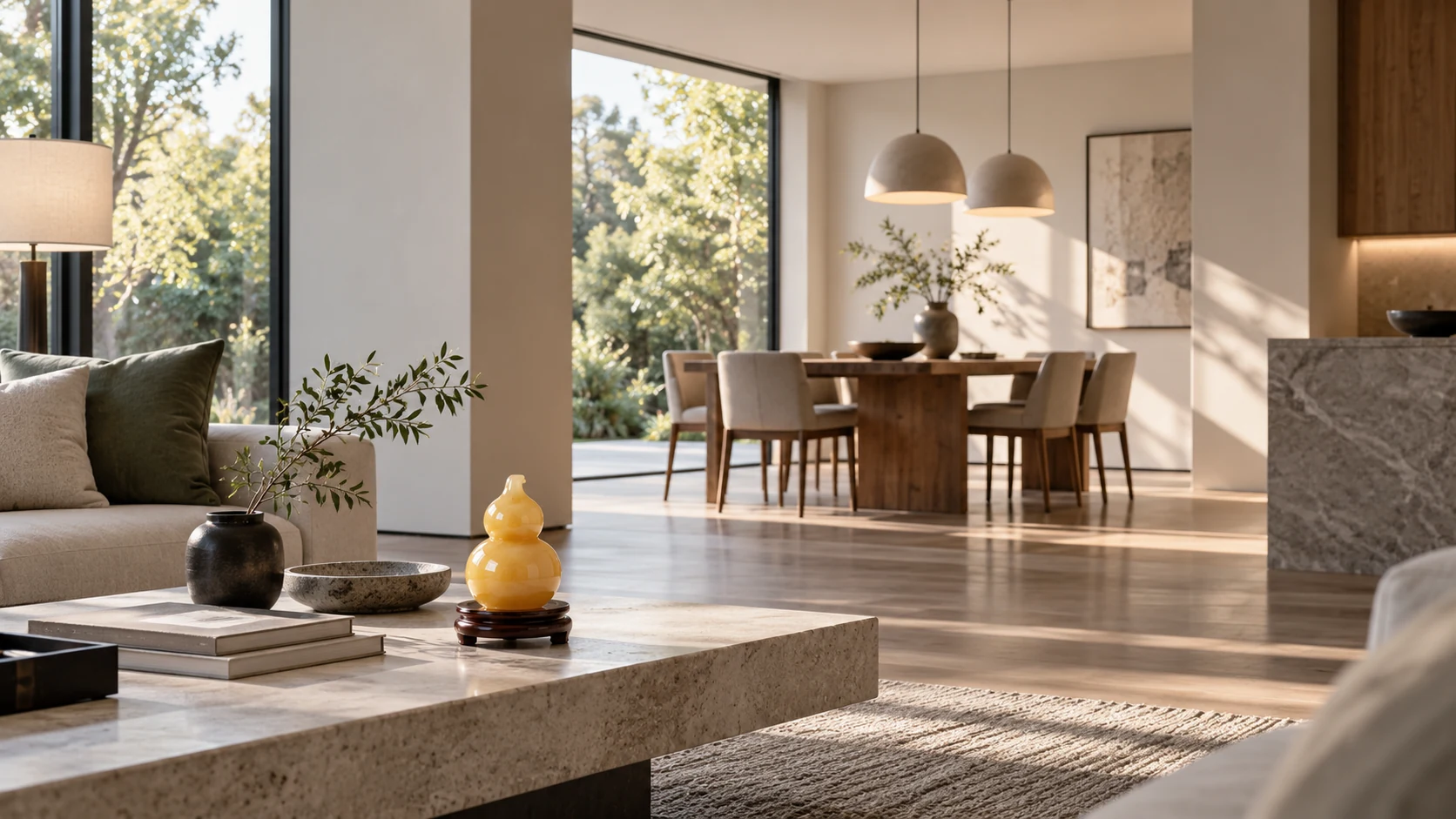
Yellow stone Wu Lou displayed in a contemporary living room

Wu Lou · 葫蘆

A Gourd With a Long Cultural Life

The Wu Lou, 葫蘆, is a useful example of how an object can carry meaning far beyond contemporary Feng Shui.

Its form comes from the bottle gourd, or hulu, whose dried shell was historically used as a practical vessel. Over centuries, the distinctive double-gourd silhouette also appeared throughout Chinese art, material culture and religious imagery.

The form gradually accumulated symbolic associations of its own.

The Wu Lou became traditionally associated with longevity, health and protection, and today it remains a familiar object within Feng Shui practice.

Those associations should be understood symbolically rather than as medical claims. A Wu Lou is not a substitute for healthcare, nor does owning one guarantee health.

What makes the form particularly suitable for a contemporary home is that it does not need excessive decoration to remain recognisable.

Rendered in a warm yellow mineral stone, the simple double-gourd silhouette can sit almost like a small piece of sculpture within a modern interior. Its meaning remains rooted in Chinese tradition while its material and restrained form allow it to exist naturally alongside contemporary furniture.

Editorial object

Yellow Stone Wu Lou

黃色玉石葫蘆
03 · Bedroom

The Bedroom · 臥室

Feng Shui for a Quieter Space

The bedroom asks a different question from the entrance or living room.

It is primarily a place for rest.

That changes what deserves attention. A bedroom filled with visual stimulation, accumulated clutter and competing focal points can feel very different from one organised around a clear place to sleep.

Begin with the bed itself.

Many traditional Feng Shui approaches favour a position that gives the bed a sense of support while allowing some awareness of the room and its entrance. The exact recommendation can vary according to the room and the Feng Shui school being followed, so it is more useful to understand the principle than to force every bedroom into a universal diagram.

Look at what surrounds the bed as well.

Is the space visually stable? Is there excessive clutter immediately beside or above the sleeping area? Are screens and electronics dominating the room? Does the room feel quieter than the more active spaces of the home?

A bedroom does not need to be perfectly symmetrical or almost empty. It simply needs to support what it is there for: rest.

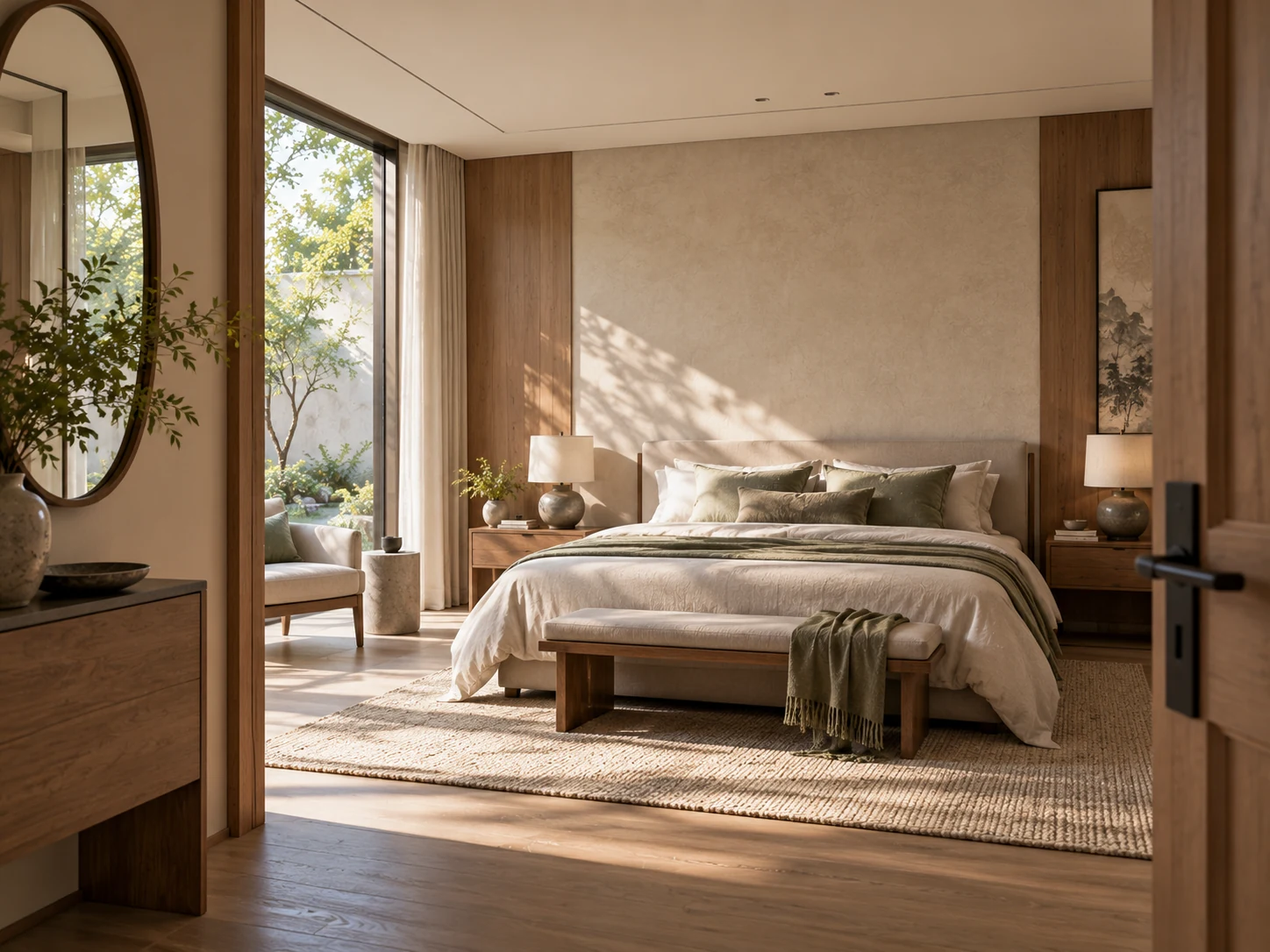
Contemporary bedroom with a supported bed position and mirror placed away from the bed

What About Mirrors?

One of the best-known bedroom cautions in Feng Shui concerns a mirror positioned so that it directly reflects the bed.

The traditional reasoning is more useful when considered without the frightening claims sometimes attached to it.

A mirror introduces reflection and visual activity. In a room intended primarily for sleep, a large reflection of the bed can make the environment feel more visually active, particularly at night or in low light.

For that reason, traditional Feng Shui advice frequently recommends reconsidering a mirror that directly reflects the sleeping position.

This does not mean a bedroom cannot contain mirrors.

The question is placement.

A mirror positioned elsewhere in the room can serve its practical purpose without becoming the dominant visual presence from the bed.

04 · Study

The Study · 書房

A Space for Attention

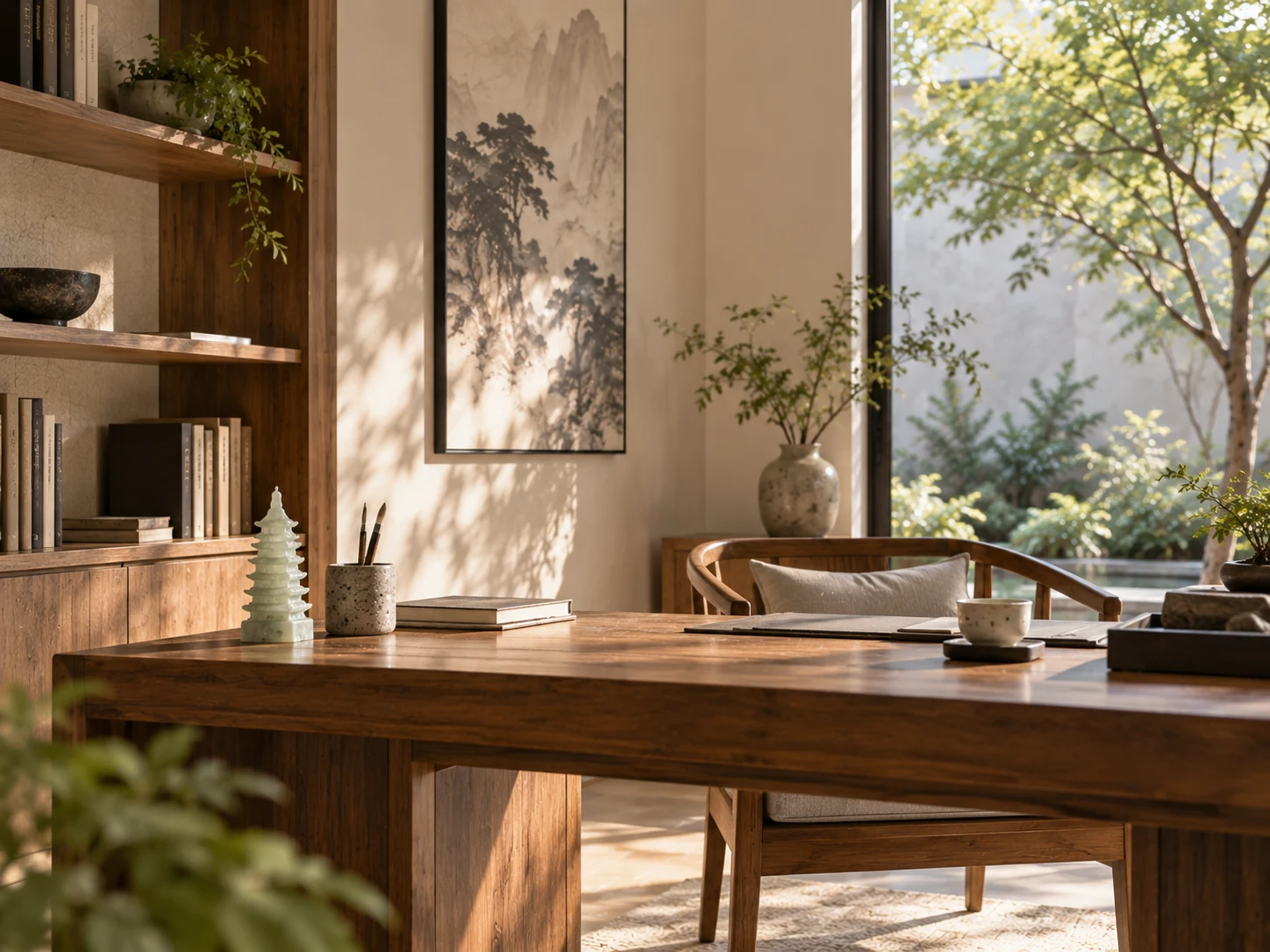
The study carries particular cultural resonance in the Chinese tradition.

For centuries, scholarship, literature and success in the examination system could shape a family's social and intellectual life. The scholar's room was therefore more than simply a place containing a desk.

For a modern home, the context has changed, but the basic question remains useful:

Does this space support attention?

Sit where you normally work and observe the room from that position.

What is behind you? What occupies your field of view? Is the desk permanently overwhelmed by objects unrelated to the task at hand? Does movement through the room constantly interrupt the working area?

The purpose is not to create a perfectly empty desk.

A study can contain books, objects and evidence of actual work. What matters is whether the room helps attention settle or continually pulls it elsewhere.

Pale Wenchang Pagoda displayed in a contemporary home study

Wenchang Pagoda · 文昌塔

The connection between Feng Shui and scholarship is perhaps most clearly expressed through Wenchang, 文昌.

Within Chinese tradition, Wenchang became closely associated with literature, scholarship and academic achievement. Over time, the Wenchang Pagoda became a familiar symbolic object connected with study and educational aspirations within Feng Shui practice.

Its meaning makes it particularly suited to the study, library or working environment.

But symbolism should not be confused with a guarantee.

A pagoda on a desk cannot replace study, discipline or good teaching, and it does not guarantee examination results.

Its role is cultural and symbolic: an object representing an aspiration toward learning and intellectual achievement.

For YukDao, the Wenchang Pagoda is especially compelling when carved from pale translucent stone.

The architectural tiers remain recognisably traditional, while the restrained mineral material removes the need for gold, red tassels or excessive inscription.

Editorial object

Pale Stone Wenchang Pagoda

文昌塔

What to Avoid

5 Things to Avoid in Home Feng Shui

Placement, support and spatial experience

Sometimes the most useful Feng Shui question is not what to add, but what to reconsider.

Many traditional recommendations concern relationships that already exist within the home: what the bed faces, what sits behind or above it, and whether the main entrance allows an easy transition into the space.

These ideas are more useful when understood as principles of placement, support and spatial experience rather than predictions of bad luck.

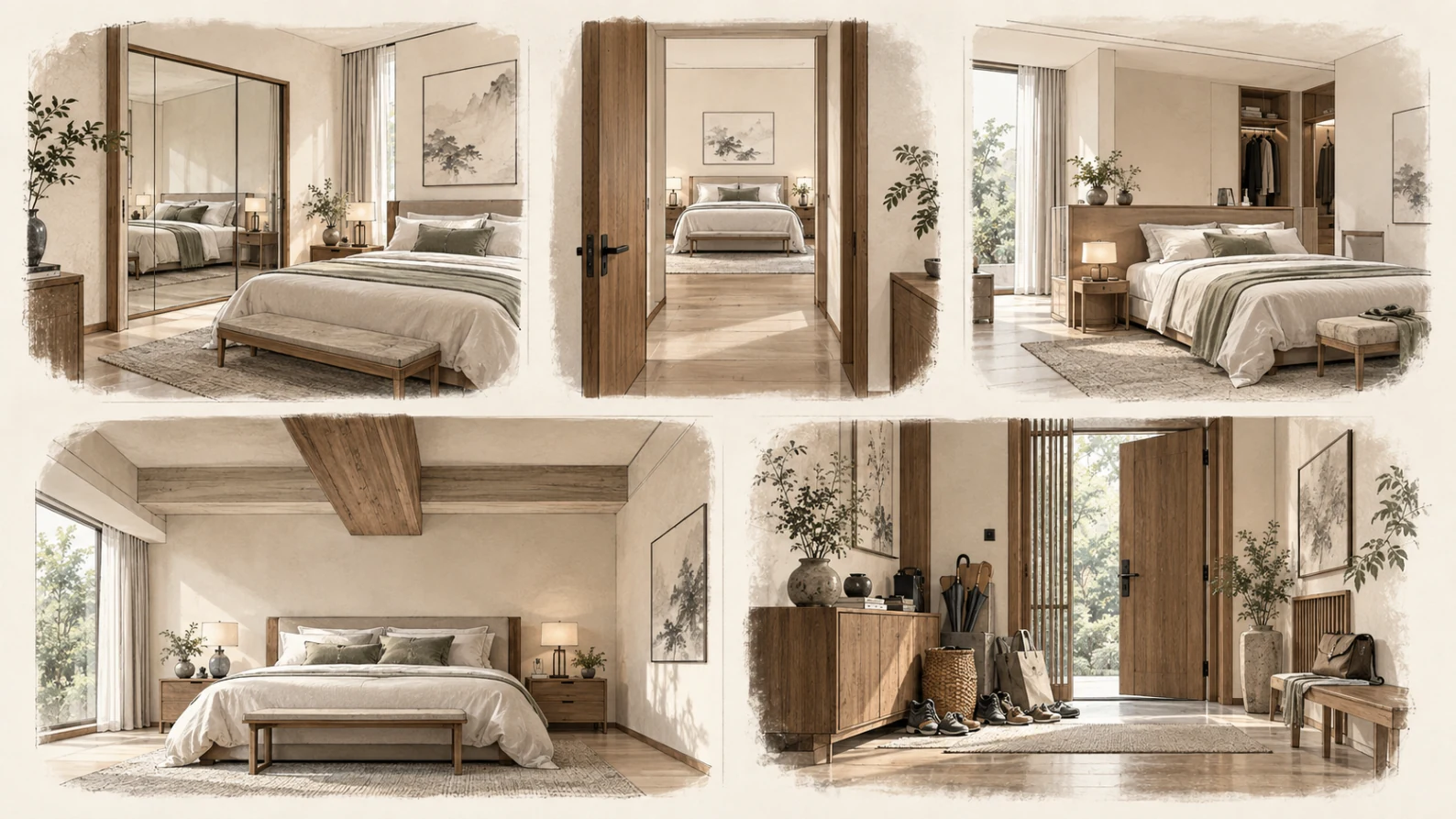
Here are five arrangements traditionally treated with caution in home Feng Shui.

Five illustrated home arrangements traditionally treated with caution in Feng Shui

01

A Mirror Reflecting the Bed

Mirrors are useful objects, but their position receives particular attention in traditional bedroom Feng Shui.

A mirror that directly reflects the bed introduces another layer of visual activity into a space primarily intended for rest. Reflections, movement and changing light can become particularly noticeable at night.

Traditional Feng Shui therefore often recommends placing mirrors where they do not directly reflect the sleeping position.

This does not mean mirrors are inherently unsuitable for bedrooms. The concern is the relationship between the mirror and the bed, not the existence of the mirror itself.

02

A Bed Directly in Line With the Door

Another frequently discussed arrangement is a bed positioned directly in line with the bedroom door, particularly when the foot of the bed points straight toward it.

Traditional Feng Shui generally prefers a sleeping position that allows awareness of the entrance without placing the bed directly in its path.

There is also a practical spatial logic to this idea. A doorway is an active point of movement, light and interruption, while the bed serves the opposite purpose.

Where the room allows, shifting the bed away from the door's direct line can create a greater sense of separation between circulation and rest.

03

A Bed Without a Solid Wall Behind the Headboard

Support is a recurring idea in traditional Feng Shui, and the position behind the bed is one place where that principle becomes particularly visible.

A solid wall behind the headboard creates a clear visual and physical boundary around the sleeping position.

By contrast, a bed floating in the room or positioned directly beneath a large window can feel less anchored.

Not every bedroom allows an ideal arrangement, and architecture should always be taken into account. The useful principle is not to follow a rule at any cost, but to consider whether the head of the bed feels visually supported and settled within the room.

04

A Heavy Exposed Beam Directly Above the Bed

Traditional Feng Shui also tends to treat a substantial exposed beam directly above the bed with caution.

The concern is particularly relevant when the beam visually cuts across the sleeping position or creates a strong sense of weight overhead.

Even outside Feng Shui, architectural elements above a bed can change how enclosed or visually pressured a sleeping space feels.

This does not mean every visible ceiling beam is a problem. Scale, position and the architecture of the room matter.

The traditional principle is to avoid placing the main sleeping position directly beneath a heavy, visually dominant structural element when another sensible arrangement is available.

05

A Blocked or Cluttered Main Entrance

The final example returns us to where our walk through the home began.

In Feng Shui, the entrance represents an important transition between outside and inside. When that transition is dominated by clutter or physical obstruction, the space can feel congested before the rest of the home has even been entered.

Look particularly at the immediate path around the door.

Shoes, boxes, furniture or stored objects should not prevent the door from opening comfortably or make normal movement unnecessarily difficult.

The goal is not an empty entrance. It is a usable one.

A clear threshold, appropriate lighting and a deliberate first view into the home can often accomplish more than adding another symbolic object.

Watch

5 Things to Avoid in Home Feng Shui

Watch
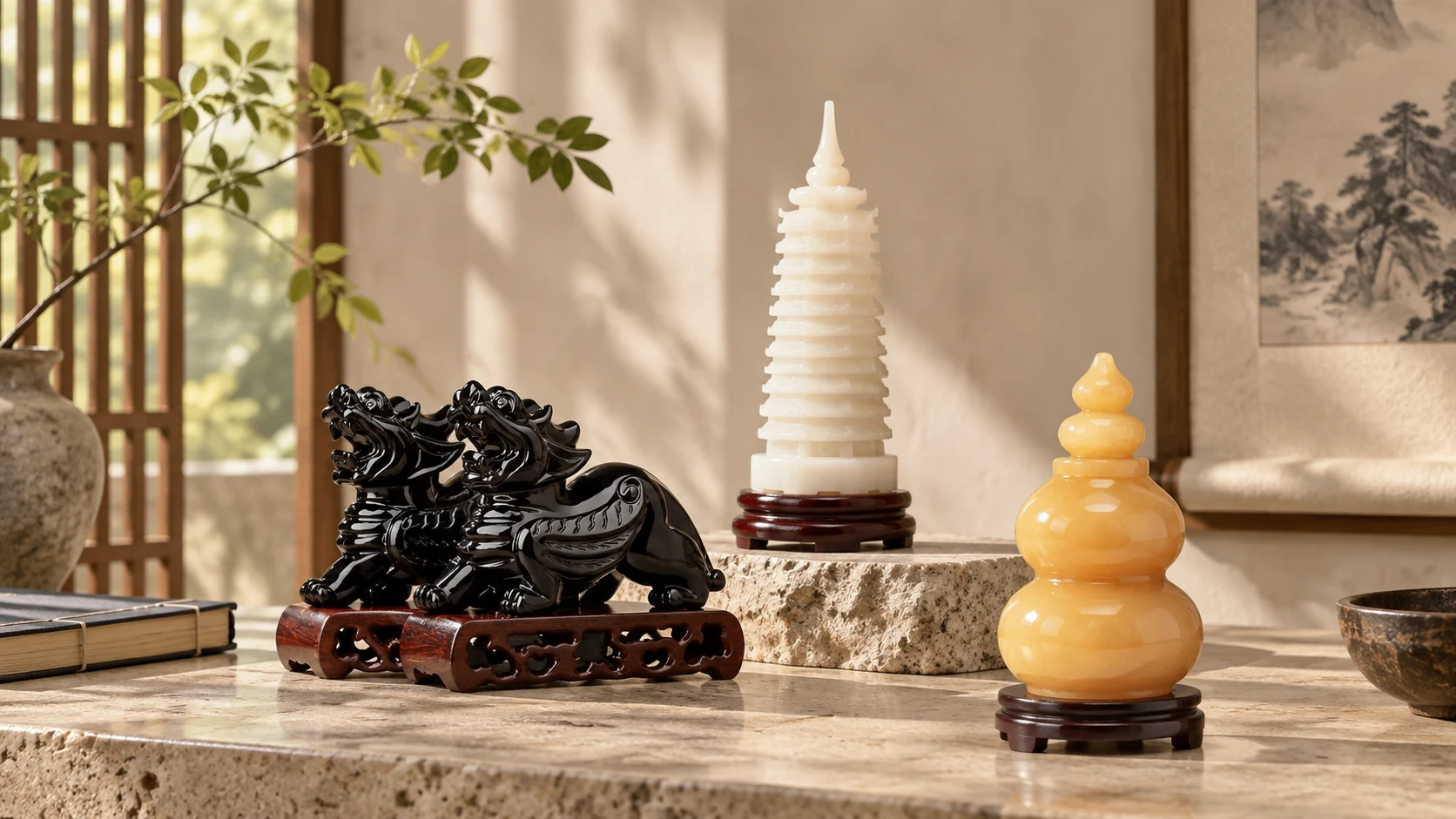
Black Pi Xiu, pale Wenchang Pagoda and yellow Wu Lou displayed in an editorial interior still life
Objects & Meaning

Objects Are Only Part of Feng Shui

Objects Are Symbols, Not Shortcuts

Pi Xiu, Wu Lou and Wenchang Pagodas can carry layers of cultural symbolism, but an object alone is not the entirety of Feng Shui.

Traditional approaches may consider orientation, timing, the relationships between rooms, the surrounding environment and the people inhabiting a space.

That distinction matters.

It is easy for Feng Shui to become reduced to a shopping list: place one object here, another object there, and expect a particular result.

YukDao takes a different approach.

Understanding why an object has meaning should matter as much as owning it.

A Pi Xiu becomes more interesting when we understand the mythology and symbolism surrounding the creature. A Wu Lou carries a cultural history extending beyond its contemporary Feng Shui use. A Wenchang Pagoda connects to a much larger Chinese tradition surrounding scholarship and learning.

Material matters too.

Natural stone allows these traditional forms to exist within contemporary interiors without relying on bright metallic finishes, red tassels or excessive ornamentation.

The result can be both culturally meaningful and visually restrained.

Traditional forms. Natural stone. Contemporary restraint.

Start Here

Start With the Home You Already Have

Observation before intervention

Before buying an object or rearranging an entire room, spend some time observing the home you already have.

Enter through the front door as though you were seeing the space for the first time.

Where does your attention go?

Notice where movement feels easy and where it becomes interrupted.

Sit in the place where you normally work. Look ahead, behind and around you.

Then do the same from the bed, the sofa and the places where you spend the most time.

Consider whether each room supports what actually happens there.

The most useful changes may be surprisingly small: clearing a pathway, reconsidering a mirror, moving the bed away from a direct line with the door, reducing visual clutter or simply becoming more deliberate about the objects you choose to keep around you.

Feng Shui begins with paying attention.

Explore Further

Continue Through the Home

Future editorial explorations

03

Five Elements at Home

How Wood, Fire, Earth, Metal and Water can be understood through materials, forms and the character of a space.

The Journal of You

Your Space Is Only Part of the Picture

Feng Shui considers the environment around you. BaZi explores the elemental pattern associated with the moment you were born.

Explore Your BaZi →