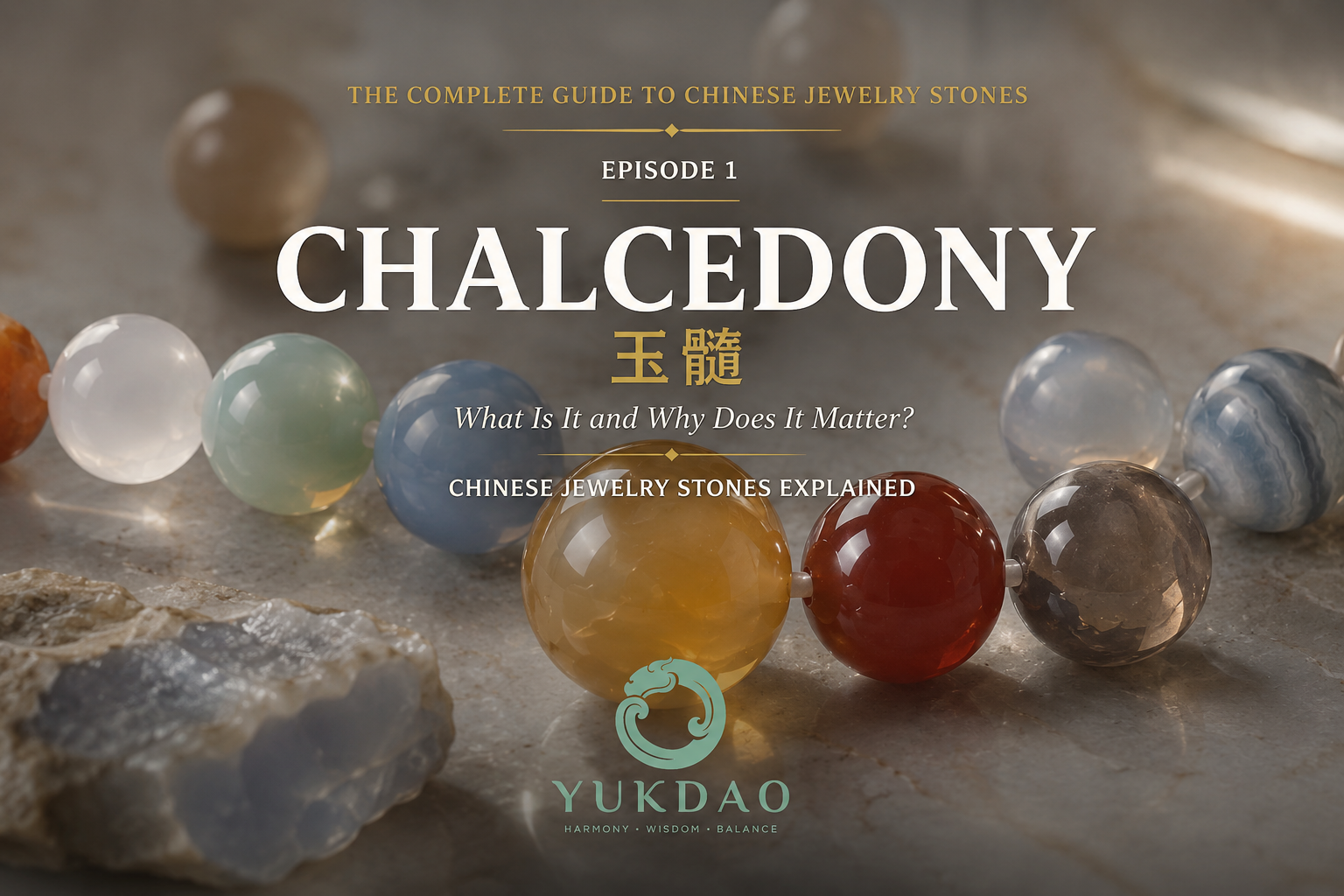
What Is Chalcedony? The Stone Behind Chinese Craftsmanship
Learn what chalcedony is, why it is called 玉髓 in Chinese, how it differs from jade, and why it has remained one of the most widely used materials in Chinese craftsmanship.
Walk through any market in China where stones are sold and you will see it long before anyone names it. Beads the color of honey. Cabochons the color of a winter sky. Small carved animals in a soft, milky white that seems to hold light rather than reflect it.
Ask what the material is and the answer often arrives quickly, and often incorrectly: jade.
In most cases the stone is chalcedony — one of the most widely used, most frequently misidentified and most quietly important materials in the history of Chinese decorative art. It is not jade. It is not an imitation of jade. It is a distinct mineral with its own structure, its own working properties and its own long record of use.
Understanding chalcedony is the beginning of understanding a great deal about how Chinese craftsmanship actually developed: what could be carved, what could be polished, what could be worn every day, and what a workshop could reliably obtain.
What Is Chalcedony?
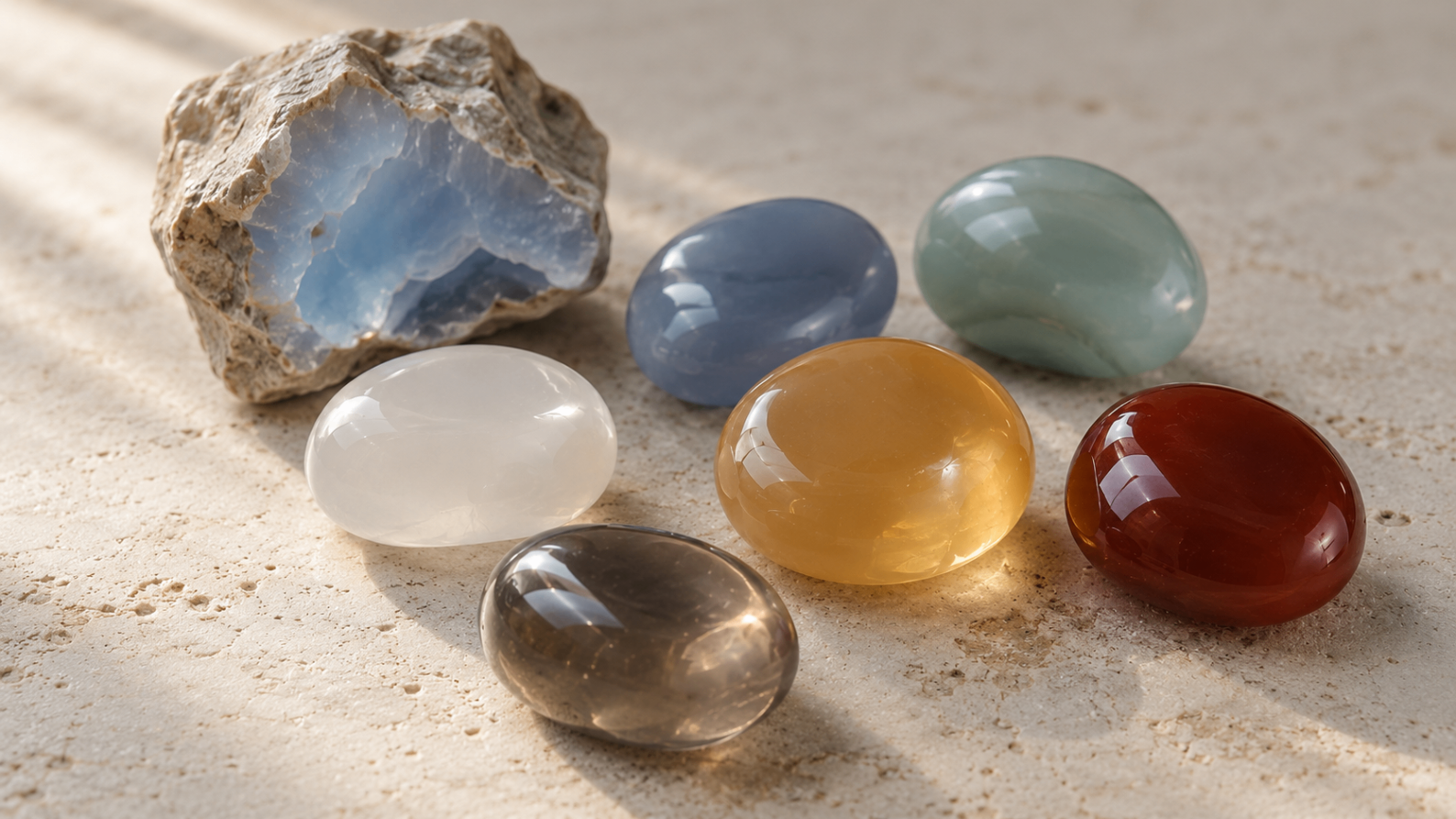
Chalcedony is a microcrystalline variety of quartz. Chemically it is silicon dioxide — SiO₂ — the same composition as rock crystal, amethyst and citrine. The difference is not what it is made of but how it is assembled.
A quartz crystal grows as a single, visible, geometric individual. Chalcedony instead consists of countless submicroscopic fibers of silica, intergrown so tightly that no individual crystal can be seen even under a standard microscope. Mineralogists call this cryptocrystalline or microcrystalline structure. It is the reason chalcedony looks solid and waxy rather than glassy and faceted, and it is the reason it behaves so differently under a carver’s tool.
How it forms
Chalcedony forms at relatively low temperatures from silica-saturated water moving through rock. Volcanic rocks are especially productive hosts: gas bubbles trapped in cooling lava leave cavities, and over long periods silica-bearing solutions deposit layer upon layer of fibrous quartz inside them. Sedimentary environments also produce chalcedony where silica accumulates in fractures, nodules and fossil cavities.
Because deposition happens in successive layers, chalcedony often preserves a visible record of its own formation. When those layers are curved and banded, the result is agate. When they are straight and parallel, the result is onyx. Chalcedony, agate and onyx are not separate minerals; they are the same material described by the way it grew.
Structure and durability
That dense fibrous structure gives chalcedony a Mohs hardness of roughly 6.5 to 7 — hard enough to resist scratching from ordinary dust, keys and household surfaces. It also takes an unusually uniform polish, because there are no large crystal faces to catch the light unevenly.
Chalcedony is durable, but it is not indestructible. Its toughness — resistance to breaking rather than scratching — is good but well below that of jade. A sharp blow against a hard edge can chip it. For everyday wear this rarely matters; for a carver working thin walls it matters a great deal.
Translucency
The quality most responsible for chalcedony’s reputation is its translucency. Light entering the stone is scattered gently between the fibers rather than passing straight through, producing a soft internal glow that seems to come from within the material instead of from its surface. Held against a window, a well-cut chalcedony bead lights up along its edges while remaining quiet at the center.
This is the visual quality that Chinese connoisseurship has always prized in stone: not brilliance, but depth.
A material with a global history
Chalcedony is one of humanity’s oldest worked materials. Its fine grain made it suitable for tools long before it was valued as ornament, and the same property later made it ideal for engraving. Mesopotamian and Persian workshops cut cylinder seals from it. Egyptian craftsmen shaped amulets and beads from carnelian, the orange-red variety. Greek and Roman engravers used it for intaglios and cameos, exploiting the banded layers of onyx and sardonyx to set a pale figure against a dark ground.
The pattern repeats across cultures: wherever people had access to chalcedony, they carved it. China was no exception — but there the material entered a very particular conversation, one that had already been shaped for millennia by jade.
Why Is Chalcedony Called 玉髓?
The Chinese name for chalcedony is 玉髓, pronounced yù suǐ. It is worth taking the two characters separately, because together they explain a great deal about how the stone was perceived.
玉 — yù
玉 is usually translated as “jade,” but in classical Chinese usage it was broader than any modern mineralogical definition. It described a category of fine, hard, translucent ornamental stone that could be worked to a smooth surface and that carried moral and aesthetic weight. Nephrite was its center, but the term extended outward to other beautiful stones of comparable character.
髓 — suǐ
髓 means marrow — the substance held within bone. It carries a sense of essence, of the concentrated inner part of something. Applied to stone, it suggests material drawn from deep inside the rock rather than shaped from its surface.
What the name actually claims
玉髓 is therefore best read as “the marrow of jade” — a descriptive, poetic name recording a resemblance in appearance, not a statement of geological relationship. Chalcedony looks like jade: translucent, waxy, smooth, capable of the same restrained glow. It is not jade, and traditional Chinese connoisseurship was perfectly aware of the difference.
This distinction matters today because the name is sometimes used commercially to blur the line. A seller describing chalcedony as 玉髓 is naming it correctly. A seller describing it simply as 玉 is not.
Chalcedony Is Not Jade
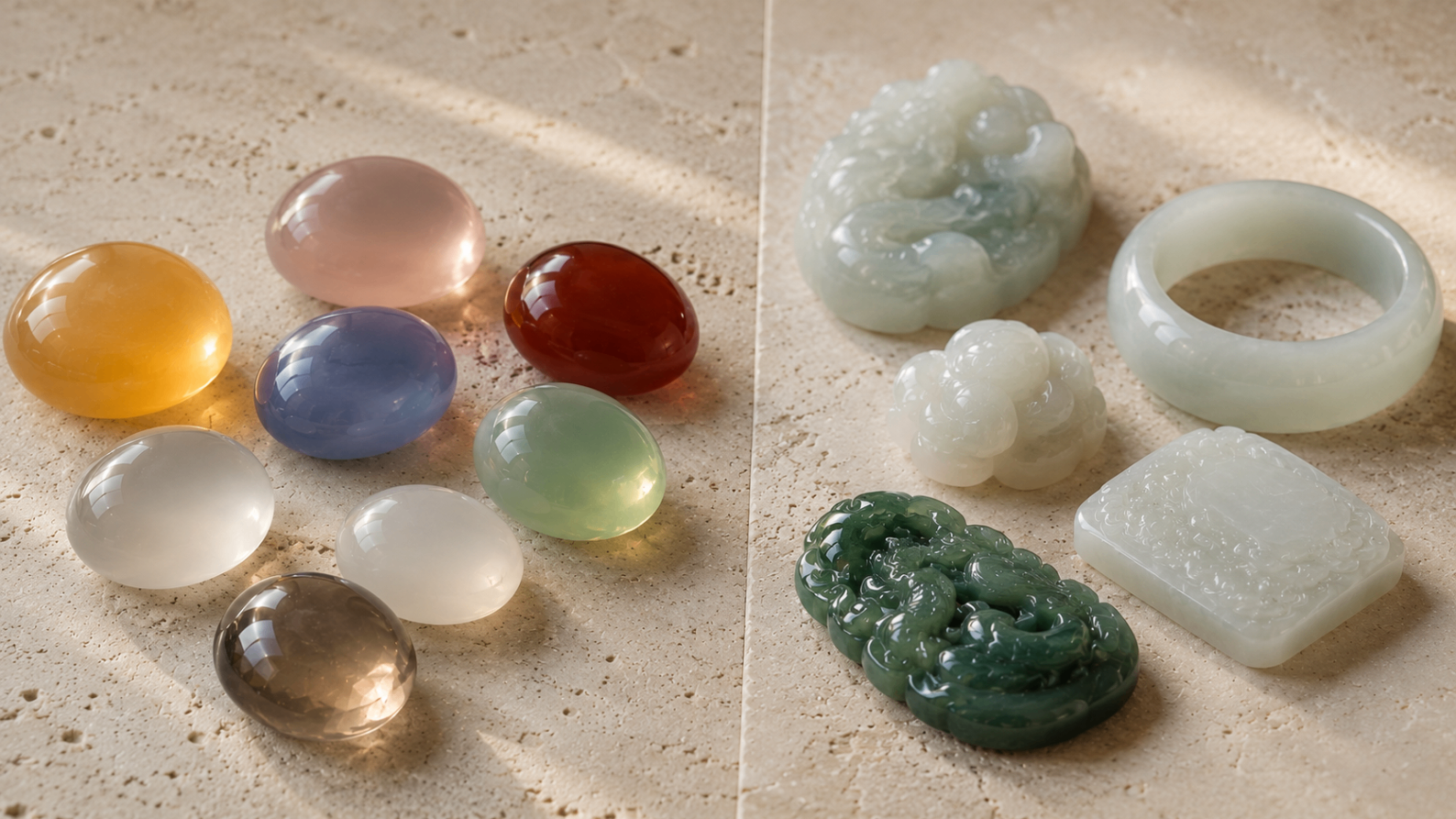
“Jade” is not one mineral. It is a term covering two unrelated materials: nephrite, a calcium-magnesium amphibole, and jadeite, a sodium-aluminum pyroxene. Nephrite is the historic jade of China, worked continuously for more than five thousand years. Jadeite arrived far later, largely from Burma during the Qing dynasty, and became the vivid green material most Western buyers picture today.
Chalcedony belongs to neither family. It is quartz. The three materials differ in composition, structure, density and behavior.
| Property | Chalcedony | Jade (Nephrite & Jadeite) |
|---|---|---|
| Mineral Family | Quartz (silica) | Nephrite: amphibole · Jadeite: pyroxene |
| Chemical Composition | SiO₂ (silicon dioxide) | Nephrite: Ca₂(Mg,Fe)₅Si₈O₂₂(OH)₂ · Jadeite: NaAlSi₂O₆ |
| Crystal Structure | Microcrystalline / cryptocrystalline, often fibrous | Nephrite: interlocking fibrous crystals · Jadeite: interlocking granular crystals |
| Mohs Hardness | 6.5 – 7 | Nephrite: 6 – 6.5 · Jadeite: 6.5 – 7 |
| Density | About 2.58 – 2.64 g/cm³ | Nephrite: 2.90 – 3.03 · Jadeite: 3.30 – 3.38 g/cm³ |
| Typical Colors | White, gray, blue, yellow, orange, red, green, lavender, pink, brown | Nephrite: white to spinach green · Jadeite: white, green, lavender, orange, black |
| Luster | Waxy to vitreous | Nephrite: greasy · Jadeite: vitreous to pearly when polished |
| Transparency | Translucent to nearly opaque | Translucent to opaque; the finest jadeite is semi-transparent |
| Toughness | Good, but lower than jade — chips on sharp impact | Exceptional; among the toughest natural materials known |
| Common Uses | Beads, bracelets, cabochons, small carvings, seals, snuff bottles | Bi discs, cong tubes, pendants, bangles, ritual and imperial objects |
| Historical Chinese Use | Widely used for everyday adornment and decorative objects | Reserved for ritual, burial, court and status objects |
- Chalcedony
- Quartz (silica)
- Jade
- Nephrite: amphibole · Jadeite: pyroxene
- Chalcedony
- SiO₂ (silicon dioxide)
- Jade
- Nephrite: Ca₂(Mg,Fe)₅Si₈O₂₂(OH)₂ · Jadeite: NaAlSi₂O₆
- Chalcedony
- Microcrystalline / cryptocrystalline, often fibrous
- Jade
- Nephrite: interlocking fibrous crystals · Jadeite: interlocking granular crystals
- Chalcedony
- 6.5 – 7
- Jade
- Nephrite: 6 – 6.5 · Jadeite: 6.5 – 7
- Chalcedony
- About 2.58 – 2.64 g/cm³
- Jade
- Nephrite: 2.90 – 3.03 · Jadeite: 3.30 – 3.38 g/cm³
- Chalcedony
- White, gray, blue, yellow, orange, red, green, lavender, pink, brown
- Jade
- Nephrite: white to spinach green · Jadeite: white, green, lavender, orange, black
- Chalcedony
- Waxy to vitreous
- Jade
- Nephrite: greasy · Jadeite: vitreous to pearly when polished
- Chalcedony
- Translucent to nearly opaque
- Jade
- Translucent to opaque; the finest jadeite is semi-transparent
- Chalcedony
- Good, but lower than jade — chips on sharp impact
- Jade
- Exceptional; among the toughest natural materials known
- Chalcedony
- Beads, bracelets, cabochons, small carvings, seals, snuff bottles
- Jade
- Bi discs, cong tubes, pendants, bangles, ritual and imperial objects
- Chalcedony
- Widely used for everyday adornment and decorative objects
- Jade
- Reserved for ritual, burial, court and status objects
Why the confusion persists
The two materials are confused for entirely understandable reasons. Both are translucent. Both are polished into smooth, undercut forms rather than faceted. Both appear in white, green and lavender. Both are carved into the same vocabulary of shapes — bangles, pendants, beads, small animals — by workshops that have handled both for generations.
The differences that separate them most reliably are density and toughness, and neither is visible. Jade is noticeably heavier for its size. Jade resists breaking to a degree that no quartz can match. Everything else — color, glow, surface, carving style — can overlap.
One further distinction is cultural rather than physical. In Chinese history, nephrite carried ritual and political meaning that chalcedony never did. Jade was buried with the dead, used in state ceremony and invoked in Confucian writing as a model of virtue. Chalcedony was worn, carried, handled and enjoyed. It was the stone of daily life rather than the stone of rite.
Why Chinese Craftsmen Loved Chalcedony
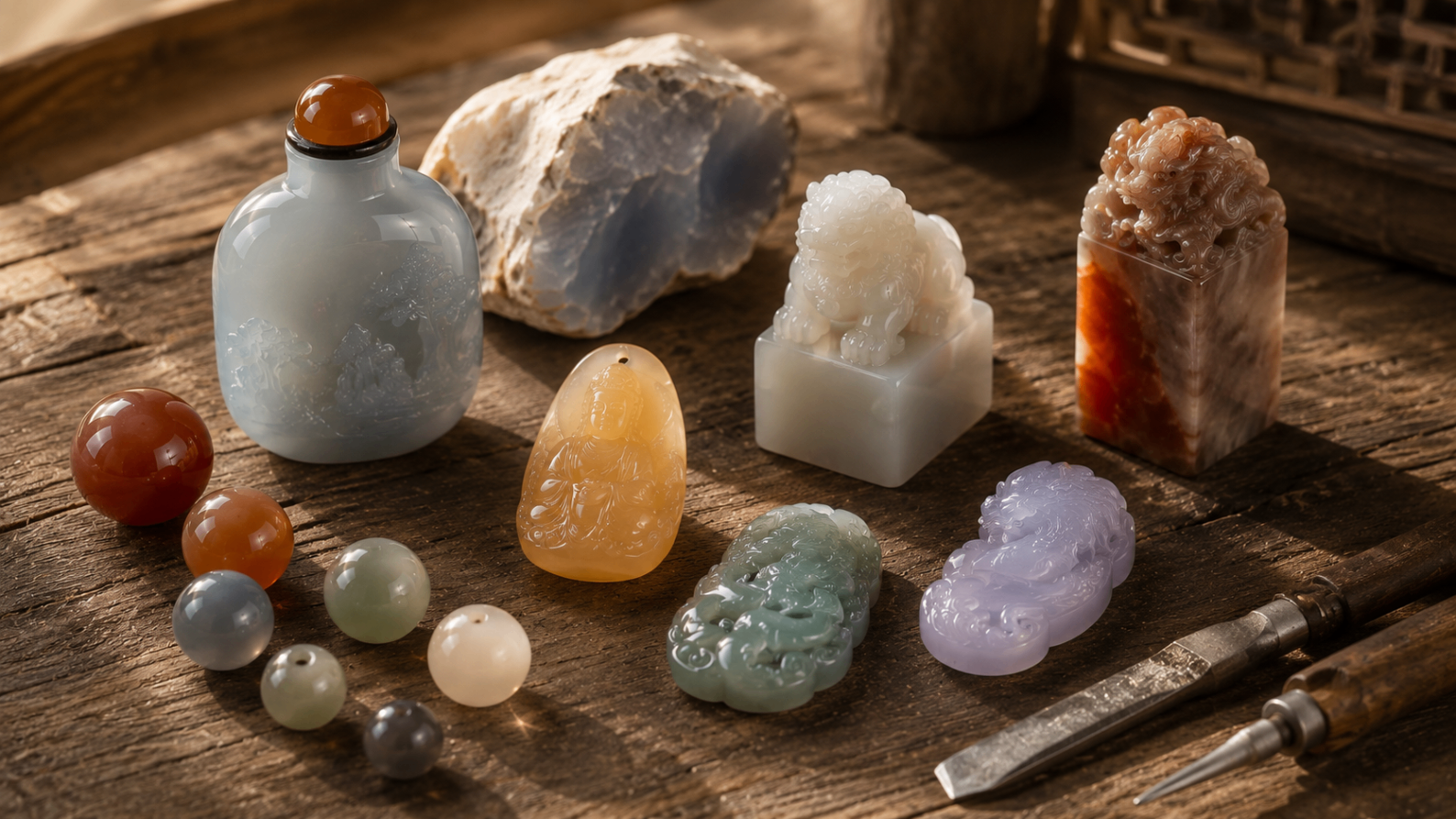
Craft traditions are shaped as much by what a material allows as by what an artisan imagines. Chalcedony allowed a great deal.
Durability suited to daily use
At 6.5 to 7 on the Mohs scale, chalcedony sits above the hardness of most airborne dust, which is largely quartz at hardness 7. A chalcedony bead worn against clothing for years keeps its polish. A seal handled daily keeps its crisp edges. For objects meant to be used rather than displayed, this mattered more than rarity.
Availability
Nephrite of good quality came from a limited number of sources, most famously the river valleys of Khotan in the far west, and travelled long distances at considerable cost. Chalcedony occurs far more widely. Workshops could obtain it in usable quantities and in a range of colors, which meant it could be worked speculatively rather than only on commission.
This changed what could be made. Expensive material encourages caution and small, precious objects. Accessible material encourages experiment, larger forms and volume production for a broader market.
Carving behavior
Chalcedony has no cleavage — no plane along which it prefers to split — and its grain is uniform in every direction. A carver can cut into it from any angle with predictable results. Undercuts, pierced work and thin relief are all achievable. Chinese lapidary technique worked by abrasion rather than percussion: rotating discs and drills fed with abrasive slurry, historically quartz sand and later corundum, gradually wearing the stone away. Chalcedony responded well to this patient method.
Polishing
The final polish is where chalcedony distinguishes itself. Its microcrystalline structure takes an exceptionally even surface, producing the soft, slightly waxy finish that Chinese taste preferred over glassy brilliance. The stone rewards long, careful finishing with increasingly buttery light — a quality difficult to photograph and immediately obvious in the hand.
Jewelry and decorative arts
The result was a material that moved easily between categories. The same block could yield beads for a bracelet, a cabochon for a ring, a small standing carving for a scholar’s desk and a thin hollowed vessel. Few materials serve so many workshop purposes.
Chalcedony objects survive in quantity from the Han dynasty onward and became especially prominent during the Ming and Qing periods, when a prosperous merchant and scholar class created sustained demand for well-made personal objects that were beautiful without being imperial.
The Many Colors of Chalcedony
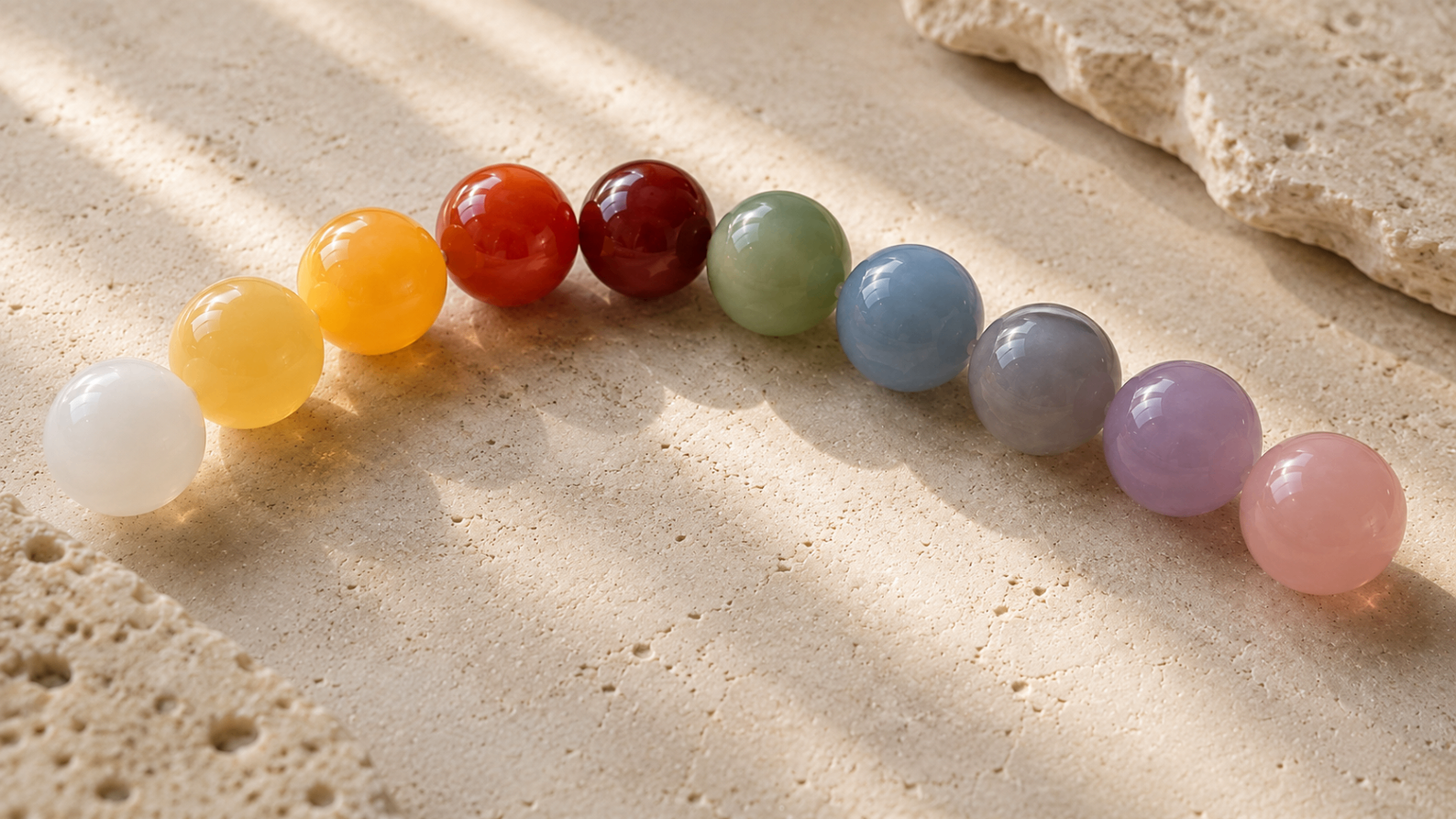
Few gem materials offer chalcedony’s range. Color comes almost entirely from trace elements and microscopic inclusions within the silica, and small differences in chemistry produce very different results.
The symbolism described below is historical and cultural. It records how colors were understood within Chinese decorative tradition. It is not a claim that any stone influences health, fortune or events.
White
White chalcedony is the classic form — milky, evenly translucent, and sometimes described as having a slight bluish cast. Its color comes from light scattering within the fiber structure rather than from a coloring element, which is why the finest examples look luminous rather than chalky.
In Chinese tradition, white was one of the five orthodox colors, associated with the west, with autumn and with the Metal phase. It carried connotations of clarity and purity. White chalcedony was widely used for beads, small carvings and pieces meant to resemble fine white nephrite.
Yellow
Yellow chalcedony ranges from pale straw to warm honey. The color is produced by finely dispersed iron compounds, chiefly hydrated iron oxides such as goethite.
Yellow held particular weight in Chinese culture: the color of the center, of the Earth phase and, from the Ming period, of imperial reservation in specific contexts. Warm honey-toned chalcedony was valued for beads and carvings where a rich but soft color was wanted.
Orange
Orange chalcedony is carnelian, colored by iron oxide in a more concentrated and oxidized form. Its tone runs from apricot to deep amber, often with a subtle internal glow when backlit.
Carnelian is among the most widely traded chalcedonies in history, reaching China along the Silk Road from South and Central Asia. It appears in beads, seals and inlay work, and its warmth associated it with vitality and celebration in decorative use.
Red
Deeper red chalcedony — historically distinguished as sard when brownish-red — takes its color from the same iron oxide chemistry at higher concentration. Some material is heat-treated, a practice documented in antiquity, which deepens yellow and orange tones toward red.
Red is the most culturally significant color in China: the color of the Fire phase, of the south, and of celebration, weddings and the New Year. Red chalcedony beads were common in festive and gift objects.
Green
Green chalcedony includes chrysoprase, colored by nickel, and other green varieties colored by chlorite or amphibole inclusions. Tones range from pale apple to a saturated green that can resemble fine jadeite.
Green corresponds to the Wood phase, to the east and to spring, carrying associations with growth and renewal. Because green chalcedony can closely approach the appearance of jade, it is both the most admired and the most frequently misrepresented variety.
Blue
Blue chalcedony is rarely blue in the way sapphire is blue. Its color is largely structural, produced by the scattering of light within the fiber structure — the same physical effect that makes the sky blue — sometimes assisted by trace inclusions. The result is a soft, hazy, slightly gray blue.
Blue and green were not always sharply separated in classical Chinese color language; the term 青 (qīng) covered a range from blue through green. Pale blue chalcedony was appreciated for its resemblance to mist and distant water, qualities central to landscape aesthetics.
Gray
Gray chalcedony is the most common natural color and often the most underestimated. Its neutral, smoky tone results from finely dispersed inclusions and from the structural scattering that also produces blue.
Gray sat close to the scholarly aesthetic of restraint — the same sensibility that valued ink monochrome over color in painting. It was frequently used for seals, brush rests and desk objects where quiet presence was preferred to display.
Lavender
Lavender chalcedony shows a pale violet to grayish-purple tone, attributed to trace elements and inclusions in combination with structural scattering. Fine, evenly colored lavender material is uncommon.
Purple carried elevated associations in Chinese tradition, connected with the north celestial pole and imperial symbolism — the Forbidden City is 紫禁城, the Purple Forbidden City. Lavender chalcedony was valued for pendants and beads where a rare, delicate color was wanted.
Pink
Pink chalcedony ranges from the palest blush to a soft rose, colored by very low concentrations of iron or manganese. It is typically gentle rather than saturated.
Pink was not one of the five orthodox colors and appears more often in later decorative work, particularly in objects associated with spring, blossom and personal adornment. Its rise in popularity is largely a modern phenomenon, though blossom imagery has been central to Chinese decorative vocabulary for centuries.
Chalcedony in Chinese Jewelry
Chalcedony’s versatility produced a wide catalog of forms, most of which are still made today.
Bracelets
Beaded bracelets are the most enduring use. Round beads of even diameter, drilled and strung, suit the material perfectly: the shape is easy to produce accurately, the polish survives constant contact with skin and cloth, and the translucency reads clearly at small scale. Solid carved bangles were also made, though jade’s superior toughness made it the safer choice for a form under continuous stress.
Pendants
Flat or gently domed pendants carried carved motifs — gourds, lotus, bats, dragons, ruyi heads — each drawn from a shared decorative vocabulary. Chalcedony’s uniform grain allowed fine detail on small surfaces, and its translucency gave carved relief visible depth.
Hair ornaments
Hairpins, combs and inlay plaques used chalcedony both as carved elements and as color accents set into metal. Its lighter weight compared with jade was an advantage in ornaments worn in the hair for long periods.
Snuff bottles
Among the most demanding objects in Chinese lapidary art, snuff bottles required hollowing a small solid stone through a narrow neck using bent drills and abrasive slurry. Chalcedony and agate were favored materials, and skilled carvers used natural color banding deliberately — placing a dark inclusion so that it became a bird, a branch or a figure against a pale ground. These are among the finest demonstrations of the material’s possibilities.
Beads
Beyond bracelets, chalcedony beads appear in necklaces, court necklaces, rosaries and garment ornaments. Standardized bead production was an industry in its own right, with regional centers specializing in particular sizes and finishes.
Small carvings
Table-sized figures of animals, fruit, deities and mythical creatures were produced in large numbers. These objects were meant to be picked up and turned in the hand, and chalcedony’s smooth polish and comfortable weight suited that use.
Seal stones
Seals demanded a material that would hold a precisely cut character through repeated pressing and cleaning. Chalcedony and agate served well where a harder, more durable seal than soft soapstone was wanted, though the difficulty of cutting them meant softer stones remained more common for scholars carving their own.
Chalcedony in Modern Craftsmanship
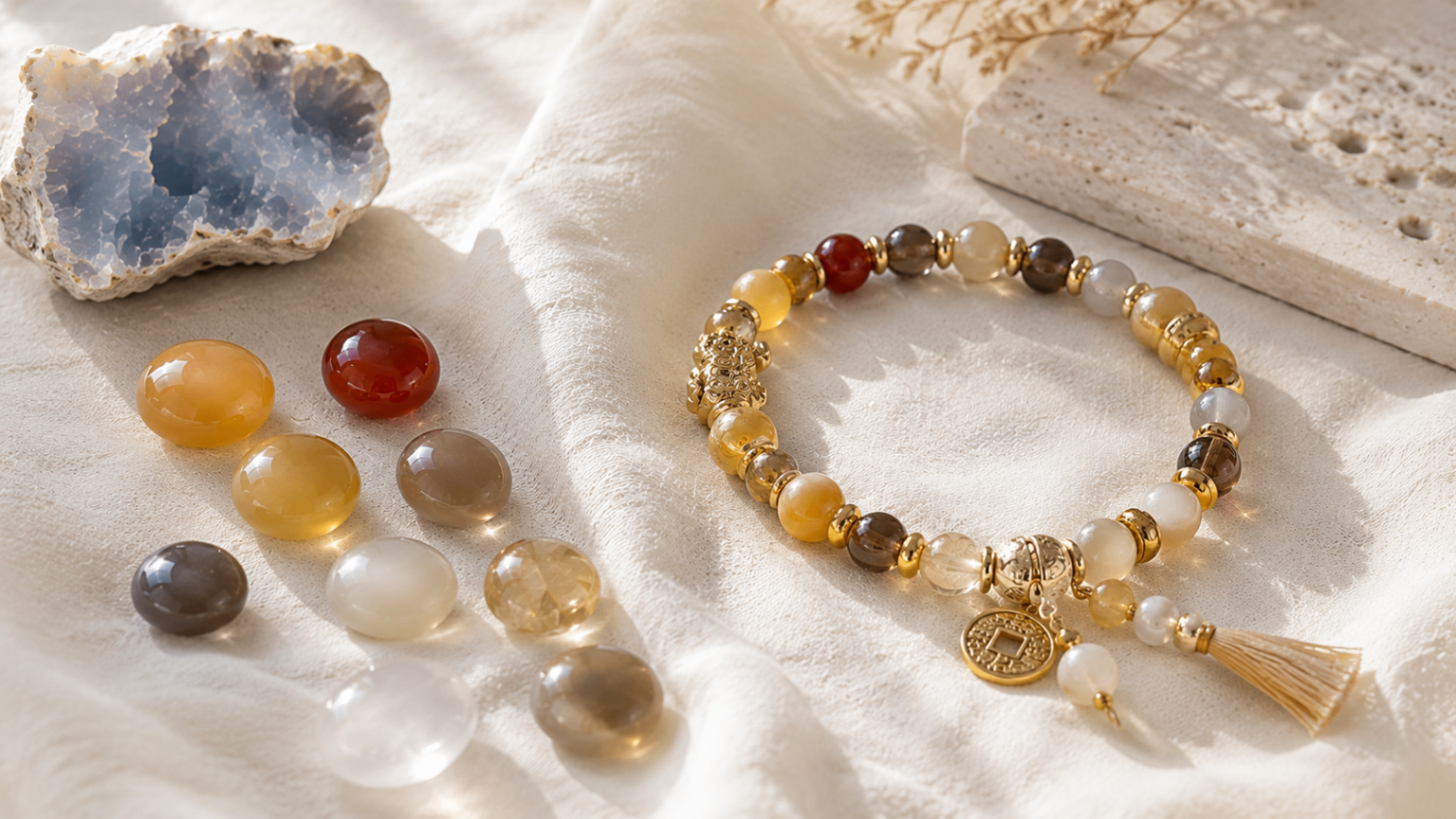
Contemporary designers continue to reach for chalcedony, and the reasons are largely the same ones that persuaded workshops centuries ago.
Durability
Jewelry is worn, not stored. A material that survives daily contact without dulling is worth more in practice than a rarer stone that requires protection. Chalcedony’s hardness keeps its surface intact through ordinary use.
Beauty
The soft internal glow of well-finished chalcedony is difficult to replicate. Glass is too bright and too even. Dyed stone reads flat. Chalcedony’s translucency changes with the light around it, which is precisely what makes it engaging over years rather than minutes.
Affordability
Fine jadeite is among the most expensive gem materials in the world. Chalcedony is not. That accessibility allows careful design, considered proportions and honest construction at a price that does not depend on scarcity. It also allows a maker to choose a stone for how it looks rather than for what it costs.
Versatility
Its color range means a single material can carry an entire collection — warm and cool, pale and saturated — with a consistent surface quality throughout. Few natural materials offer that coherence.
Timeless appearance
Chalcedony does not look of a particular decade. A honey-colored bead bracelet made today is visually continuous with one made three hundred years ago. In an industry driven by seasonal change, that continuity is itself a design argument.
How To Tell Chalcedony From Jade
For a buyer, the practical question is not academic. Chalcedony and jadeite can differ in price by orders of magnitude, and the two are regularly confused — sometimes innocently, sometimes not. The following checks help, in roughly increasing order of reliability.
Weight
This is the single most useful non-destructive indicator. Jadeite has a density of around 3.3 g/cm³ and nephrite around 2.95 g/cm³, while chalcedony sits near 2.6 g/cm³. Two bangles of identical size will feel distinctly different in the hand — jade noticeably heavier. Comparing pieces of similar dimensions is far more informative than assessing one in isolation.
Touch
Both materials feel cool because both conduct heat away from the skin, so coolness alone proves nothing. Jade tends to stay cool slightly longer and warms more slowly. This is a suggestive impression, not a test.
Texture
Under magnification, nephrite often shows a faint fibrous or felted texture, and jadeite can show a granular, slightly dimpled surface after polishing, sometimes called orange-peel effect. Chalcedony polishes to a smoother, more featureless surface, though it may show faint banding or color zoning that jade rarely displays in the same way.
Luster
Nephrite has a characteristically greasy luster. Polished jadeite is more vitreous, sometimes approaching a glassy brightness. Chalcedony typically sits between the two, waxy and soft. Luster is a genuine diagnostic clue for an experienced eye but is easily misread by a beginner, and surface treatments can alter it.
Price
Price is information. Fine translucent green jadeite is a rare material with a well-established market. A large, vividly green, highly translucent bangle offered at a modest price is not a bargain — it is a different material, or a treated one. Suspiciously low pricing is one of the most reliable warnings available to a buyer.
Professional testing
Certainty requires a laboratory. Specific gravity measurement distinguishes the materials cleanly. Refractive index readings separate quartz from both jades. Raman and infrared spectroscopy identify the mineral definitively and can also detect polymer impregnation and dye — treatments common in the jadeite trade and invisible to the eye. For any significant purchase, a report from an independent gemological laboratory is the only complete answer.
Why looking is not enough
Every visual characteristic that distinguishes these stones overlaps somewhere. Dyed chalcedony can imitate jadeite green convincingly. Treated jadeite can look better than untreated jadeite. Glass, resin and reconstituted composites are made specifically to defeat casual inspection. Experienced dealers rely on instruments precisely because experience taught them that eyes are not sufficient. A buyer should expect the same standard: ask what the material is, ask whether it has been treated, and ask for documentation when the value warrants it.
Caring For Chalcedony
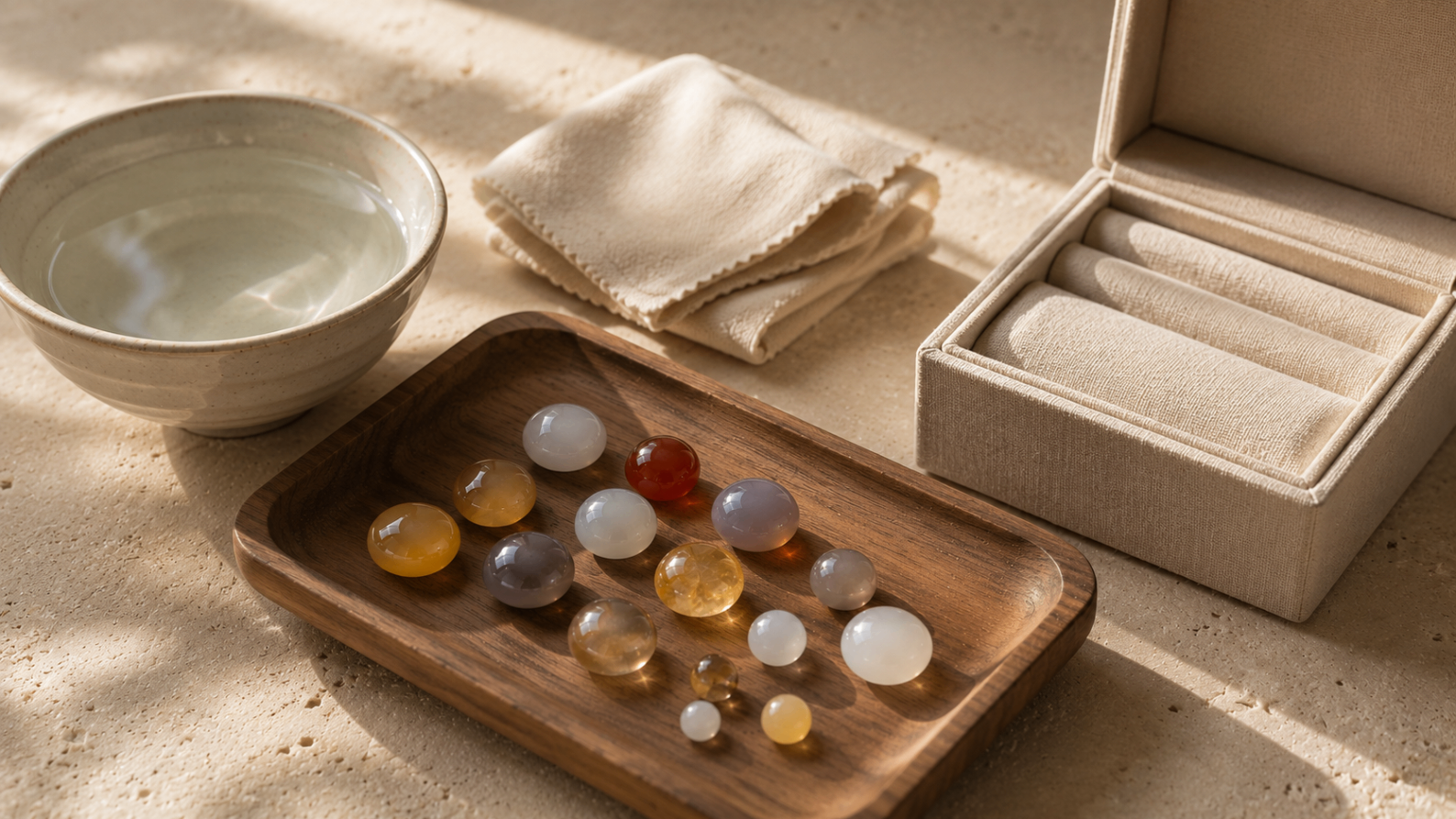
Chalcedony is an easy material to keep well, provided a few simple habits are observed.
Cleaning
Warm water, a drop of mild soap and a soft cloth are sufficient. Wipe the stone, rinse briefly and dry thoroughly with a lint-free cloth. For beaded pieces, dry the cord or elastic completely before wearing again; damp thread degrades far faster than the stone ever will. Avoid ultrasonic and steam cleaners, which can stress fractures and damage settings and stringing.
Storage
Store pieces separately in a soft pouch or a lined compartment box. The main risk to chalcedony is not the world at large but the rest of the jewelry drawer: harder gems will scratch it, and metal clasps will mark it. Keep bracelets loosely coiled rather than stretched, which prolongs the life of elastic cord considerably.
Avoiding harsh chemicals
Remove jewelry before using household cleaners, bleach or solvents, and before swimming in chlorinated water. Perfume, hairspray, sunscreen and cosmetics should be applied and allowed to dry before putting stones on — residues dull polish over time and can weaken adhesives and cord. Any dyed or coated material is especially vulnerable to chemical exposure.
Avoiding impact
Hardness protects against scratching; it does not protect against breaking. Remove bracelets and rings before sport, heavy lifting, gardening or any activity likely to knock stone against a hard surface. Most damage to chalcedony jewelry comes from a single sharp impact, not from gradual wear.
Long-term care
Inspect strung pieces every few months for stretched elastic, frayed cord or loose knots, and restring before failure rather than after. Keep stones out of prolonged direct sunlight, which can fade some treated or dyed material even though natural color is stable. Avoid sudden temperature changes. Handled sensibly, a chalcedony piece will outlast the person who bought it — which is, historically, exactly what it was made to do.
Why YukDao Uses Chalcedony
At YukDao, we value chalcedony not because we believe a stone changes destiny, but because it represents centuries of Chinese craftsmanship, remarkable durability and timeless beauty. Every bracelet begins with respect for the material and the traditions that shaped it.
That respect is practical as much as sentimental. It means naming the material accurately rather than borrowing the prestige of another stone. It means selecting for translucency, evenness of polish and consistency of color rather than for the loudest possible effect. It means building pieces that can be worn every day, because a stone that spends its life in a box has been misunderstood.
Chalcedony has served Chinese workshops for two thousand years without ever pretending to be something else. That is the standard we work to.
“Great craftsmanship begins not with decoration, but with understanding the material itself.”
- Chinese Craft
- Chalcedony
- Chalcedony Vs Jade
- Chinese Chalcedony
- Yu Sui
- Chinese Gemstones
- Chinese Jewelry Materials
- Quartz Gemstone
Related Articles
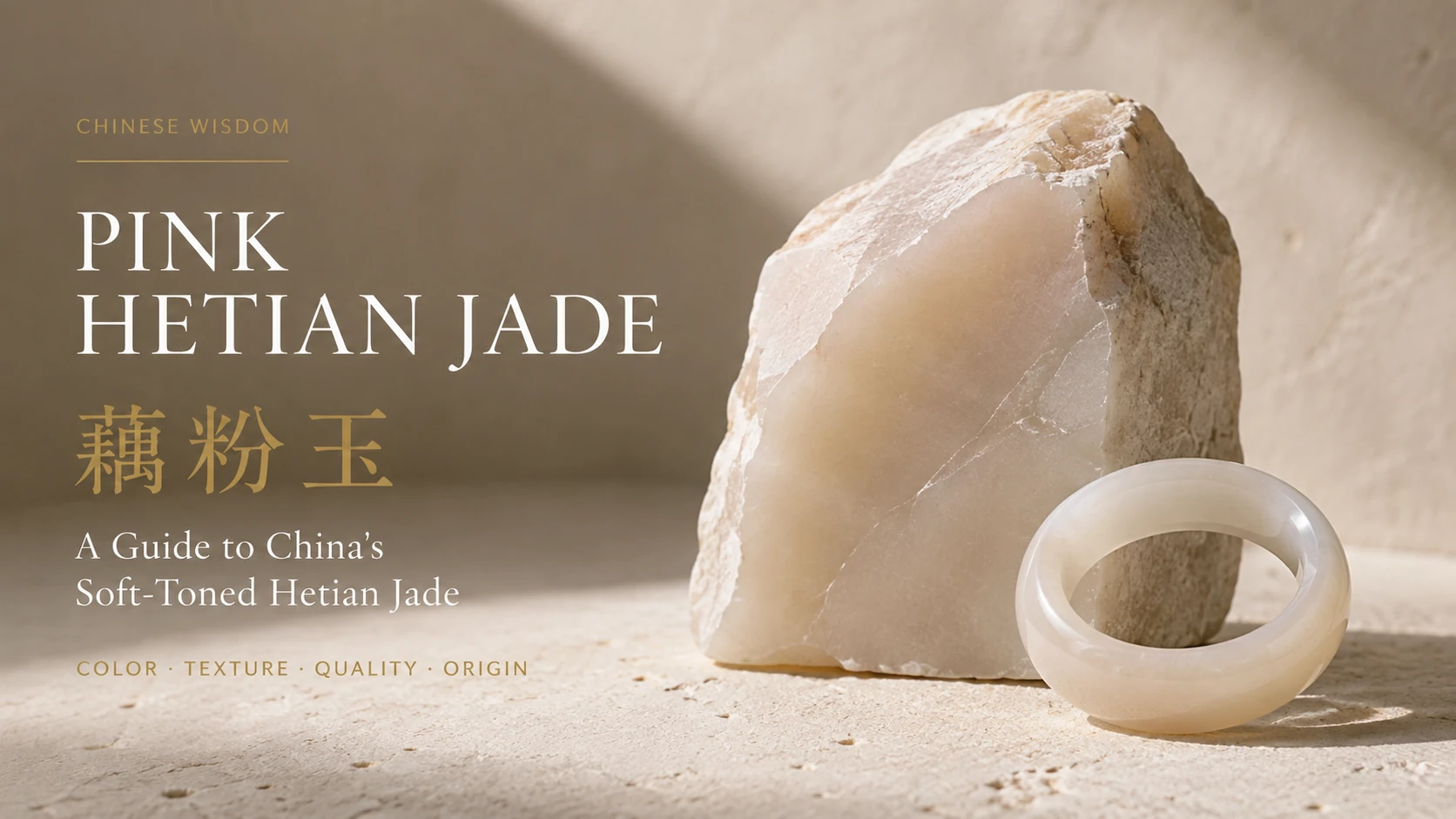
What Is Pink Hetian Jade? A Guide to Qinghai 藕粉玉
Named after lotus root powder, 藕粉玉 is a soft pink-toned Qinghai Hetian jade prized for its warmth, translucency and quiet water lines.
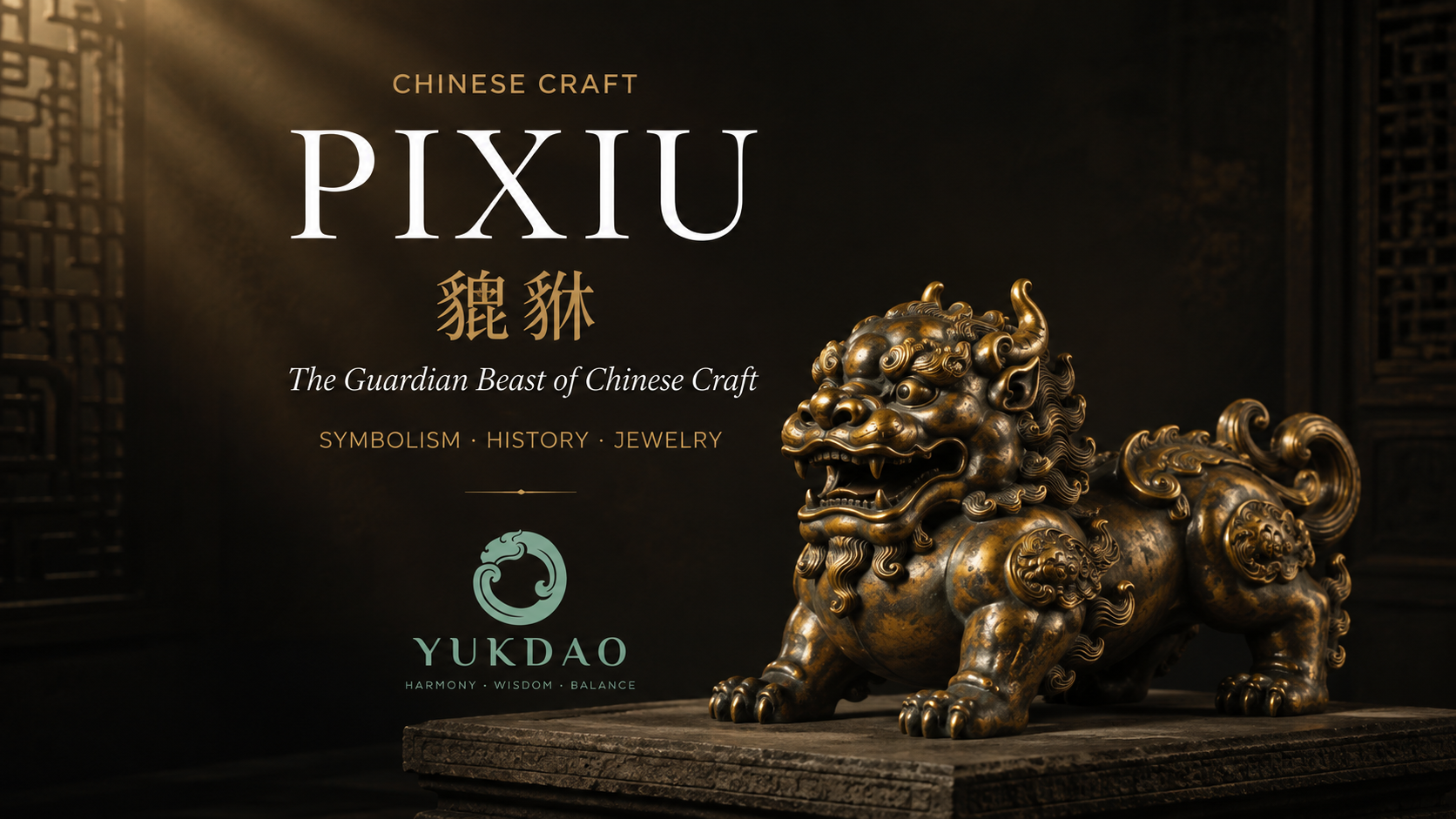
What Is Pixiu (貔貅)? The Guardian Beast of Chinese Craft
Winged, fierce and famously without an exit, Pixiu has guarded Chinese homes, tombs and treasuries for two thousand years — and it remains one of the most carved figures in Chinese craft.
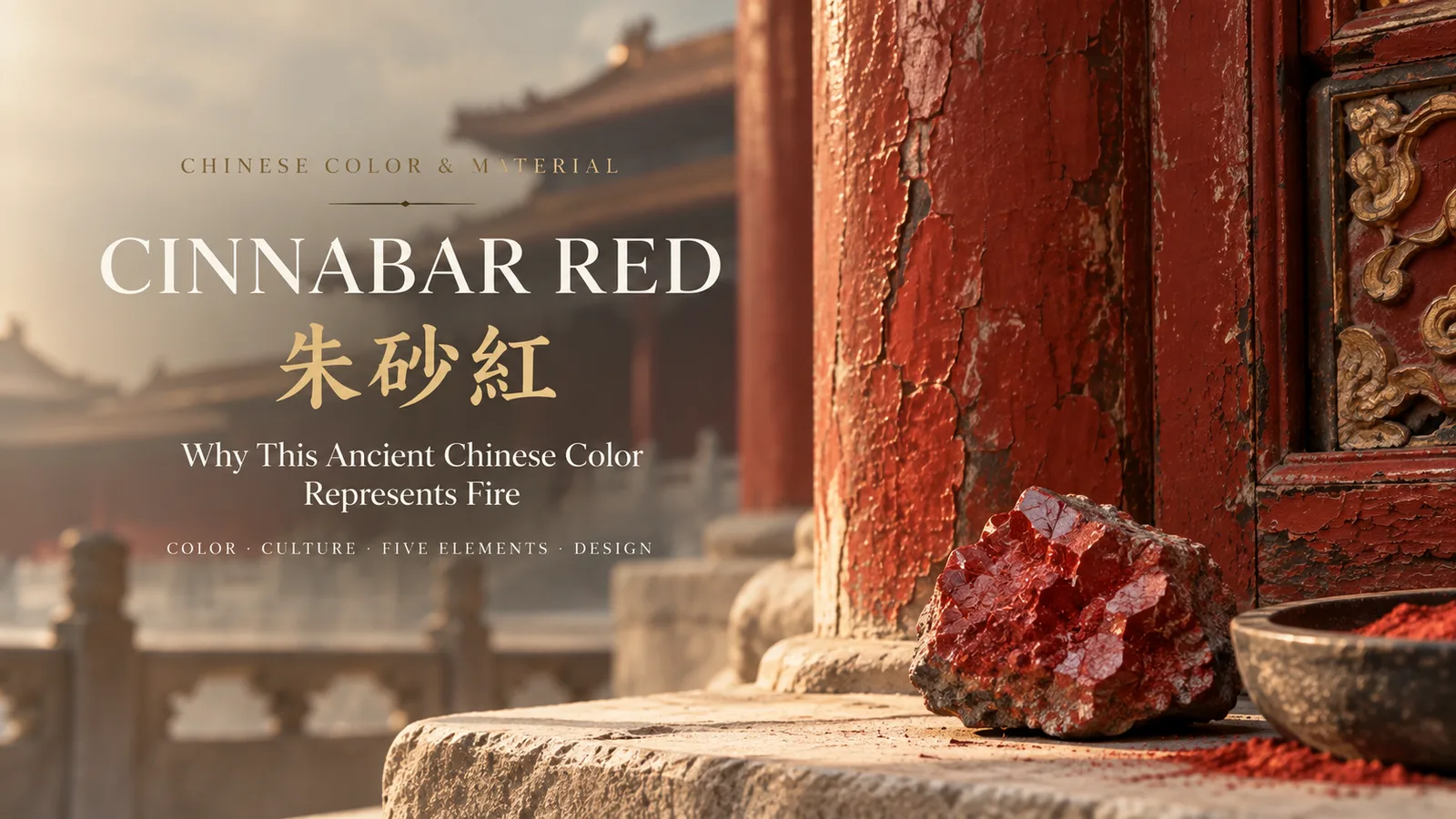
Cinnabar Red: Why This Ancient Chinese Color Represents Fire
From mineral pigment and imperial architecture to Five Element symbolism and contemporary jewelry, cinnabar red 朱砂紅 carries a Chinese story far deeper than its color alone.