
What Is Pixiu (貔貅)? The Guardian Beast of Chinese Craft
It sits at the entrance of banks in Hong Kong, on the desks of shopkeepers in Guangzhou, on the wrists of students in Chengdu and at the gates of tombs that have stood for eighteen centuries. It has the body of a lion, the head of a dragon, sometimes a pair of small wings folded against its shoulders, and an expression that is fierce without being cruel.
This is Pixiu (貔貅) — the guardian beast of Chinese craft. Few creatures in the Chinese imagination have been carved more often, in more materials, over a longer period of time.
Most explanations of Pixiu begin and end with money. That is a modern abbreviation of a much older idea. Pixiu was a protector long before it was a prosperity symbol, and understanding the difference explains why it looks the way it does, why it is placed where it is placed, and why craftsmen still return to it.
What Is Pixiu?
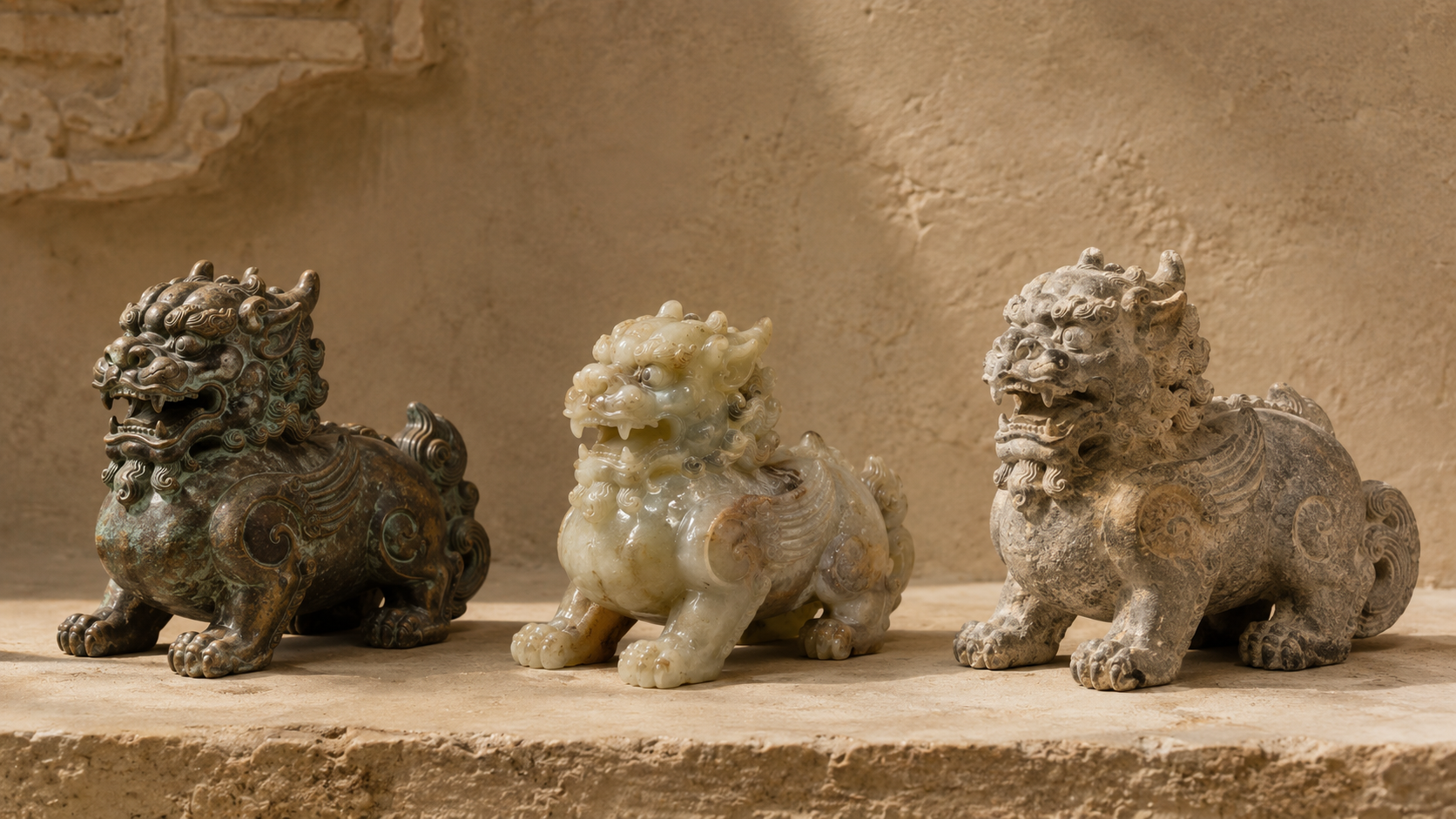
Pixiu is a mythical hybrid creature in Chinese tradition, usually described as having the head of a dragon, the body and paws of a lion, and — in many depictions — a pair of wings. The name is often written 貔貅 and pronounced pí xiū. In southern China and in much of the Hong Kong and Southeast Asian trade, the same creature is commonly called pi yao (貔貅), and the two names refer to the same beast.
A pair, not a single figure
Classically, Pixiu appears as a pair. The male, pi, is traditionally shown with a single horn; the female, xiu, with two. In practice the distinction is inconsistently observed by carvers, and many pieces make no attempt to differentiate them at all. What survives reliably is the sense of a guardian couple: one gathering, one holding.
The famous detail
The characteristic that everyone eventually hears about is anatomical: Pixiu has a mouth but no anus. In the traditional account, the creature consumes gold, silver and treasure and cannot expel any of it. Wealth enters and does not leave.
It is easy to treat this as a joke, and it is often told as one. But it is a precise piece of symbolic engineering. A prosperity emblem that only attracts is incomplete; the Chinese concern has always been as much with retaining what has been gathered as with acquiring it. Pixiu encodes accumulation and retention in a single body.
Related but distinct creatures
Pixiu is frequently confused with two other guardian figures. Bixie (辟邪, literally “to ward off evil”) and tianlu (天禄, “heavenly emolument”) are the names given in Han-dynasty texts to the winged lion-like tomb beasts that are, in visual terms, Pixiu’s ancestors. It is also distinct from the shishi — the paired stone lions at gateways — and from the dragon-descended qilin, which is a benevolent omen rather than a guardian.
Origins: From Tomb Guardian To Treasure Beast
The winged lion enters Chinese art during the Han dynasty (206 BCE–220 CE), almost certainly under influence from Central and Western Asia, where winged lions had a long iconographic history. In China the form was absorbed and rapidly made local.
The spirit road
The earliest monumental examples stand on the shendao, the spirit road leading to an imperial or aristocratic tomb. Carved from single blocks of limestone and often two to three meters long, these beasts were placed in pairs to flank the approach. Their job was not decorative. They were there to intercept malevolent influence before it reached the dead.
Several of these Han and Southern Dynasties beasts survive in the countryside around Nanjing, weathered nearly featureless, still standing where they were set down more than a millennium and a half ago. Anyone who has seen them understands immediately that Pixiu did not begin as a small ornament.
From tomb to threshold
Over the Tang and Song periods the guardian function migrated from the tomb to the living world — to palace gates, then temple precincts, then the doorways of merchants and officials. As it moved, it shrank. A creature that had been carved at monumental scale became something that could sit on a desk, cap a seal, or be worn.
The Ming and Qing turn toward wealth
The explicit association with money belongs mainly to the later imperial period, and it strengthened with the rise of commercial urban culture in the Ming and Qing dynasties. There is a persistent tradition that Pixiu was reserved for the imperial treasury, and that its use by commoners was restricted — an attractive story that is better understood as a reflection of the creature’s prestige than as documented statute.
What is clear is that by the Qing dynasty, Pixiu had become the standard emblem of the merchant and the banker: a guardian repurposed for an age in which the thing most needing protection was capital.
What Pixiu Symbolizes
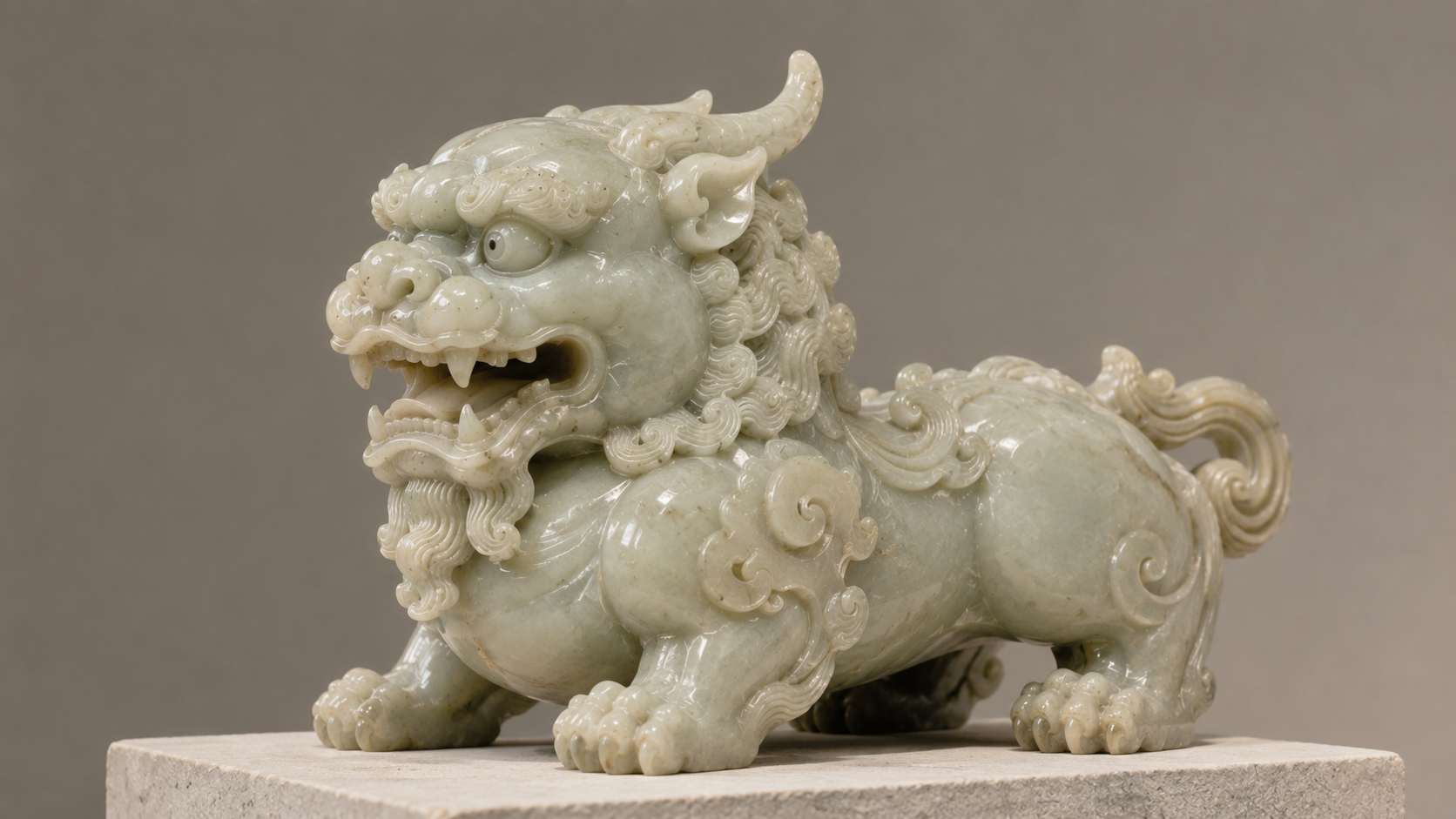
Four ideas cluster around Pixiu, and they are worth separating because they are not the same idea.
Protection
This is the original and the oldest layer. Pixiu deflects malevolence, hostility and misfortune. Its posture in carving — forequarters raised, head turned outward, mouth open — is the posture of something facing away from what it guards.
Attraction of wealth
The later layer. Pixiu gathers cai (財) — wealth, resources, opportunity. In shops it is placed facing the door or the street, positioned to draw inward.
Retention
The layer most often forgotten and, arguably, the most characteristic. Pixiu does not merely bring; it keeps. In a culture with a long memory of dynastic collapse, currency reform and abrupt reversal, retention is not a lesser virtue than acquisition.
Loyalty
A quieter association, drawn from the mythology in which Pixiu serves a single master. It informs the custom of not passing a personal Pixiu piece casually from hand to hand, and of treating one’s own as one’s own.
A note on how to hold all of this: these are cultural meanings, not claims about how the world works. Pixiu is worth understanding the way any long-lived symbol is worth understanding — as a record of what people valued and feared. At YukDao we present it in exactly that spirit.
The Materials Of Pixiu
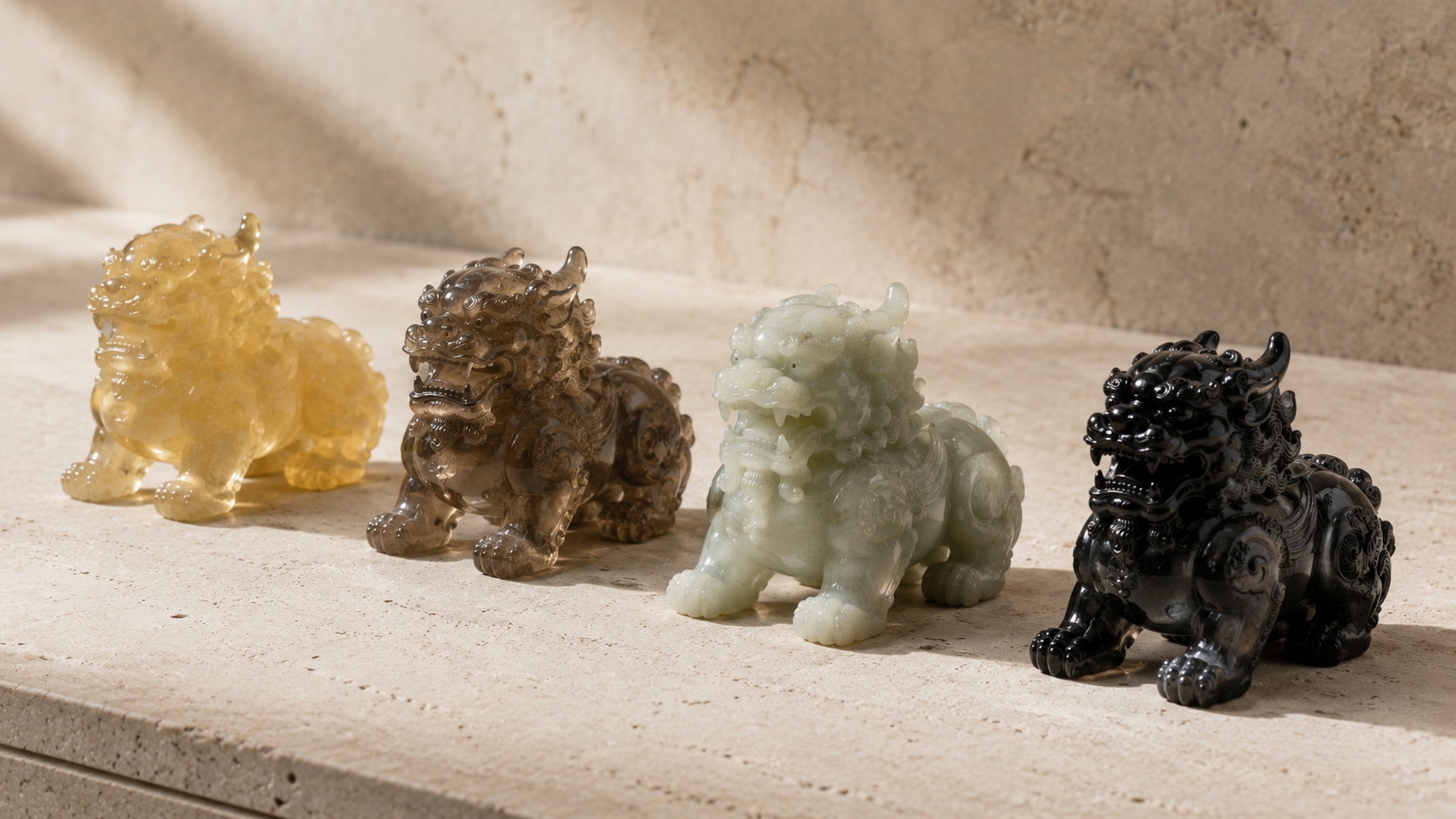
Pixiu has been rendered in almost every material Chinese workshops have ever worked, and the choice of material is never neutral: it determines how much detail is possible, how the piece catches light, and how it can be used.
Bronze
The material of the earliest small-scale figures and of most large architectural pairs. Casting allows undercutting and fine surface texture that stone cannot easily achieve, and bronze develops a patina that flatters the form as it ages.
Stone
Limestone and granite for monumental guardians; smaller decorative stones for domestic work. Stone forces simplification — mass and silhouette carry the figure rather than detail — which is why the oldest examples still read clearly after centuries of weathering.
Jade
Nephrite and, later, jadeite. Jade is exceptionally tough, which makes carving slow and expensive but permits thin, resilient sections. A jade Pixiu was historically a statement of both means and taste.
Obsidian and smoky quartz
Both are strongly associated with protective use. Obsidian takes a deep, near-black polish with a glassy luster; smoky quartz gives a translucent brown-grey that reads as sober rather than showy. These are the materials most often chosen when the protective meaning is the point.
Chalcedony
Yellow and honey-colored chalcedony has become one of the most common materials for wearable Pixiu, for practical reasons rather than fashionable ones. At 6.5–7 on the Mohs scale it is hard enough to hold a crisp carved edge and take a fine polish, it occurs in a wide and consistent range of warm colors, and it is available in sizes suitable for beads and small figures without the cost of fine jade.
If you want the full account of that material — what it is, how it differs from jade, and why Chinese workshops have relied on it for two thousand years — we wrote it here: What Is Chalcedony? The Stone Behind Chinese Craftsmanship.
How A Pixiu Is Carved
A wearable Pixiu is a small object with a great deal of work in it. The sequence below describes how a bead-scale figure is made in a traditional workshop.
Selecting the rough
The carver reads the raw stone for color zoning, internal fractures and inclusions, then orients the figure to place the best material at the head and back — the surfaces that will be seen. A great deal of the final quality is decided before a single cut is made.
Roughing the form
The block is reduced to the essential mass: crouching body, raised forequarters, turned head. At this stage the piece is judged in silhouette, because silhouette is what will be legible at arm’s length.
Defining the features
Diamond burrs of decreasing size cut the mane, the brow ridge, the open mouth, the curled tail and — where the design calls for them — the folded wings. This is where a Pixiu either acquires character or becomes generic. The difference between a memorable carving and a dull one is almost always in the head.
Drilling
For a bracelet piece, the bore is drilled from both sides to meet in the middle, which reduces the risk of chipping at the exit. The hole must run true or the figure will sit crooked on the wrist — a fault that cannot be corrected afterward.
Polishing
Successive grits bring the surface up to a soft luster. Good polishing preserves the crispness of the carved lines; over-polishing rounds them and softens the face. Restraint here is what separates workshop practice from mass production.
Final inspection
The piece is checked for symmetry of the paws, cleanliness of the bore, evenness of polish and — the criterion no machine applies — whether the animal looks alive.
Wearing And Placing Pixiu
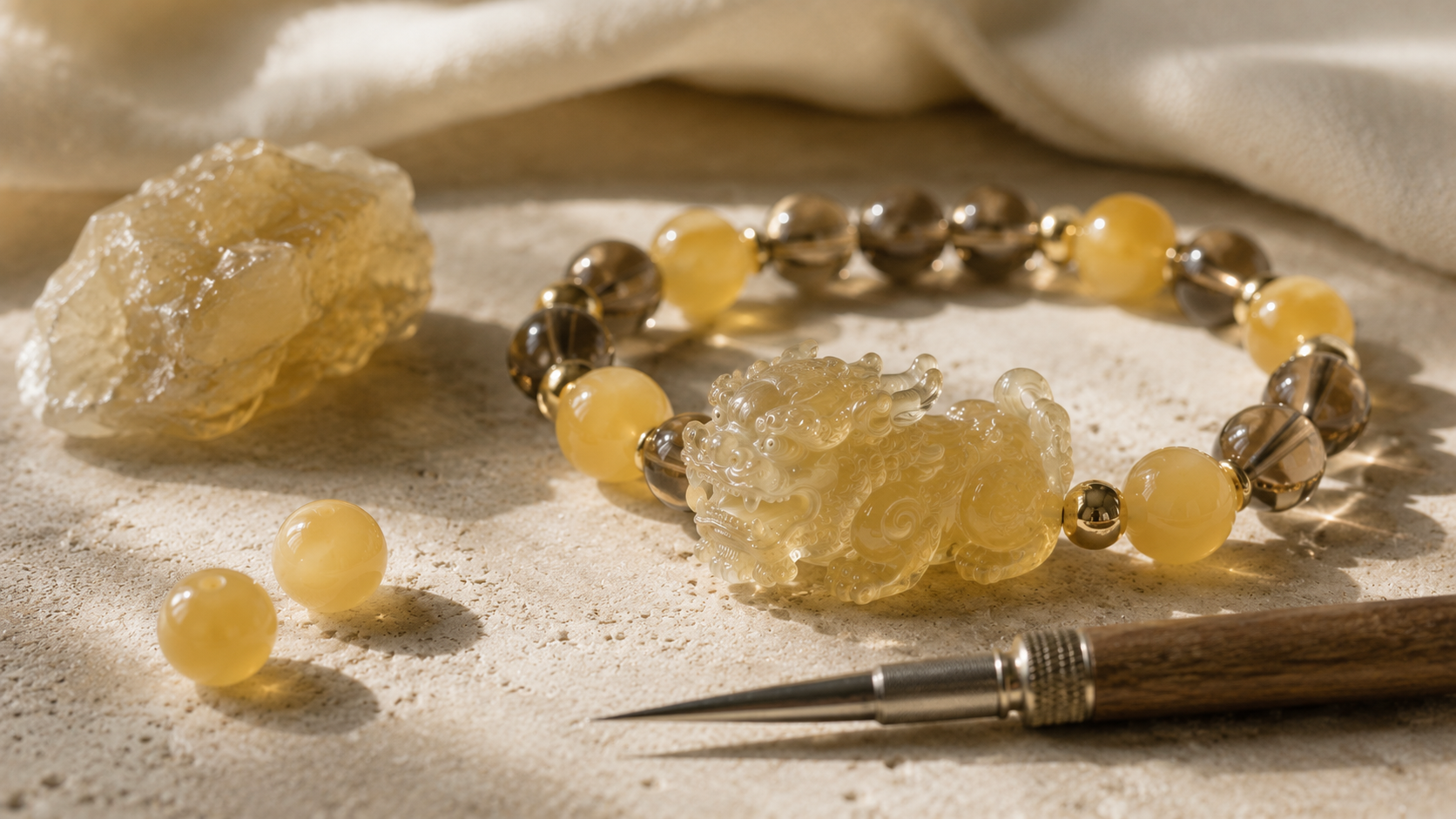
The customs around Pixiu are widely shared, informally taught and not entirely consistent from region to region. They are worth knowing — and worth holding lightly.
Which wrist
The most common convention places a Pixiu bracelet on the left wrist, following the general principle that the left side receives and the right side gives. Since Pixiu is understood to gather and keep, the receiving side is preferred.
Which way it faces
On a bracelet, the head is customarily oriented outward, away from the body, so the beast looks toward the world it is meant to gather from. For a desk or shelf figure, the same logic applies: face it toward the door or the window, not into the room, and never directly at where you sleep.
Placement in a room
Shops position Pixiu near the entrance or the till. Homes favor the living room or study rather than the bedroom, kitchen or bathroom. Keep it above floor level and free of clutter.
Handling
Tradition suggests avoiding contact with the mouth and eyes when handling a piece, and treating your own Pixiu as personal rather than passing it around. Whether or not one takes the symbolism seriously, the underlying instruction is sound: handle carved stone deliberately, not casually.
Care
Clean with warm water, a drop of mild soap and a soft cloth, and dry thoroughly — particularly the cord. Avoid ultrasonic cleaners, household chemicals, chlorinated water and perfume. Store the piece separately in a pouch so harder stones and metal clasps cannot scratch it, and keep bracelets loosely coiled rather than stretched. Remove them before sport or heavy work: hardness protects against scratching, not against impact.
Buying Well: What To Look For
Pixiu is one of the most heavily reproduced figures in the stone trade, which means quality varies enormously at similar prices.
Carving quality
Look at the face first. Are the eyes cleanly cut and level? Is the mane articulated, or merely suggested by shallow grooves? Do the paws match? Mass-produced work is recognizable by a soft, blurred head and a body that reads as a lump with details scratched onto it.
Material honesty
Ask what the stone is, by name, and whether it has been dyed, heat-treated or stabilized. Dyed chalcedony imitating jadeite is common; so is glass. A vivid, translucent green Pixiu at a low price is not fine jadeite.
Finish
Run a finger over the piece. The bore should be smooth, the polish even across the whole surface including the underside, and the carved lines still sharp. Grinding marks left inside a recess indicate a piece that was finished quickly.
Proportion
A well-made Pixiu has weight in the hindquarters and lift in the chest. Poorly proportioned copies tend to be uniformly thick, which drains the figure of the tension that makes it look like a guardian rather than an ornament.
Why YukDao Carves Pixiu
We work with Pixiu because it is the clearest single example of what Chinese craft does well: take an inherited form, refine it across centuries, and keep it useful.
We do not claim that a carved animal will change anyone’s fortune. What we can say is that a Pixiu carved carefully from good material carries two thousand years of continuous practice on the wrist — the same posture, the same turned head, the same refusal to let go of what it has gathered, worked now in yellow chalcedony instead of Han limestone.
That continuity is the reason we choose the material honestly, name it accurately, and finish the head as carefully as the body. A guardian that has been made without attention is not much of a guardian.
“A guardian is not carved to be admired. It is carved to stand between you and what you cannot see.”
- Chinese Craft
- Pixiu
- Pi Yao
- Guardian Beast
- Chinese Mythology
- Chinese Symbolism
- Chinese Carving
- Chalcedony
Related Articles
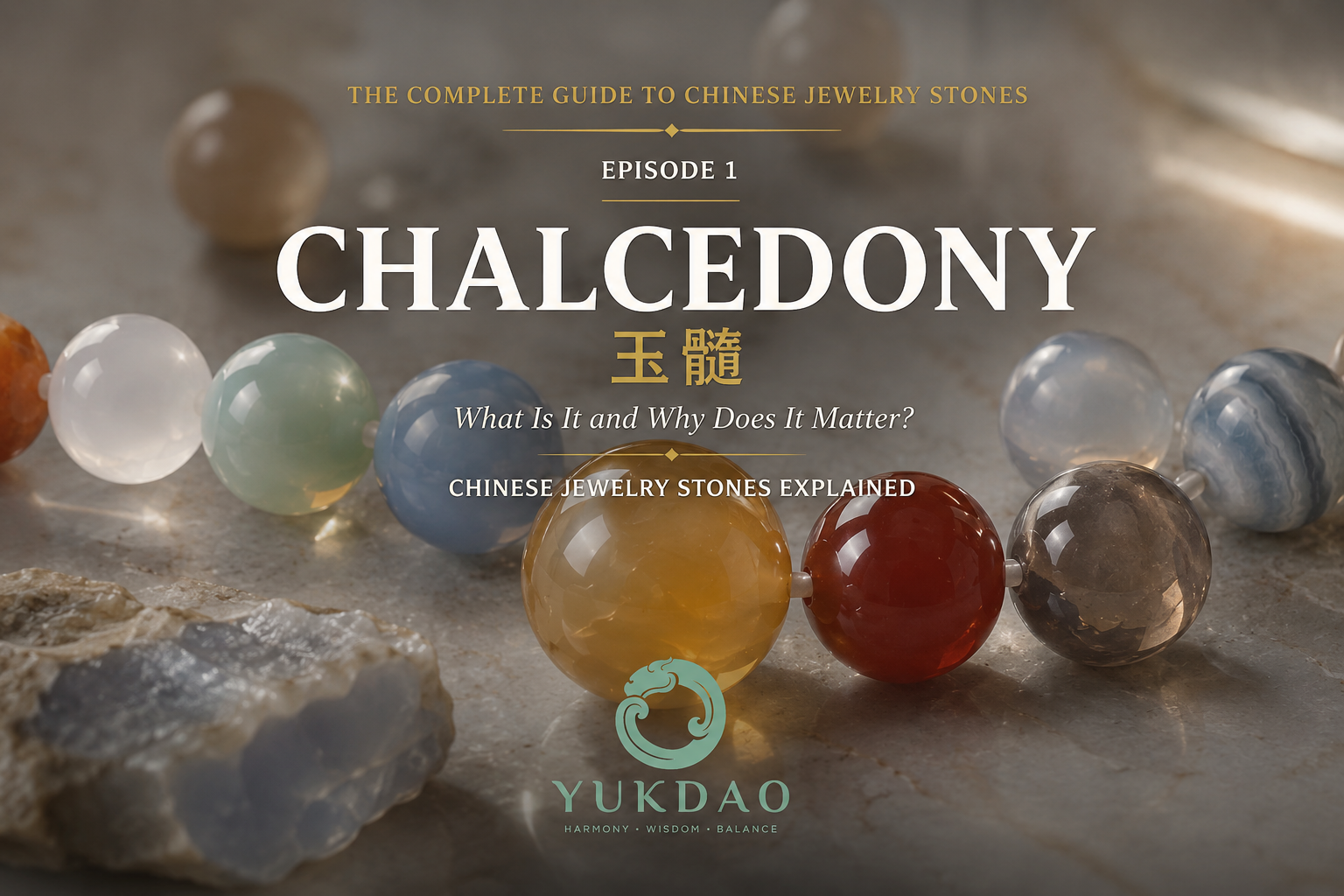
What Is Chalcedony? The Stone Behind Chinese Craftsmanship
Often mistaken for jade, chalcedony has been treasured in Chinese craftsmanship for centuries for its beauty, durability and remarkable variety of colors.
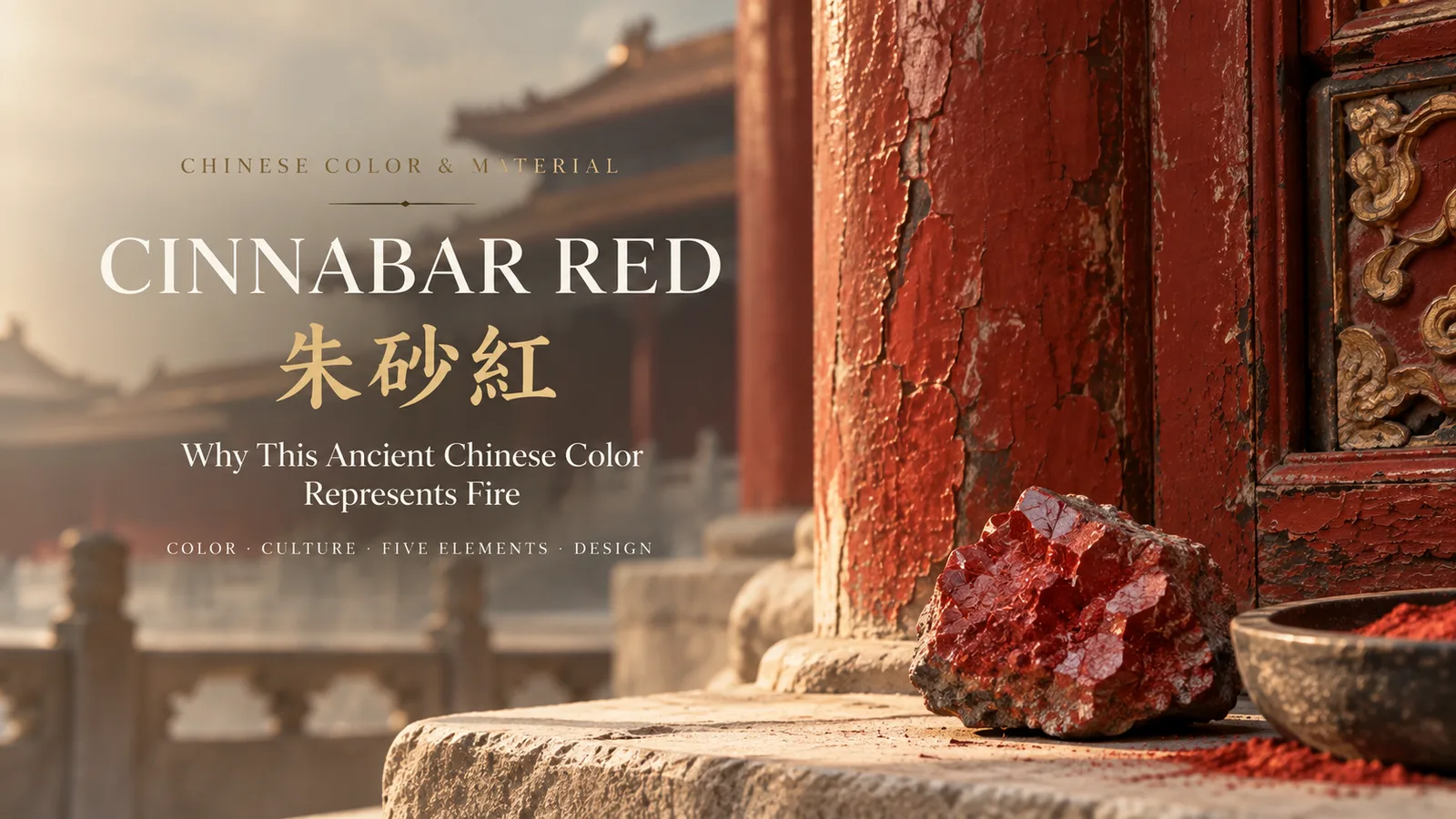
Cinnabar Red: Why This Ancient Chinese Color Represents Fire
From mineral pigment and imperial architecture to Five Element symbolism and contemporary jewelry, cinnabar red 朱砂紅 carries a Chinese story far deeper than its color alone.
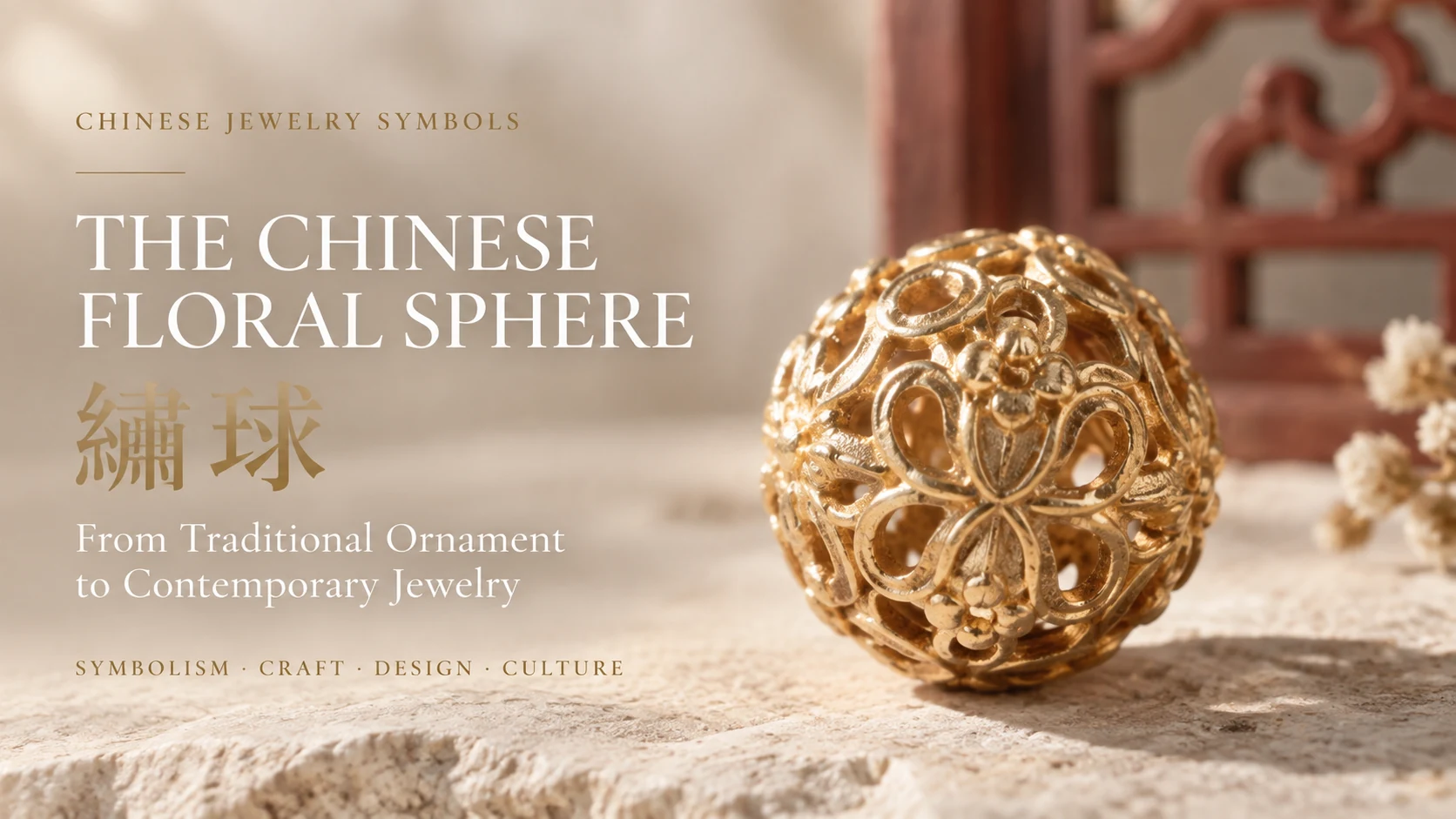
The Chinese Floral Sphere: From Xiuqiu to Contemporary Chinese Jewelry
In Chinese decorative art a flower is rarely just a flower. How the 繡球 (xiuqiu) tradition of floral ornament travels from textile and architecture into contemporary Chinese jewelry.