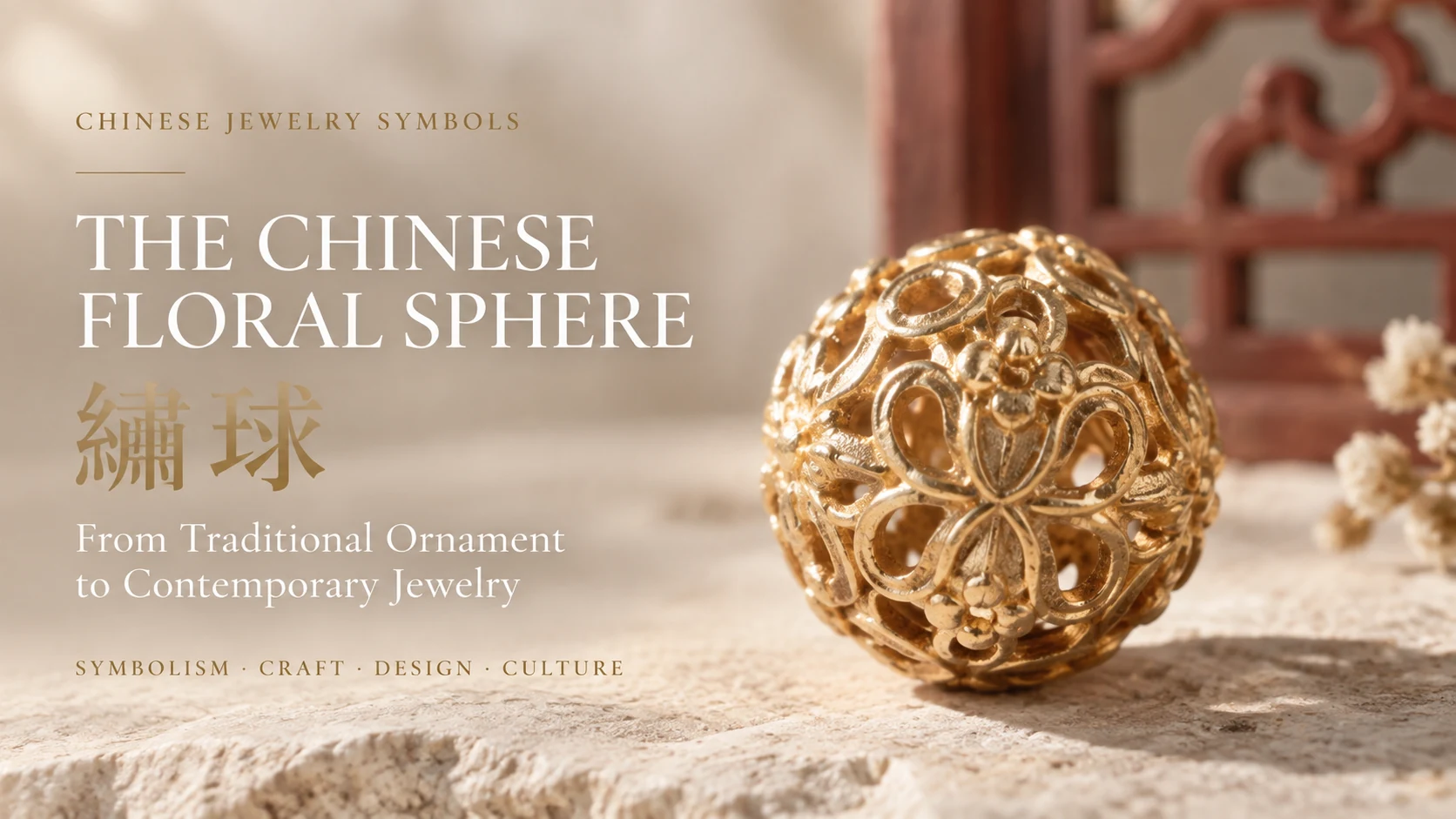
The Chinese Floral Sphere: From Xiuqiu to Contemporary Chinese Jewelry
In Chinese decorative art, a flower is rarely just a flower. The 繡球 — which we call the Chinese Floral Sphere — shows how petals become geometry, and how an old ornamental language continues inside contemporary jewelry.
A closer look at the Chinese Floral Sphere — how a floral pattern travels around a sphere, and how a decorative idea moves from textile and architecture into metal.
Look closely at Chinese decorative art and a flower is rarely just a flower. Across architecture, ceramics, embroidery, metalwork and jewelry, flowers have been reorganized into repeating patterns, circular compositions and highly structured ornamental forms. Petals become geometry. Stems become rhythm. Natural forms become decorative systems.
One particularly intriguing expression of this tradition is the 繡球, xiuqiu. We call its contemporary jewelry interpretation the Chinese Floral Sphere.
At YukDao, this small spherical ornament appears throughout our Five Elements bracelet designs. It is easy to see it simply as a beautiful gold-colored bead. But its design belongs to a much larger Chinese visual language.
Before Jewelry, Look at the Forbidden City
One of the best places to understand Chinese ornament is not a jewelry collection at all. It is architecture.
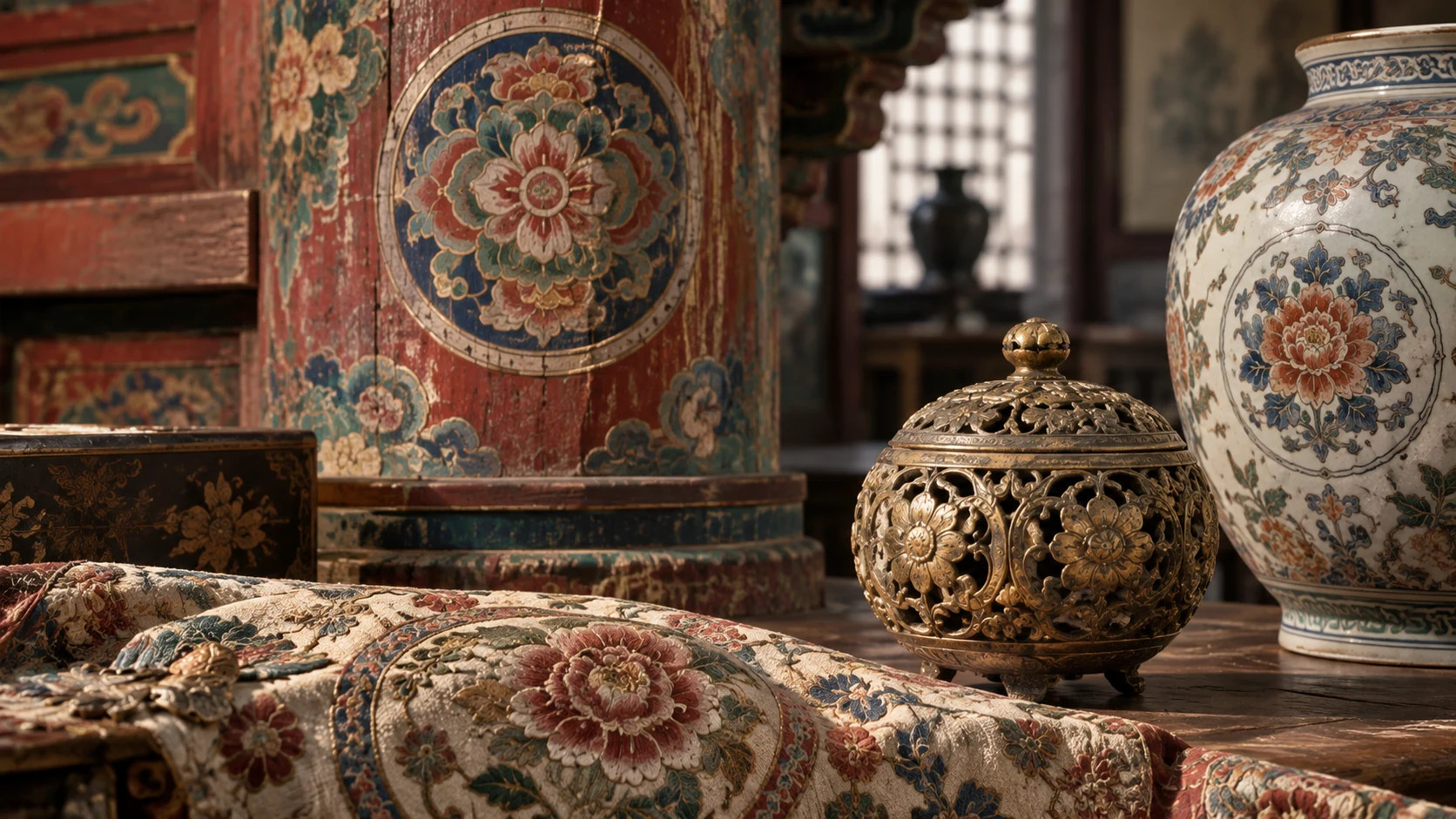
Walk through Beijing’s Forbidden City and the first impression comes from scale: vermilion walls, yellow glazed roofs, stone terraces and monumental wooden halls. Move closer, however, and another world appears.
Flowers emerge across painted beams, carved stone, ceramic surfaces, textiles and decorative objects. They are rarely treated as isolated botanical illustrations. Instead, craftsmen transform them into patterns that repeat, rotate, interlock and adapt themselves to the object carrying them.
A flower painted beneath an architectural eave behaves differently from one embroidered onto silk. A floral design wrapped around a ceramic vessel must respond to curvature. A motif translated into metal has to become structure. The material changes. The underlying decorative language continues.
This ability to transform nature into ornament is an important part of what makes traditional Chinese decorative culture so visually distinctive.
What Is a Xiuqiu 繡球?
The Chinese term 繡球 literally combines two ideas:
繡 means embroidery. 球 means sphere or ball. The term can refer to embroidered balls and other spherical decorative forms in Chinese culture.
Historically, xiuqiu are particularly associated with textile construction, where richly decorated fabric sections could be assembled into elaborate three-dimensional objects.
But for contemporary jewelry, translating 繡球 simply as “embroidered ball” can be misleading. The YukDao ornament is not made from textile. It takes the visual idea of a flower-covered or flower-structured sphere and translates that idea into metal.
That is why we use the English editorial name: Chinese Floral Sphere.
It describes what the eye actually encounters: a three-dimensional spherical ornament whose surface is organized through floral forms. Rather than reproducing a historical xiuqiu literally, the design carries the concept into another material and another scale.
When a Flower Stops Looking Like a Flower
Modern floral jewelry often makes its subject immediately recognizable. A rose looks like a rose. A daisy looks like a daisy. A leaf looks like a leaf.
Traditional Chinese ornament frequently works differently. Natural forms can be stylized until they become part of a larger geometry. A petal can repeat around a center. Several flowers can interlock. Curved lines can continue from one motif into another. The pattern can expand until it seems to have no obvious beginning or end. The result sits somewhere between nature and geometry.
This becomes especially interesting on a sphere. A flat floral motif has a front, an edge and a boundary. A spherical ornament does not. The pattern has to travel around the object. Turn the sphere and another part of the composition appears. There is no single privileged viewpoint. The decoration becomes continuous.
That quality is central to the Chinese Floral Sphere.
Embroidery Translated Into Metal
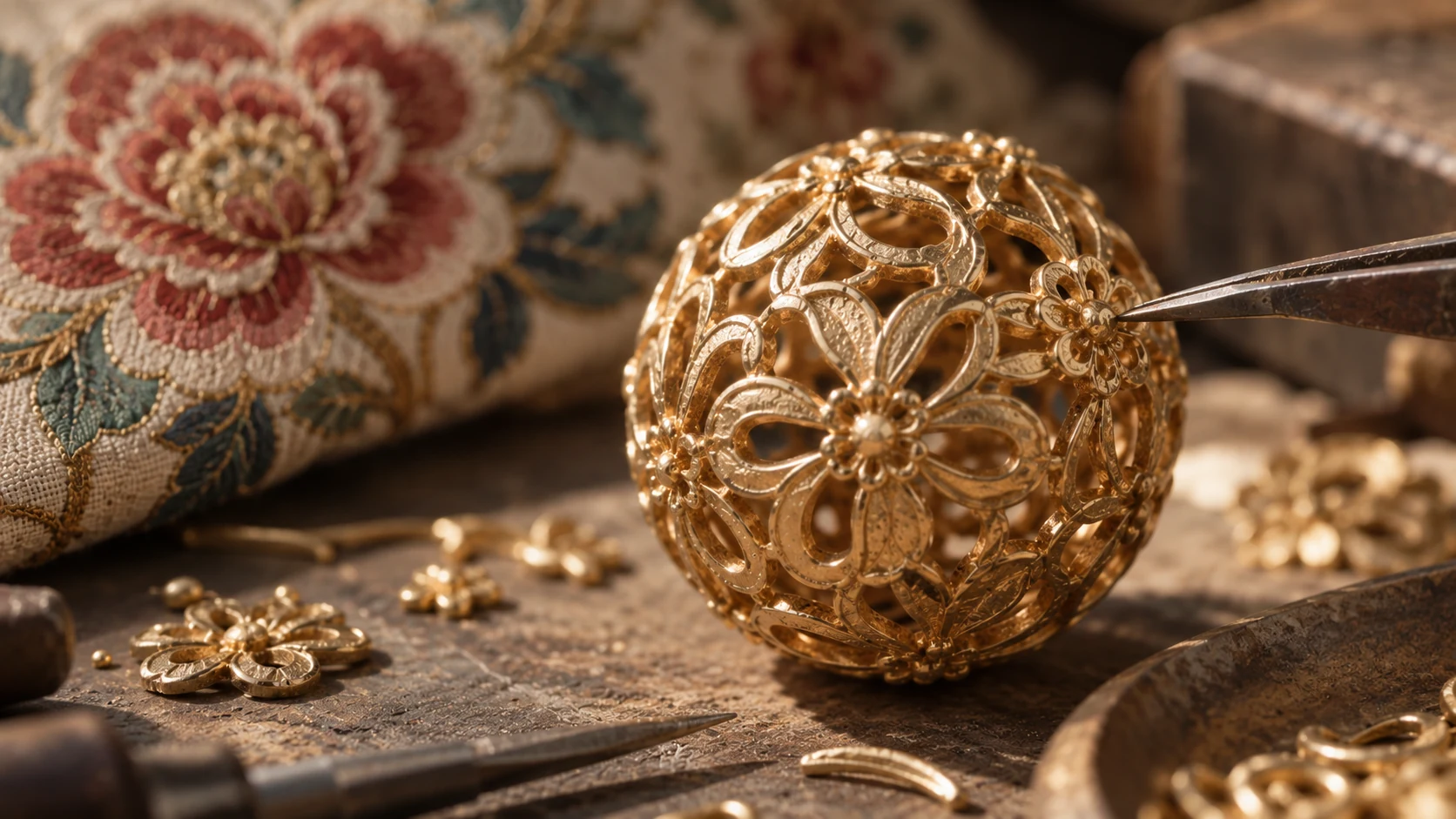
There is another reason the name xiuqiu remains useful. Look closely at fine openwork metal and it can begin to resemble thread. Thin metal lines curve around openings. Small junctions connect one section to another. Petal-like structures overlap. Empty spaces become as important as the metal surrounding them. The effect can recall embroidery even though no thread is present.
This is where the object becomes more than a floral bead. It demonstrates a recurring principle in Chinese material culture: a visual idea can migrate from one craft to another. A flower can become embroidery. Embroidery can become pattern. Pattern can become three-dimensional structure. And structure can be translated into metal. The material changes, but the visual memory remains.
What Does the Floral Sphere Symbolize?
Chinese floral decoration does not have one universal meaning. Different flowers acquired different associations in different periods and contexts. Lotus, peony, plum blossom, chrysanthemum and other botanical motifs each developed their own cultural histories.
The broader floral sphere should therefore not be reduced to a simplistic formula such as “this bead means luck.” Its significance is more interesting than that.
The sphere brings together ideas that recur throughout Chinese decorative culture: flourishing, continuity, completeness, abundance and harmonious arrangement. Its circular three-dimensional form reinforces the sense of completeness. Its repeating floral construction suggests growth continuing around the object rather than terminating at a single point.
This is why floral ornament could work so effectively across domestic objects, textiles, architecture and personal adornment. Beauty and meaning were not necessarily separate layers. The pattern itself could carry cultural associations.
From Historical Ornament to Contemporary Jewelry
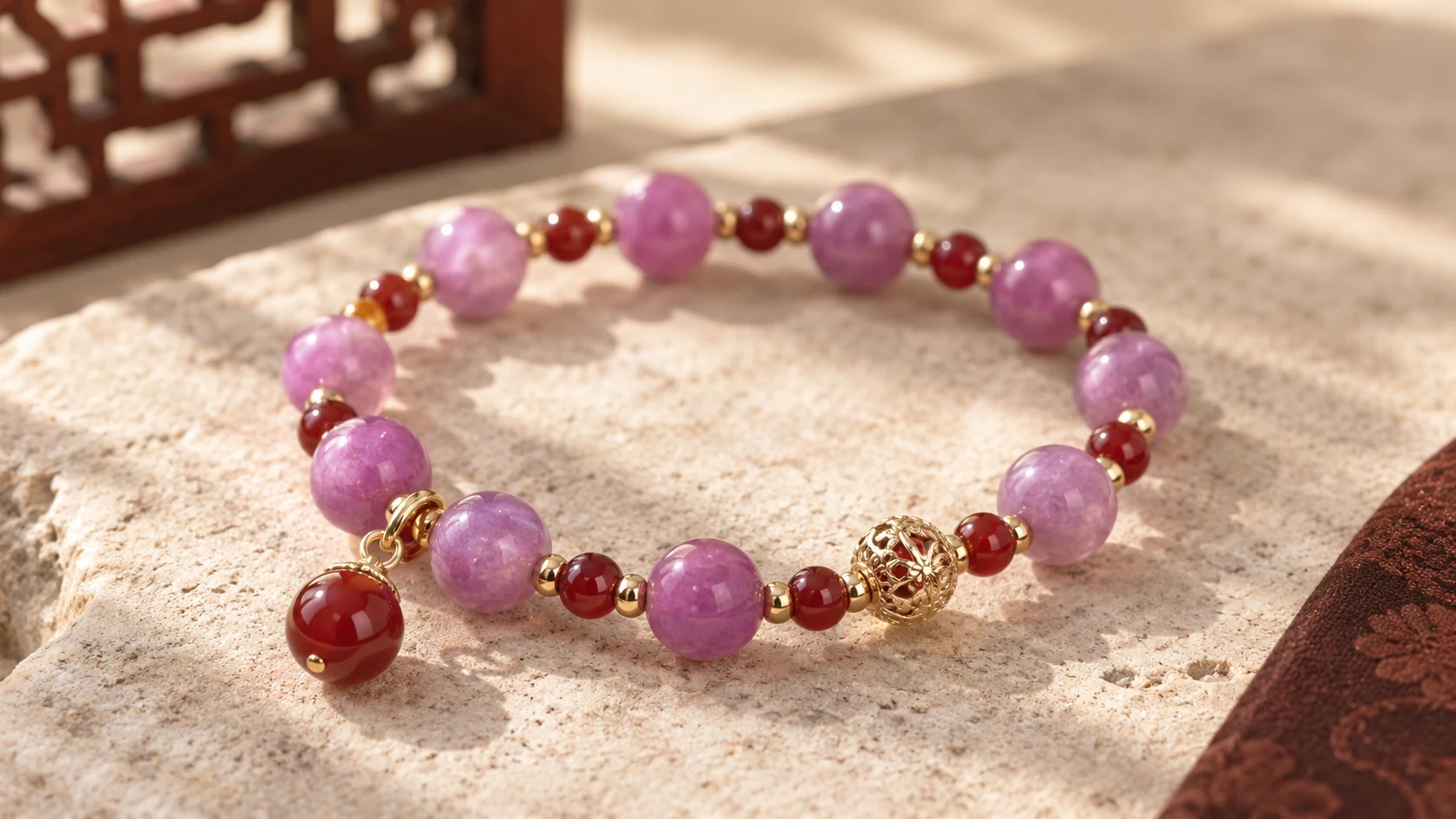
There is an important distinction here. The Chinese Floral Sphere used in YukDao jewelry is not presented as an antique reproduction. Nor are we claiming that this exact metal bead existed historically in the same form. That would flatten the difference between historical craft and contemporary design.
Instead, our approach is to take a recognizable principle from Chinese decorative culture and allow it to live within a contemporary object. The scale becomes smaller. The material changes. The surrounding design becomes cleaner. The ornament sits beside polished stones rather than embroidered silk. But the idea of a floral pattern wrapping around a sphere remains.
That distinction matters to how we think about Chinese design. Culture does not have to be frozen in the visual language of the past in order to remain culturally recognizable.
Why It Appears in YukDao Five Elements Bracelets
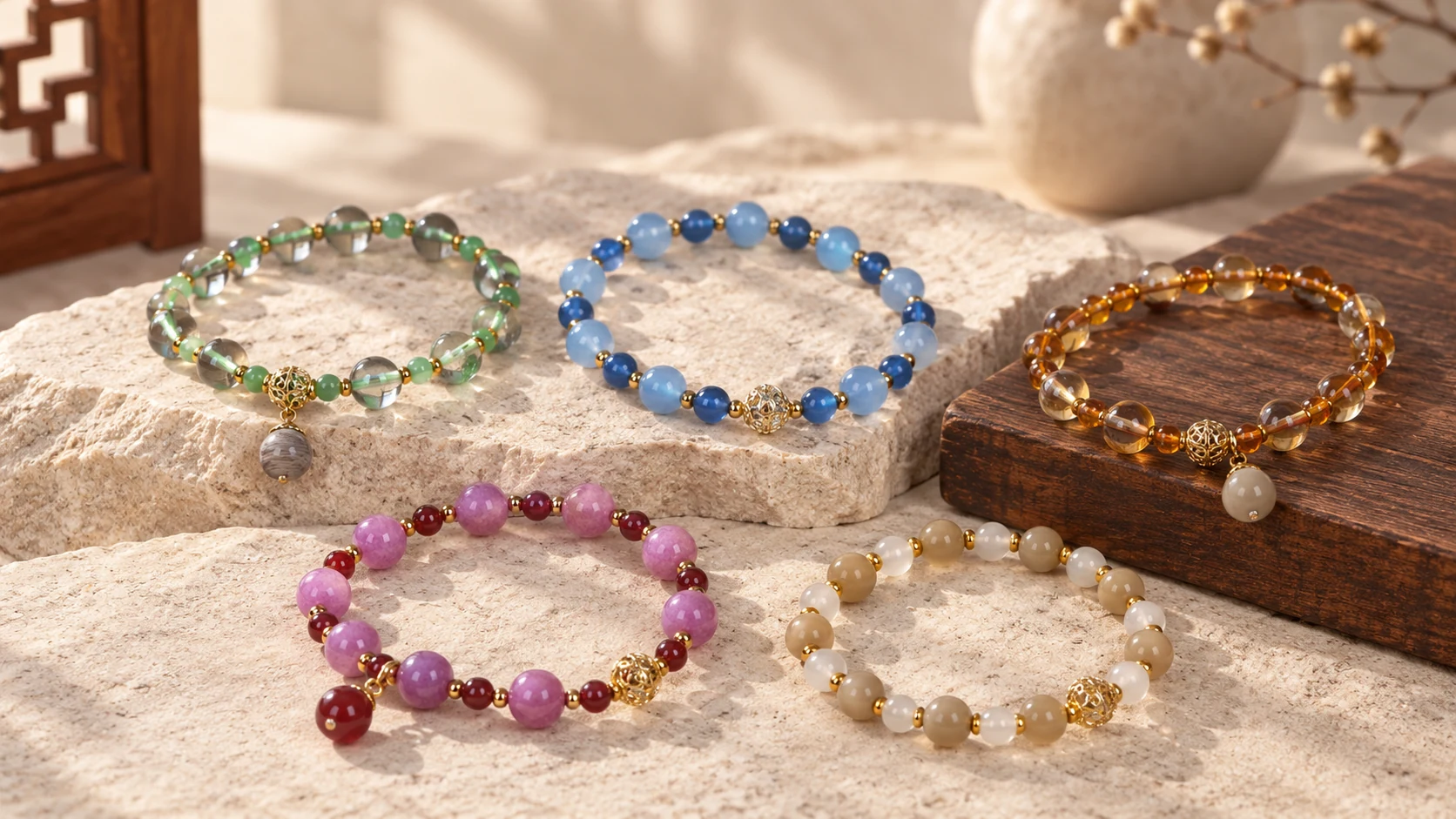
This brings us to the bracelets themselves. YukDao’s Five Elements bracelets begin with a different Chinese system: Wu Xing 五行, the Five Elements of Wood, Fire, Earth, Metal and Water.
The stones can therefore change. The colors can change. Their proportions and combinations can change. Different designs can emphasize different elemental directions. But across the collection, another detail returns: the Chinese Floral Sphere.
That repetition is intentional. The Five Elements provide one layer of the design. Chinese ornamental culture provides another. One is personal. One is cultural. Together, they allow the bracelet to communicate more than a combination of gemstones.
The Five Elements Make It Personal
In BaZi, the Five Elements are not simply five universally “lucky” categories. A birth chart contains its own elemental structure. The useful question is therefore not: Which element is lucky? It is: Which elements support the structure of this particular chart, and which may already be excessive or challenging?
That is why two people do not necessarily need the same elemental emphasis. A bracelet can reflect that difference through its stones, colors and material composition.
Find out your supporting and challenging Five Elements →
This is the personalized side of the design. But personalization alone does not explain why the bracelets look the way they do.
The Floral Sphere Makes the Cultural Language Visible
Imagine removing the Chinese Floral Sphere and replacing it with an ordinary polished metal spacer. The bracelet would still contain gemstones. It could still use colors associated with the Five Elements. But something would disappear. The connection to a wider Chinese decorative vocabulary would become quieter.
That is why the Floral Sphere matters. It is not there simply to make the bracelet look “more Chinese.” Its purpose is subtler. It creates a visual bridge between a contemporary piece of jewelry and a much older habit within Chinese design: taking natural forms, organizing them into pattern and allowing those patterns to travel across materials and generations.
From textile to architecture. From ceramics to metalwork. From historical ornament to something worn today.
Chinese Jewelry Does Not Have to Look Ancient
Contemporary Chinese design faces an interesting question. How can an object carry Chinese culture without becoming a costume of the past?
The answer does not have to involve covering everything with dragons, phoenixes, clouds, coins or conspicuous traditional symbols. Sometimes cultural identity lives in smaller decisions. A proportion. A material. A color relationship. A recurring pattern. A particular way of transforming nature into geometry.
The Chinese Floral Sphere is one such detail. It does not ask a modern bracelet to imitate an antique. Instead, it allows an older decorative idea to continue inside a contemporary design.
More Than a Gemstone Bracelet
This is ultimately why we use the Chinese Floral Sphere across the YukDao Five Elements collection.
The stones tell one story. They connect the bracelet to the Five Elements and to the individual elemental structure for which a design is selected. The Floral Sphere tells another. It connects the object to Chinese decorative culture itself.
Together, those two layers express what we want a contemporary YukDao bracelet to be: personal without being generic, Chinese without becoming theatrical, and contemporary without forgetting where its visual language came from.
The Five Elements make each bracelet personal. The Chinese Floral Sphere gives it another layer of Chinese identity.
- Chinese Craft
- Chinese Floral Sphere
- Xiuqiu
- Chinese Ornament
- Chinese Jewelry
- Five Elements
- Wu Xing
Related Articles
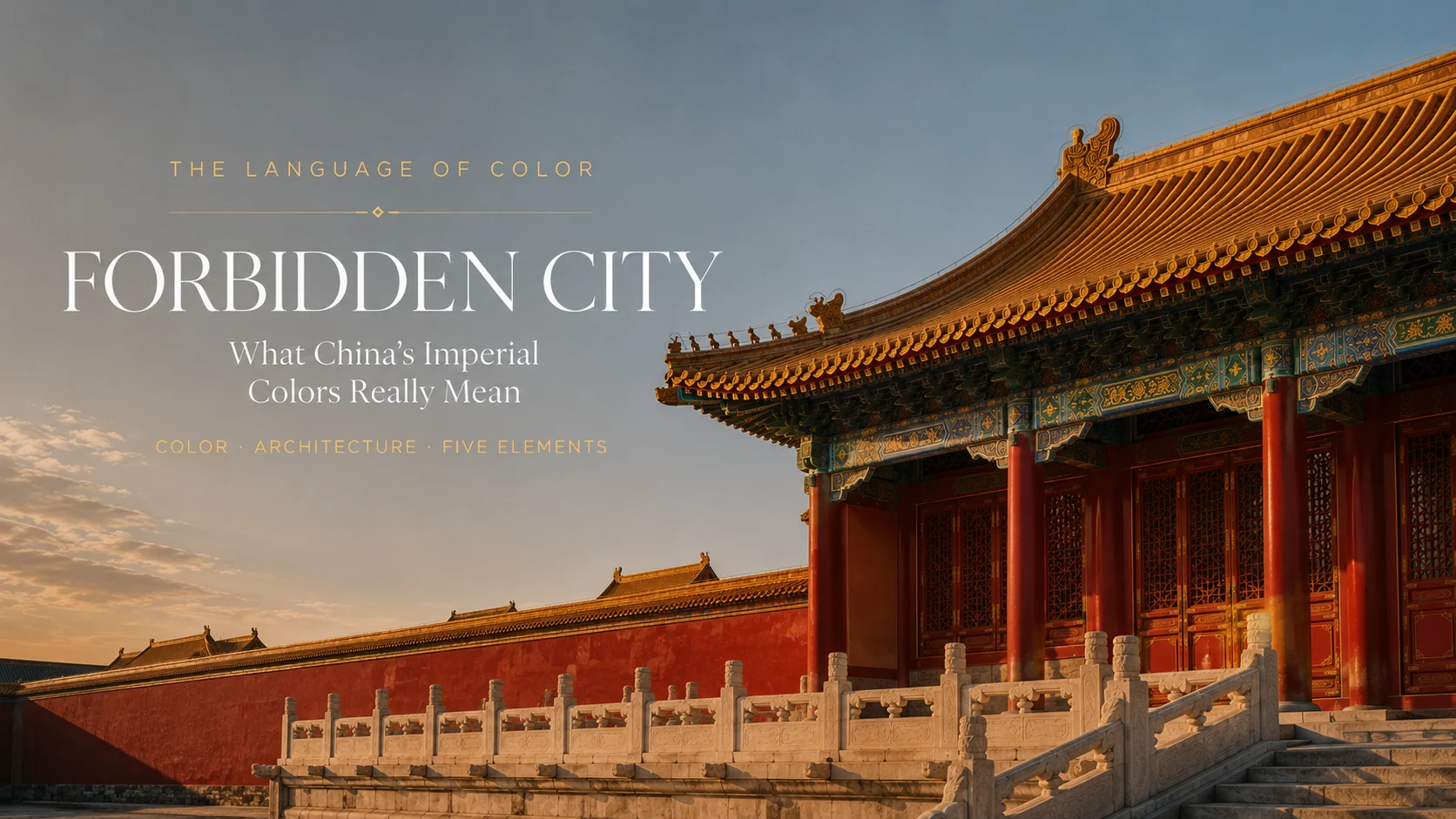
The Language of Color: What the Forbidden City’s Colors Really Mean
Vermilion walls, imperial yellow roofs, a green roof in the east and one almost black. A guide to reading the Forbidden City through color, material and the Five Elements.
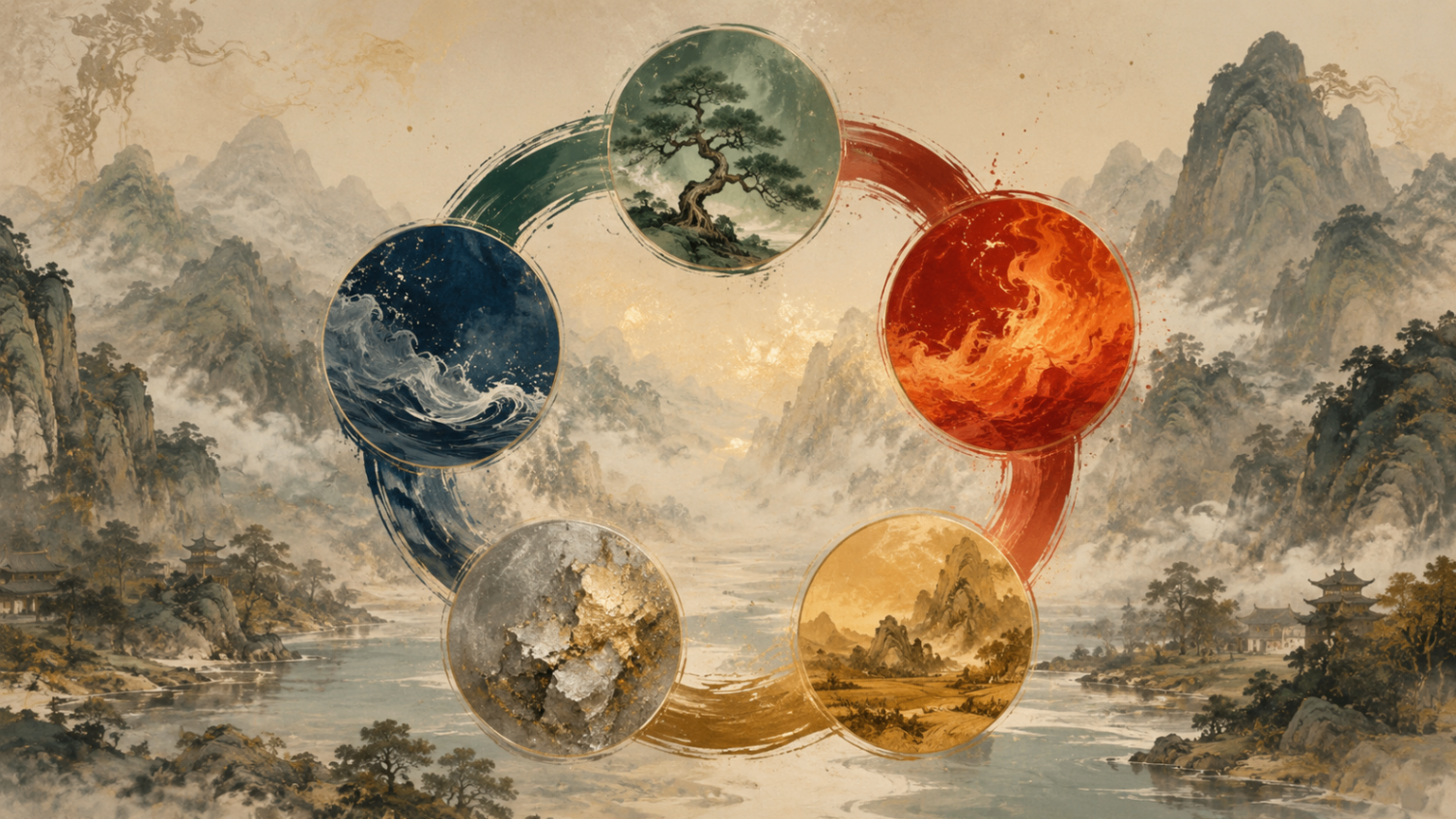
The Five Phases: What Ancient China Understood About Change That the Modern World Forgot
Wu Xing is not mysticism. It is one of history's most practical frameworks — used by emperors, physicians, and farmers for over two thousand years to understand the patterns that govern everything.
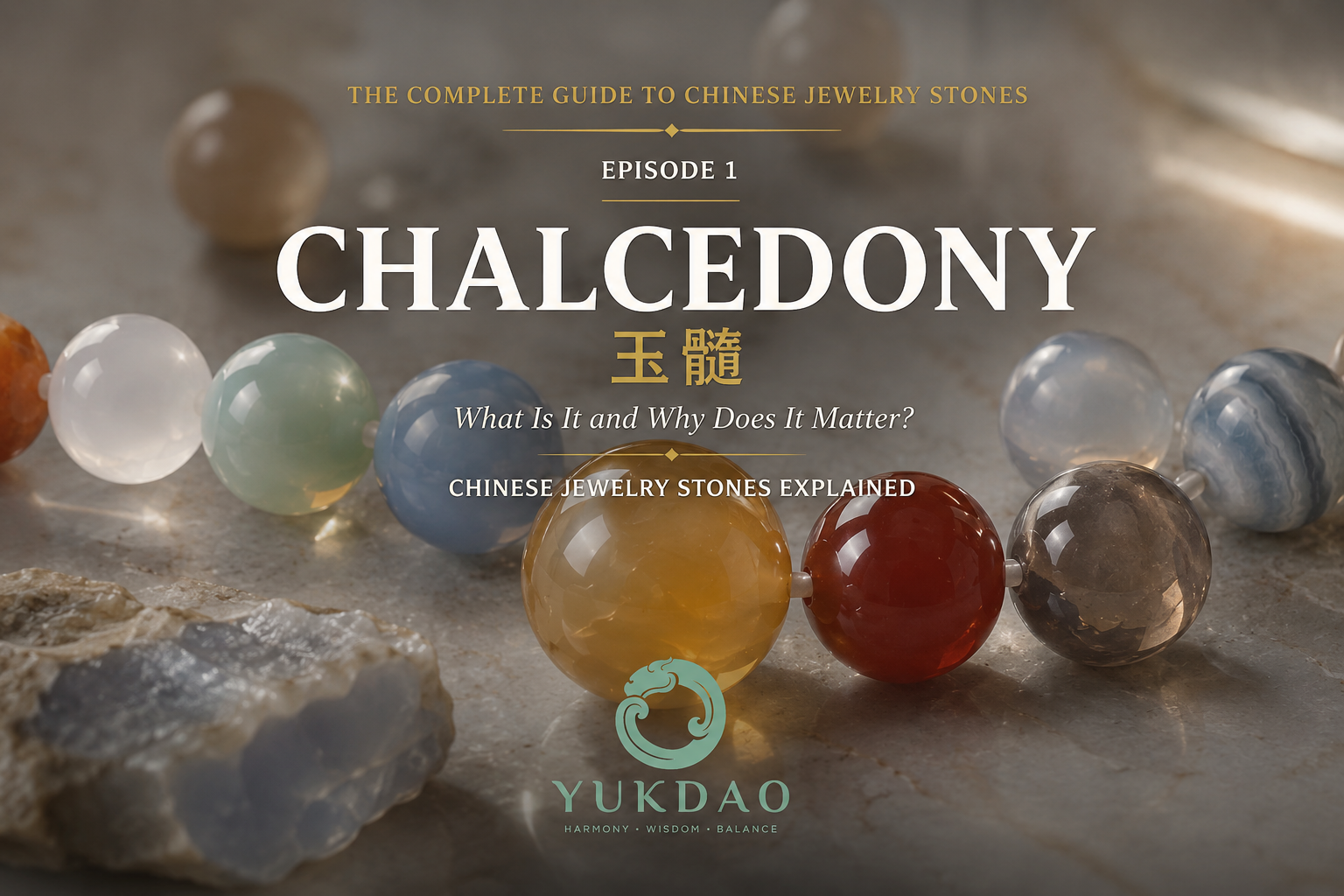
What Is Chalcedony? The Stone Behind Chinese Craftsmanship
Often mistaken for jade, chalcedony has been treasured in Chinese craftsmanship for centuries for its beauty, durability and remarkable variety of colors.