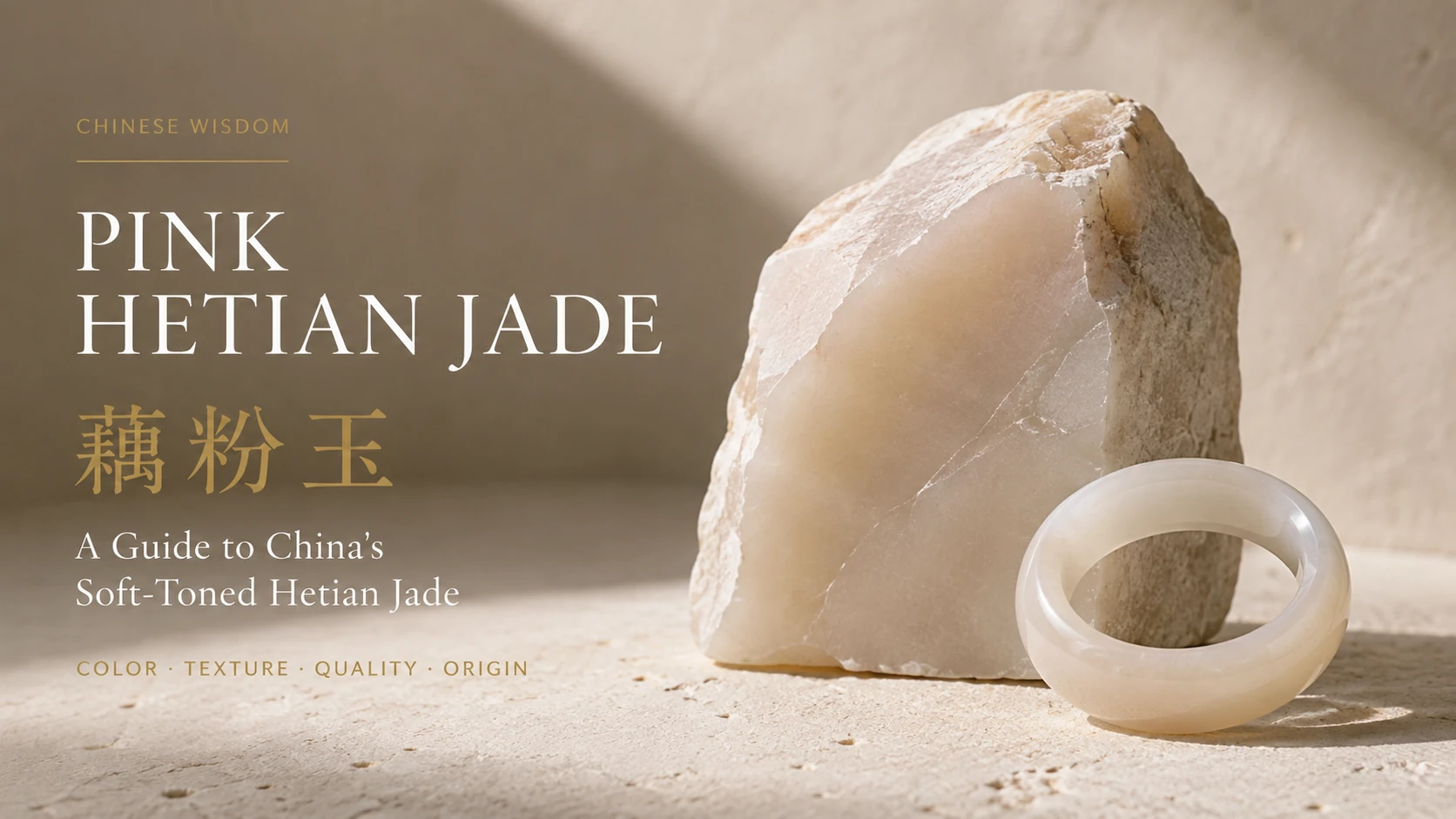
What Is Pink Hetian Jade?
Watch the material in motion to see its subtle warm tone, soft translucency and waxy nephrite luster more clearly.
Most people meet Hetian jade as a colour they already expect: mutton-fat white, a little grey, sometimes the deep spinach green of older carvings. Then they see a bangle that is none of those things — a warm, powdery pink that looks less like stone than like something poured and allowed to settle.
In Chinese the material has a name that describes exactly that impression: 藕粉玉, literally “lotus root powder jade.” It is not a marketing invention, not a dyed stone, and not a separate mineral. It is nephrite — genuine Hetian jade — from the Qinghai deposits, in the soft pink-to-beige range that Chinese buyers began naming after a food they all knew.
This guide explains where 藕粉玉 comes from, what its colours actually mean, how to read its internal structure, how quality is judged in practice, and why it sits where it does in the Five Element framework.
What 藕粉玉 Means
藕粉 (ǒu fěn) is lotus root starch: a pale, faintly pink powder that turns translucent and slightly glossy when mixed with hot water. It is a texture before it is a colour — smooth, matte-warm, gently cloudy, never sharp.
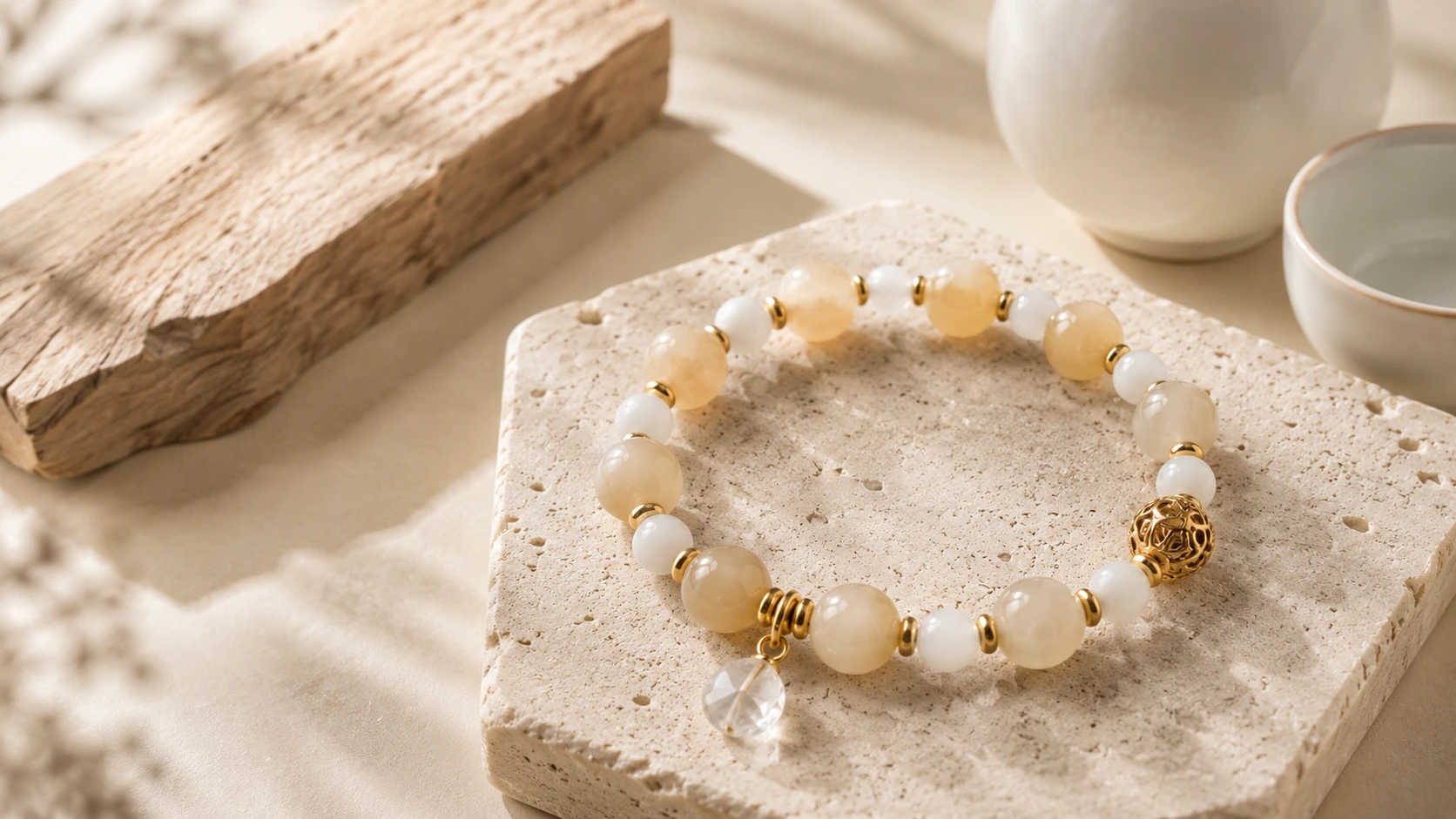
When Chinese jade merchants applied the word to stone, they were describing that whole impression rather than a precise hue. 藕粉玉 is jade whose colour sits between ivory, beige and a soft blush pink, and whose body reads as softly diffuse rather than glassy. Hold it to light and the light does not pass cleanly through; it spreads.
The name is descriptive, not classificatory. There is no laboratory boundary separating 藕粉玉 from other Qinghai nephrite — the term marks a colour and character that the trade recognises on sight.
It is still Hetian jade
“Hetian jade” (和田玉) in current Chinese usage is a material category, not only a place: it denotes tremolite-actinolite nephrite. Material from Qinghai, Russia and Korea is classified under the same heading, with the source stated separately. 藕粉玉 is nephrite by composition and Qinghai by origin.
Where It Comes From: Qinghai 青海料
The Qinghai deposits lie in the Kunlun range in western Qinghai province, along the same great mineral belt that produced the historic Hetian workings in Xinjiang, several hundred kilometres to the west. Commercial extraction there began in earnest only in the 1990s, which is why Qinghai material has no long imperial history behind it — and why its price has always been more approachable than classic Xinjiang white jade.
Geologically, the difference matters. Qinghai nephrite generally formed with a slightly coarser and more open fibre structure than the finest Xinjiang seed material. The practical result is a stone that is more translucent, more visibly variegated, and more likely to show internal lines and cloudy zones.
For a century of collectors trained to want dense, opaque, evenly white jade, those traits were flaws. For contemporary designers they are the appeal: Qinghai jade glows, and it carries colour — celadon, smoky grey, translucent “water jade,” and the warm blush range known as 藕粉.
The Colour Range
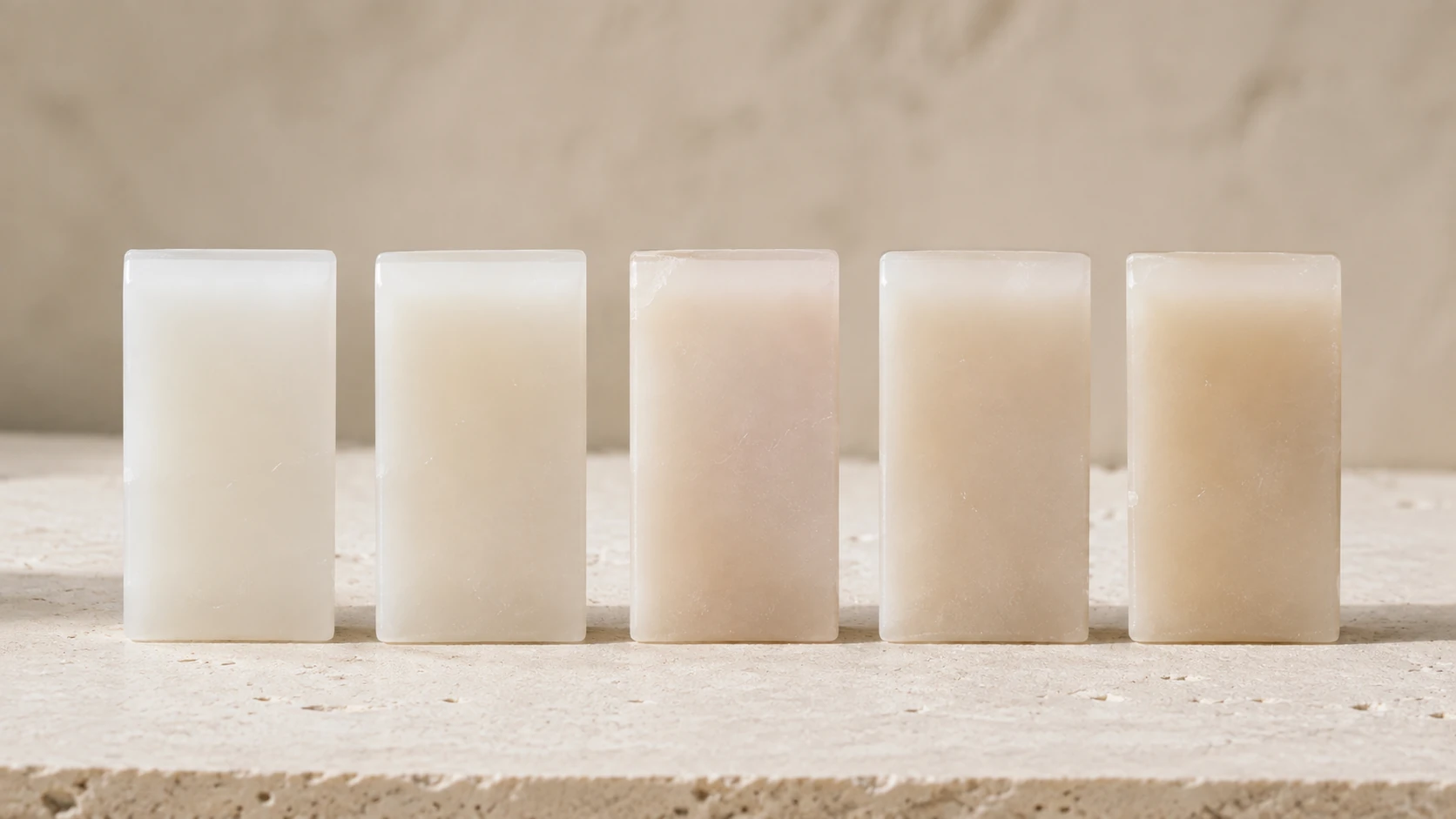
藕粉玉 is not one colour but a narrow family. Laid side by side, rough blocks move through a predictable sequence.
Warm ivory
The palest end: creamy white with a warm undertone rather than the cool blue- white of top Xinjiang material. In bright daylight it can read as simply white; beside true white jade the warmth becomes obvious.
Beige and oatmeal
A soft, slightly grey-tan middle. This is the most common range and the most forgiving in wear, since skin oils and daily handling deepen it only gradually.
Blush pink
The most sought range and the reason the name exists: a gentle, dusty pink caused by trace iron and manganese in the nephrite. It is always muted. A saturated, candy-bright pink in a stone sold as 藕粉玉 is a reason to ask questions rather than to pay more.
Mixed and drifting tones
Many pieces carry two or three of these tones drifting into one another, often with faint grey-green passages. Well-cut jewellery uses that drift deliberately: a bangle where the blush concentrates on one shoulder is a single stone telling you how it grew.
Water Lines and Internal Structure
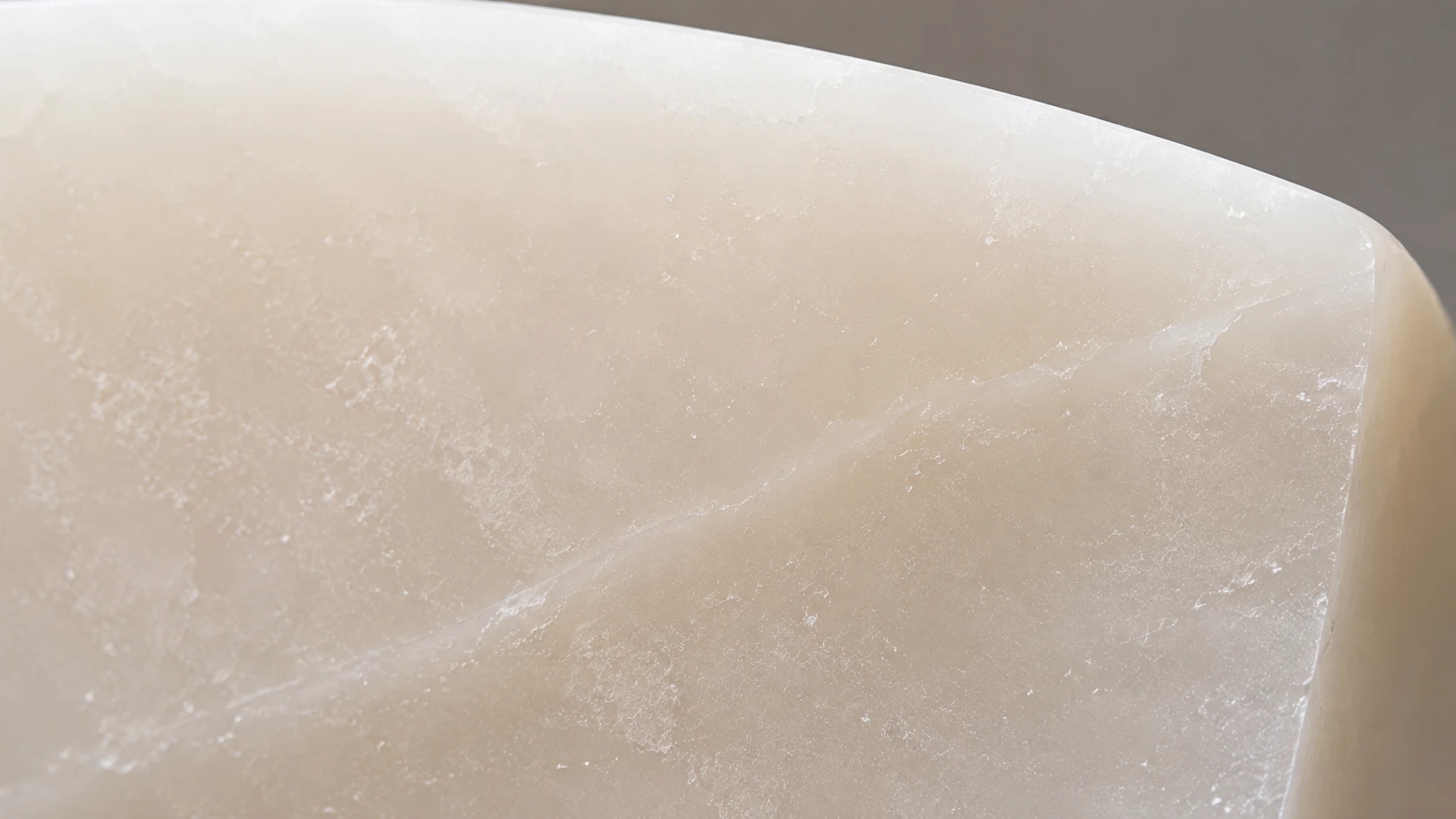
The single most discussed feature of Qinghai jade is 水线 — the “water line.” These are narrow, straighter-than-random bands of more translucent, more tightly crystallised material running through the body of the stone, usually visible only when light passes through at the right angle.
A water line is not a crack. A crack interrupts the surface and catches a fingernail; a water line is entirely internal, continuous, and does not weaken the piece. It is a record of how mineral-bearing fluid moved through the rock while the nephrite was forming.
How the market reads them
Traditional Chinese grading treats prominent water lines as a defect, and prices heavily lined material lower. That convention is worth knowing, but it is a convention. A fine, single, quiet line in an otherwise even bangle is evidence of natural Qinghai origin — something no treatment reproduces convincingly.
Other structures you will see
Alongside water lines, expect faint cloudy patches (棉, “cotton”), occasional darker mineral specks, and soft tonal drifts. All are normal in nephrite. What should concern you is different: surface-reaching fractures, colour that pools in cracks rather than in the body, and an unnaturally uniform, plastic-looking evenness.
How Quality Is Judged
Setting aside personal taste, experienced buyers assess 藕粉玉 on five things, roughly in this order.
1. Fineness of grain (细腻度)
The most important criterion in all nephrite. A fine-grained stone feels distinctly slippery-smooth, almost soapy, and shows no granularity under a loupe at the polished surface. Coarse material feels dry and looks slightly sugary.
2. Warmth of lustre (油润度)
Good nephrite has a greasy, oily sheen rather than a glassy shine. Tilt the piece: the highlight should be soft-edged and seem to sit just below the surface. A hard, mirror-bright glare usually means over-polishing or a different material altogether.
3. Evenness and character of colour
Within the blush range, buyers pay for colour that is consistent across the piece or that drifts in a way that clearly suits the cut. Muddy grey patches and abrupt boundaries reduce value.
4. Cleanliness
Fewer and quieter internal features — less cotton, fewer and finer water lines, no dark inclusions in prominent positions. Absolute cleanliness is rare and priced accordingly.
5. Workmanship
Even wall thickness in a bangle, perfectly matched bead diameters, symmetrical and centred drill holes, edges that are softened rather than sharp. Poor cutting wastes good material and shows immediately in wear.
What to ask before buying
Ask three questions and you will avoid most problems: Is it natural nephrite? Where is the material from? Has the colour been enhanced in any way? For pieces at meaningful prices, ask for testing documentation. A seller who answers plainly is the seller worth returning to.
藕粉玉 and the Five Elements
In the Five Element framework (五行), materials are placed by substance, colour and quality of feeling rather than by any single rule. Jade is a stone drawn from the ground, which places it firmly in Earth (土): stable, nourishing, associated with patience, reliability and the ability to hold things together.
The pale, cool, ivory-to-white end of 藕粉玉 also carries Metal (金) — clarity, precision, refinement, the quality of clean edges and clear decisions. In classical five-element thinking Earth generates Metal (土生金), so a stone that expresses both is internally coherent rather than conflicted.
That combination is why people often describe wearing soft-toned jade as steadying rather than energising. Earth grounds; Metal clarifies. The stone is associated with composure and considered judgement, not with drive.
None of this predicts events. It is a traditional vocabulary for describing character and correspondence — a way of saying what a material is like, in terms Chinese culture has used for two thousand years.
Wearing and Caring For 藕粉玉
Nephrite is one of the toughest natural materials known — its interlocking fibrous structure resists breaking far better than its Mohs hardness of about 6 to 6.5 suggests. It is not, however, scratch-proof, and a hard fall onto tile will still crack a thin bangle.
Everyday wear
Jade improves with contact. Skin oils gradually deepen the lustre of good nephrite, which is why old pieces look richer than new ones. Wear it. Remove it for the gym, for heavy cleaning and for swimming pools.
Cleaning
Warm water, a drop of mild soap, a soft brush at the drill holes, then dry with a soft cloth. Avoid ultrasonic cleaners, steam, bleach and solvent-based perfumes applied directly to the stone.
Storage
Store separately in a soft pouch so harder gemstones cannot scratch the surface. For strung bracelets, check the cord or elastic every few months and restring before it fails rather than after.
Why YukDao Works With It
We use 藕粉玉 because it is honest material with a clear identity. It does not imitate imperial white jade, it is not dyed to impersonate something rarer, and it does not need a story to justify itself. Its warmth is its own.
Our selection prioritises fineness of grain and warmth of lustre over colour drama, accepts a quiet water line as evidence of natural origin, and states the material and its Qinghai source plainly. A stone described accurately is worth more than a stone described impressively.
Which elements does your own chart lean on?
Earth and Metal steady one chart and crowd another. A Complete BaZi Analysis reads your Four Pillars and shows which elements your birth chart actually relies on.
“The finest stones are not the loudest. They are the ones you keep returning to.”
- Chinese Craft
- Hetian Jade
- Qinghai Jade
- Oufen Jade
- Pink Jade
- Nephrite
- Chinese Jewelry Materials
- Five Elements
Related Articles
What Is Chalcedony? The Stone Behind Chinese Craftsmanship
Often mistaken for jade, chalcedony has been treasured in Chinese craftsmanship for centuries for its beauty, durability and remarkable variety of colors.
What Is Pixiu (貔貅)? The Guardian Beast of Chinese Craft
Winged, fierce and famously without an exit, Pixiu has guarded Chinese homes, tombs and treasuries for two thousand years — and it remains one of the most carved figures in Chinese craft.
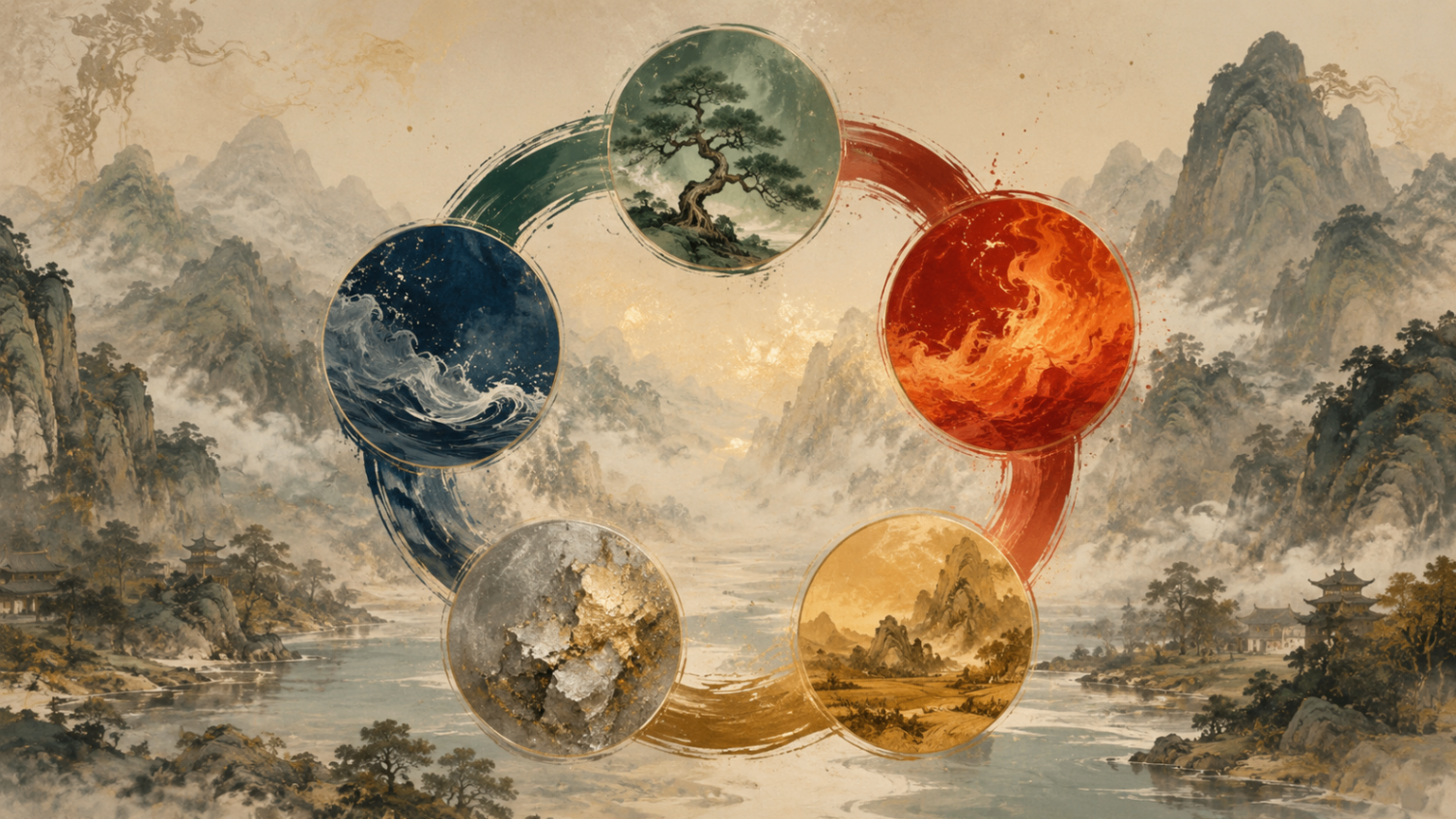
The Five Phases: What Ancient China Understood About Change That the Modern World Forgot
Wu Xing is not mysticism. It is one of history's most practical frameworks — used by emperors, physicians, and farmers for over two thousand years to understand the patterns that govern everything.