
The Dazu Rock Carvings: A Thousand Years Carved in Stone
A closer look at the monumental figures, intricate narratives and surviving colors carved into the cliffs of Dazu.
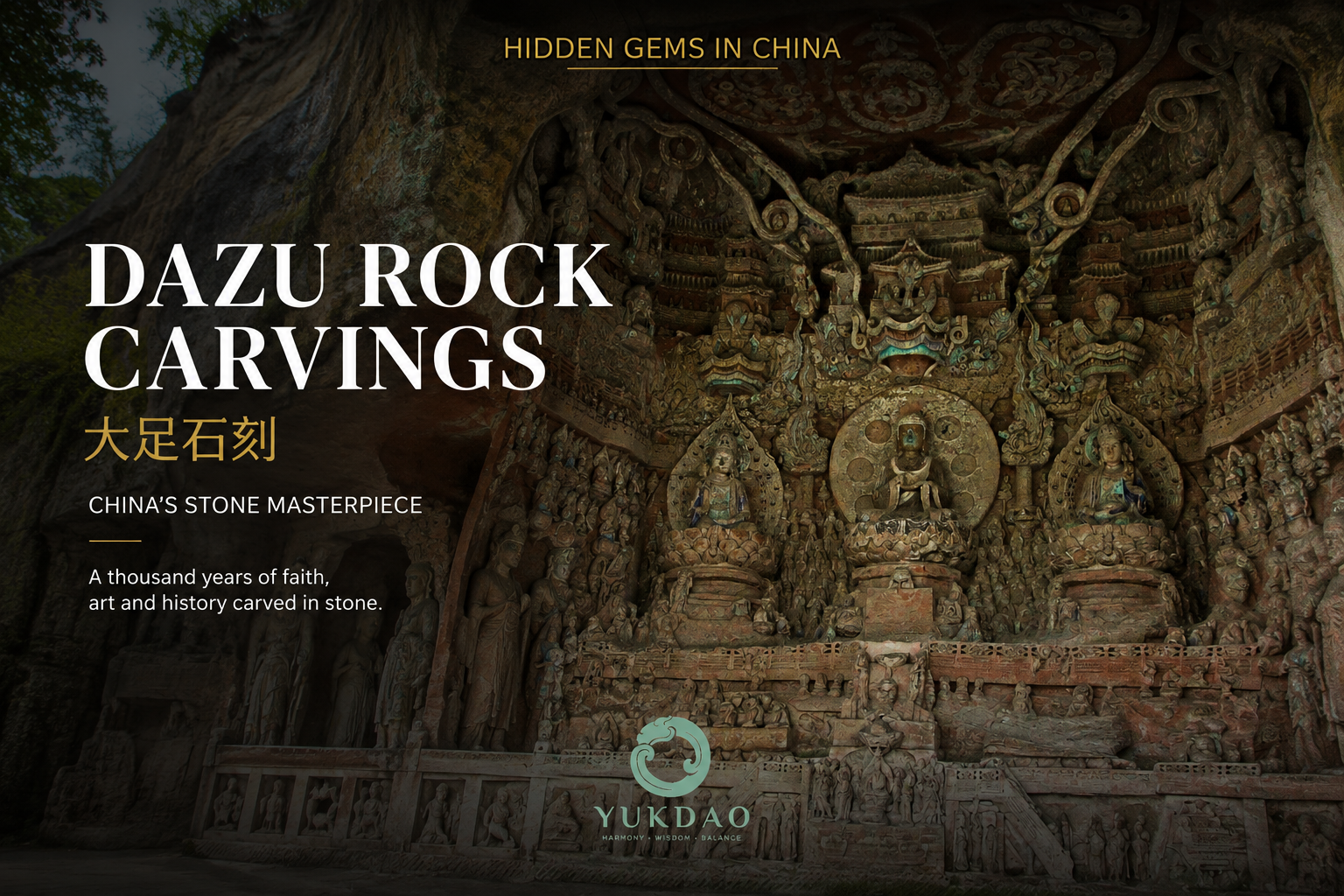
On the steep hillsides outside central Chongqing, thousands of figures emerge from the rock.
Some sit in quiet meditation.
Others fill entire cliff faces with movement, color and story.
There are Buddhas and bodhisattvas, Taoist deities, Confucian figures, guardians, musicians, animals, farmers and scenes from ordinary family life.
Together, they form the Dazu Rock Carvings.
Spread across dozens of locations in Dazu District, the carvings contain more than 50,000 statues and an immense collection of inscriptions. Their most important groups were created between the ninth and thirteenth centuries, when Chinese rock-cut religious art reached one of its final great periods of development.
Dazu is often called a masterpiece of stone carving.
Its importance, however, lies in more than scale or technical achievement.
The carvings show how religious teachings were translated into scenes that ordinary people could recognize and understand.
A landscape filled with carvings
The Dazu Rock Carvings are not one cave or one monument.
They form a network of carved sites distributed across the hills of Dazu in Chongqing.
Five groups are especially important:
Beishan.
Baodingshan.
Nanshan.
Shimenshan.
Shizhuanshan.
Each developed its own artistic character and religious emphasis.
Some are dominated by Buddhist imagery. Others combine Buddhist and Taoist subjects. At Shizhuanshan, Buddhist, Taoist and Confucian figures appear together in an unusual three-part arrangement.
This diversity makes Dazu different from sites organized around a single religious tradition.
The hills became places where several systems of belief could be presented side by side.
From the late Tang to the Song dynasty
Stone carving in Dazu began during the Tang dynasty and continued through later periods.
The most celebrated works were produced from the late ninth century to the middle of the thirteenth century.
This period included the final decades of the Tang dynasty, the Five Dynasties era and much of the Song dynasty.
Earlier Chinese cave sites had often developed along major routes connecting northern China with Central Asia.
Dazu emerged farther south, within the cultural landscape of the Sichuan Basin.
Its artists inherited established traditions of Buddhist grotto art, but they did not simply repeat them.
They developed more local styles, more detailed narratives and a closer relationship between sacred imagery and everyday experience.
The result marked a new stage in the history of Chinese cave-temple art.
Beishan: a cliff of devotion
Beishan contains more than 10,000 carvings distributed along an extended cliff face.
Many were created between the late ninth and middle of the twelfth centuries.
The carvings include Buddhist and Taoist subjects, patron inscriptions and images associated with changing religious practices.
Compared with the monumental scale of some earlier grotto complexes, many Beishan figures feel more intimate.
Faces, garments, jewelry and gestures are rendered with remarkable attention.
Bodhisattvas appear elegant and composed.
Decorative details flow around their bodies.
Small changes in posture and expression give individual figures a distinct presence.
The inscriptions are equally important.
They record donors, dates, religious intentions and historical figures, allowing the site to be studied not only as art but also as a document of its society.
Baodingshan: a complete world in stone
Baodingshan is the most famous and visually ambitious group at Dazu.
Its principal carvings were created from the late twelfth to the middle of the thirteenth century under the direction of the Buddhist master Zhao Zhifeng.
Rather than forming a collection of unrelated niches, the carvings were planned as a connected religious program.
Large scenes unfold along a curved gorge near the Holy Longevity Monastery.
One composition leads into another.
Teachings about devotion, consequence, compassion and moral responsibility are expressed through sequences of images.
The site was designed not simply to impress visitors, but to guide them.
Stone became a form of instruction.
Religion made understandable
One of Dazu's defining features is the way abstract teachings are connected with familiar human experiences.
Religious art can sometimes feel distant from ordinary life.
At Dazu, daily activities appear directly within sacred narratives.
Parents care for children.
Farmers work with animals.
Musicians perform.
People face illness, temptation, responsibility and old age.
These scenes helped explain religious ideas through situations that viewers already understood.
The carvings were not intended only for monks or scholars.
Their stories could reach merchants, farmers, families and pilgrims.
This ability to make complex teachings accessible is one reason Dazu remains so powerful.
The oxherding sequence
Among the best-known scenes at Baodingshan is a sequence showing a herder and an ox.
At first, the animal appears difficult to control.
The herder struggles to guide it.
Across successive scenes, their relationship gradually changes.
Conflict gives way to discipline.
Discipline becomes calm.
The sequence works as a Buddhist metaphor for training the mind.
The restless ox represents uncontrolled thoughts and desires. The herder's work represents the effort required to develop awareness and self-control.
Yet the imagery remains grounded in rural life.
A philosophical idea is expressed through an activity that people in an agricultural society would immediately recognize.
The kindness of parents
Another major composition focuses on parental care.
Rather than presenting devotion as an abstract moral rule, the carvings illustrate the physical and emotional work of raising a child.
Parents protect, feed and support their children.
The sequence asks viewers to recognize the sacrifices made on their behalf and to respond with gratitude and responsibility.
Its inclusion within a Buddhist site shows how religious teaching in China interacted with strong social values concerning family and filial duty.
This is one of the clearest examples of Dazu's ability to connect spiritual practice with domestic life.
Sacred teaching entered the household.
The Thousand-Armed Guanyin
One of Baodingshan's most celebrated images is the Thousand-Armed Guanyin.
Guanyin is the bodhisattva associated with compassion.
In this monumental composition, hundreds of arms extend outward in a dense, rhythmic arrangement.
Many hands contain eyes or hold symbolic objects.
The multitude of arms represents the ability to perceive suffering and respond wherever help is needed.
The work is overwhelming at first glance.
Its scale suggests limitless activity, yet the central figure remains calm.
That contrast gives the sculpture much of its power.
Compassion is represented not as a passive feeling, but as the ability to act in many directions at once.
Buddhism, Taoism and Confucianism
UNESCO highlights Dazu as outstanding evidence of the meeting of Buddhism, Taoism and Confucianism.
These traditions were different, but they were not always experienced as mutually exclusive in Chinese society.
A person might participate in Buddhist rituals, respect Confucian family values and engage with Taoist practices at different moments of life.
The Dazu carvings make this coexistence visible.
At some sites, Buddhist and Taoist figures appear within the same wider artistic environment.
At Shizhuanshan, the three traditions are arranged together with unusual clarity.
This is not evidence that their differences disappeared.
Instead, it shows how communities could draw meaning from several traditions at once.
The hills of Dazu became a stone record of that complexity.
Nanshan, Shimenshan and Shizhuanshan
The lesser-known groups add important dimensions to the whole site.
Nanshan is particularly associated with Taoist imagery.
Its carvings show celestial figures and deities connected with Taoist religious traditions.
Shimenshan brings Buddhist and Taoist subjects together along the same cliff.
Shizhuanshan is notable for presenting Buddhist, Taoist and Confucian imagery in a rare tripartite arrangement.
These sites are smaller than the most famous sections of Baodingshan and Beishan, but they are essential to understanding Dazu.
They show that the complex was never culturally uniform.
Different patrons, communities and religious traditions shaped different parts of the landscape.
Artists working with the cliff
Rock carving begins with limitation.
The artist cannot move the wall.
Its shape, fractures and depth already exist.
At Dazu, these limitations became part of the composition.
Figures emerge from natural rock surfaces.
Deep niches create shadow around central images.
Long horizontal walls support narrative sequences.
Curved spaces direct how a visitor moves and looks.
The artists worked with different levels of relief.
Some figures project strongly from the stone.
Others remain closely connected to the background.
Fine details appear in faces, textiles, ornaments, architecture and plants.
Many carvings were originally painted.
Traces of pigment remind us that the site did not always have the muted appearance associated with ancient stone.
It was once a much brighter visual world.
Art for people, not only palaces
The Dazu carvings were supported by religious figures, officials, local patrons and communities.
Their subject matter reflects a society broader than an imperial court.
Ordinary occupations and family relationships appear beside deities.
Moral lessons are expressed through recognizable situations.
This gives the site an unusual emotional range.
Monumental figures inspire awe.
Smaller scenes invite identification.
Humor, anxiety, affection and discipline exist alongside spiritual grandeur.
Dazu's achievement was not simply to carve religious icons with precision.
It was to create an artistic language that connected doctrine with human experience.
Why the carvings survived
The survival of the Dazu carvings owes much to geography.
Many of the sites were located away from the political centers and major routes that exposed other monuments to repeated conflict or redevelopment.
Their placement within sheltered cliffs and hills also provided some protection.
Yet stone is not permanent.
Water, humidity, plant growth, temperature changes and human activity all affect carved surfaces.
Pigments fade.
Cracks develop.
Details slowly soften.
Conservation therefore requires constant observation.
Specialists must manage moisture, stabilize vulnerable sections, document changes and balance visitor access with the needs of the site.
Preservation is not a one-time repair.
It is an ongoing relationship with the landscape.
A World Heritage Site
The Dazu Rock Carvings were added to the UNESCO World Heritage List in 1999.
UNESCO recognized them for their artistic quality, their diversity of style and subject matter, and the way they bring together Buddhist, Taoist and Confucian traditions.
The designation includes five principal groups of carvings.
Together, they represent one of the highest achievements of Chinese rock art from the ninth to the thirteenth centuries.
World Heritage status, however, does not turn the site into a finished object.
It creates responsibility.
The carvings must remain protected not only as tourist attractions, but as historical evidence, religious art and part of the cultural landscape of Dazu.
Looking beyond the largest figures
Visitors are naturally drawn toward the largest and most famous images.
Yet Dazu rewards slower attention.
Look at the expressions of smaller figures.
Notice how a hand holds an object.
Follow the sequence of a story across the wall.
Observe how architecture is represented inside the carvings.
Search for animals, musicians, children and workers.
Notice where color survives.
The monumental and the ordinary exist together.
A great bodhisattva may dominate the composition, while a tiny figure at the edge reveals how people dressed, worked or imagined moral life centuries ago.
The site becomes richer when these details are allowed to speak.
Dazu and the history of Chinese grotto art
China's best-known grotto sites are often introduced through Dunhuang, Yungang and Longmen.
These places document earlier phases in the development of Buddhist art across China.
Dazu represents a later chapter.
By the time its major carvings were created, Buddhism had been present in China for many centuries.
Its imagery had already been transformed through contact with Chinese artistic traditions and social values.
At Dazu, this process reached a particularly local and accessible form.
The carvings did not merely reproduce models inherited from elsewhere.
They presented religious teaching through the language of Song-dynasty society.
This makes Dazu essential to understanding how imported beliefs became deeply rooted in Chinese life.
More than a stone masterpiece
Calling Dazu a stone masterpiece is accurate, but incomplete.
The site is also a record of translation.
Ideas were translated into images.
Doctrine was translated into stories.
Compassion was translated into many hands.
Mental discipline was translated into the relationship between a farmer and an ox.
Gratitude was translated into scenes of parents caring for children.
The stone gave these ideas permanence.
The artists gave them human form.
Hidden China in plain sight
The Dazu Rock Carvings stand among China's greatest artistic achievements, yet they remain less internationally familiar than several earlier grotto complexes.
Perhaps this is partly because Dazu does not fit neatly into one category.
It is sacred and domestic.
Buddhist, Taoist and Confucian.
Monumental and intimate.
Historical and emotionally immediate.
Its figures belong to another century, but many of their concerns remain familiar.
How should people care for one another?
How can the mind be disciplined?
What responsibilities exist within a family?
How can compassion become action?
Across the hills of Dazu, these questions remain carved in stone.
“At Dazu, stone did more than preserve belief. It transformed belief into stories people could recognize as their own.”
- Hidden China
- Dazu Rock Carvings
- Chongqing
- Baodingshan Carvings
- Beishan Rock Carvings
- Chinese Buddhist Rock Art
- Buddhist Cave Art
- China Grotto Art
Related Articles
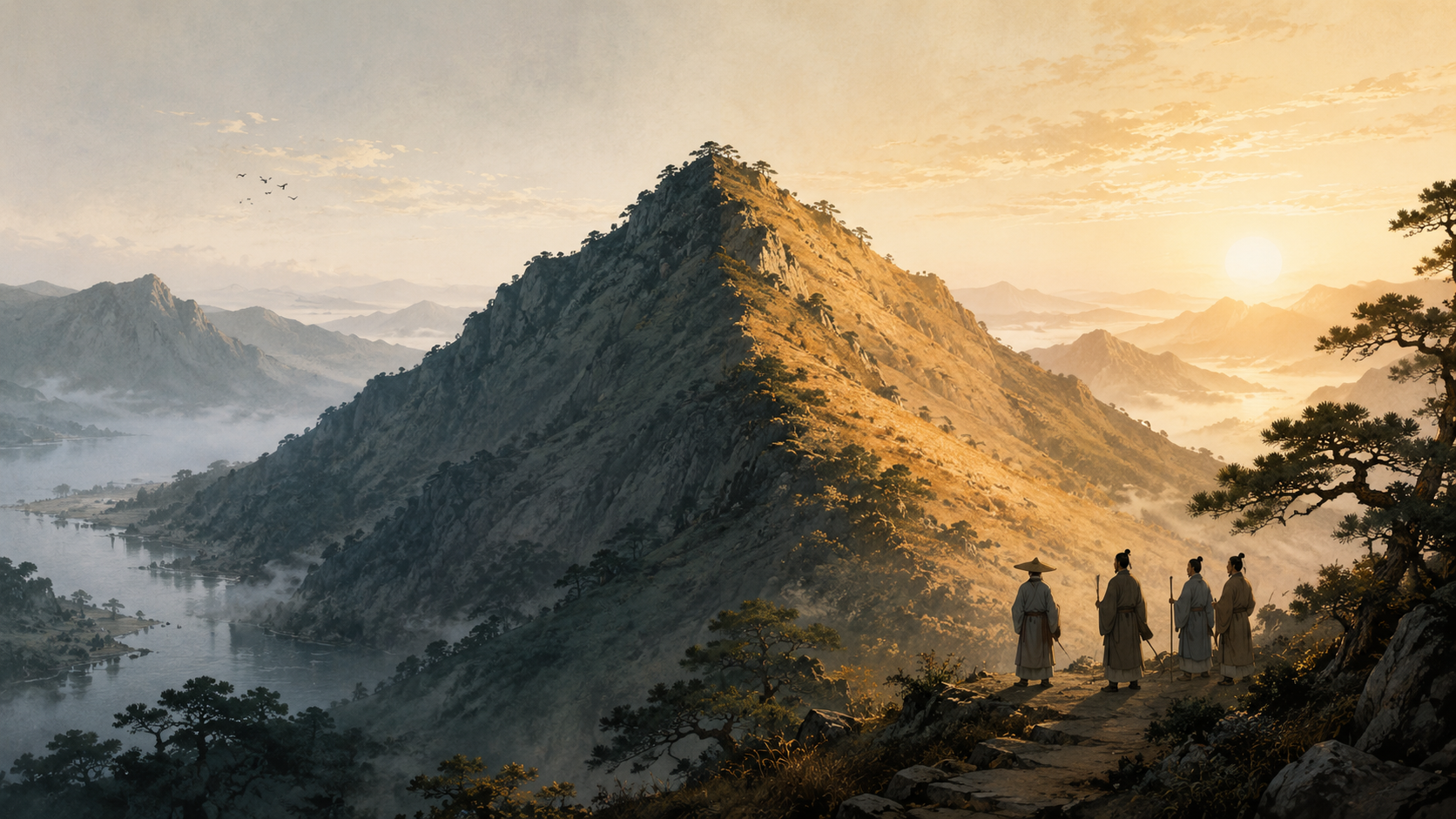
The Hill With Two Sides: What Yin and Yang Actually Mean
Most people have encountered the symbol their entire lives — but few have been told where it actually comes from.
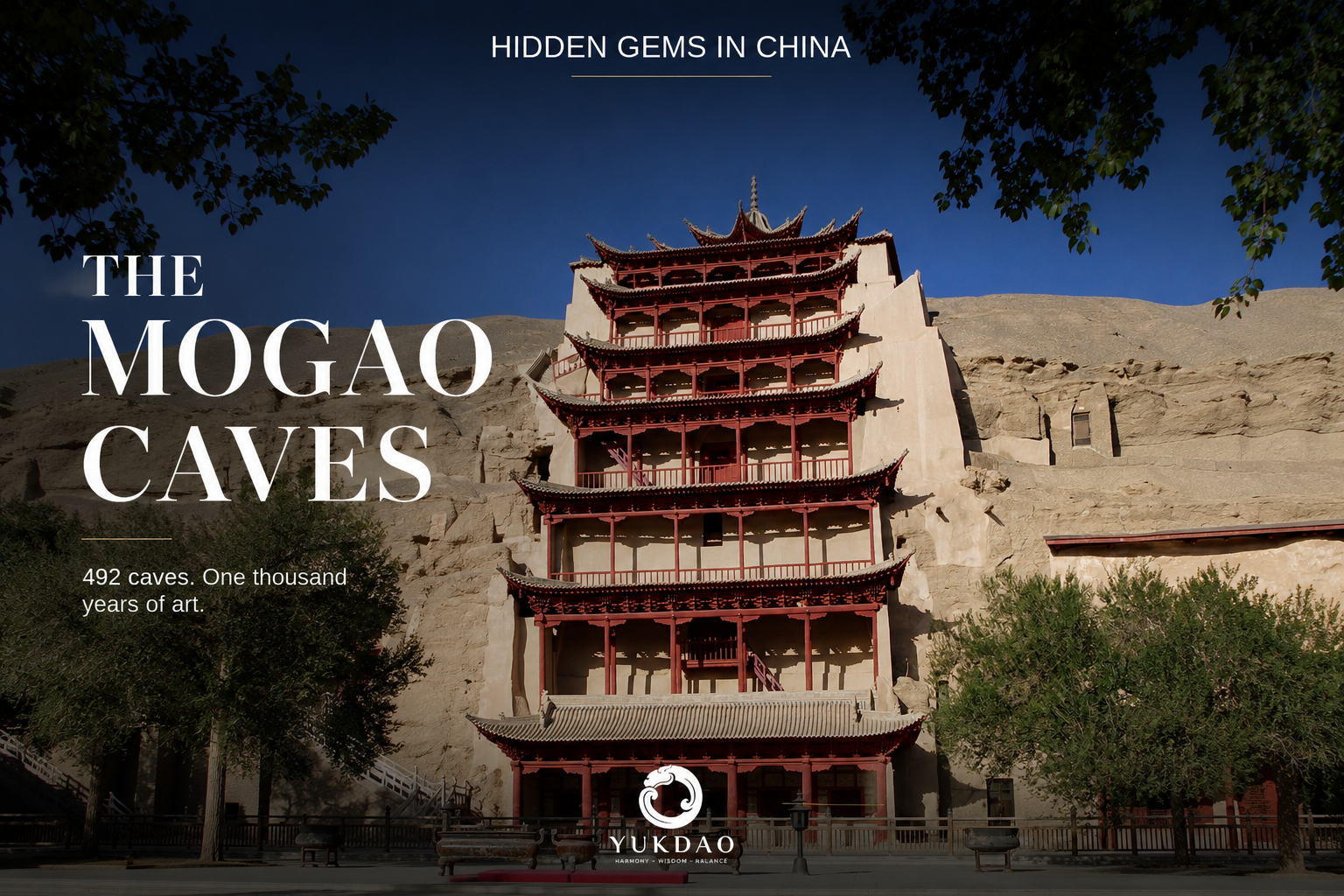
The Mogao Caves: A Thousand Years of Art Along the Silk Road
Carved into the desert cliffs near Dunhuang, the Mogao Caves preserve a thousand years of Buddhist art, Silk Road exchange and human history.
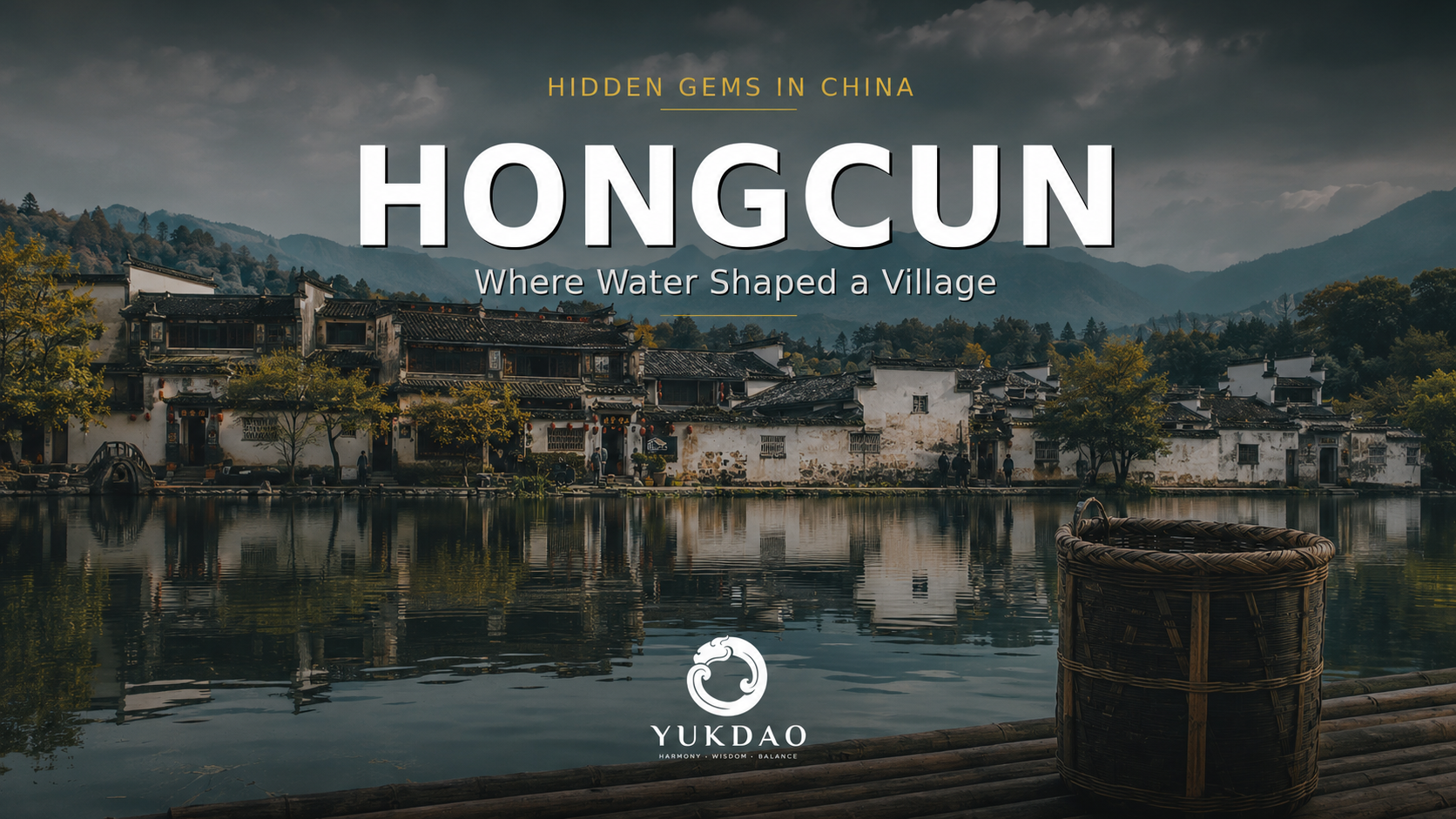
Hongcun: The Ancient Chinese Village Designed Around Water
At the foot of the mountains in southern Anhui, white-walled houses gather around ponds, canals and narrow stone lanes. Hongcun is more than a picturesque village. Its architecture, water system and carefully composed landscape reveal how an entire community was designed around the relationship between people and nature.
Keep exploring China
Hidden places, cultural stories and thoughtful ideas, one letter at a time.