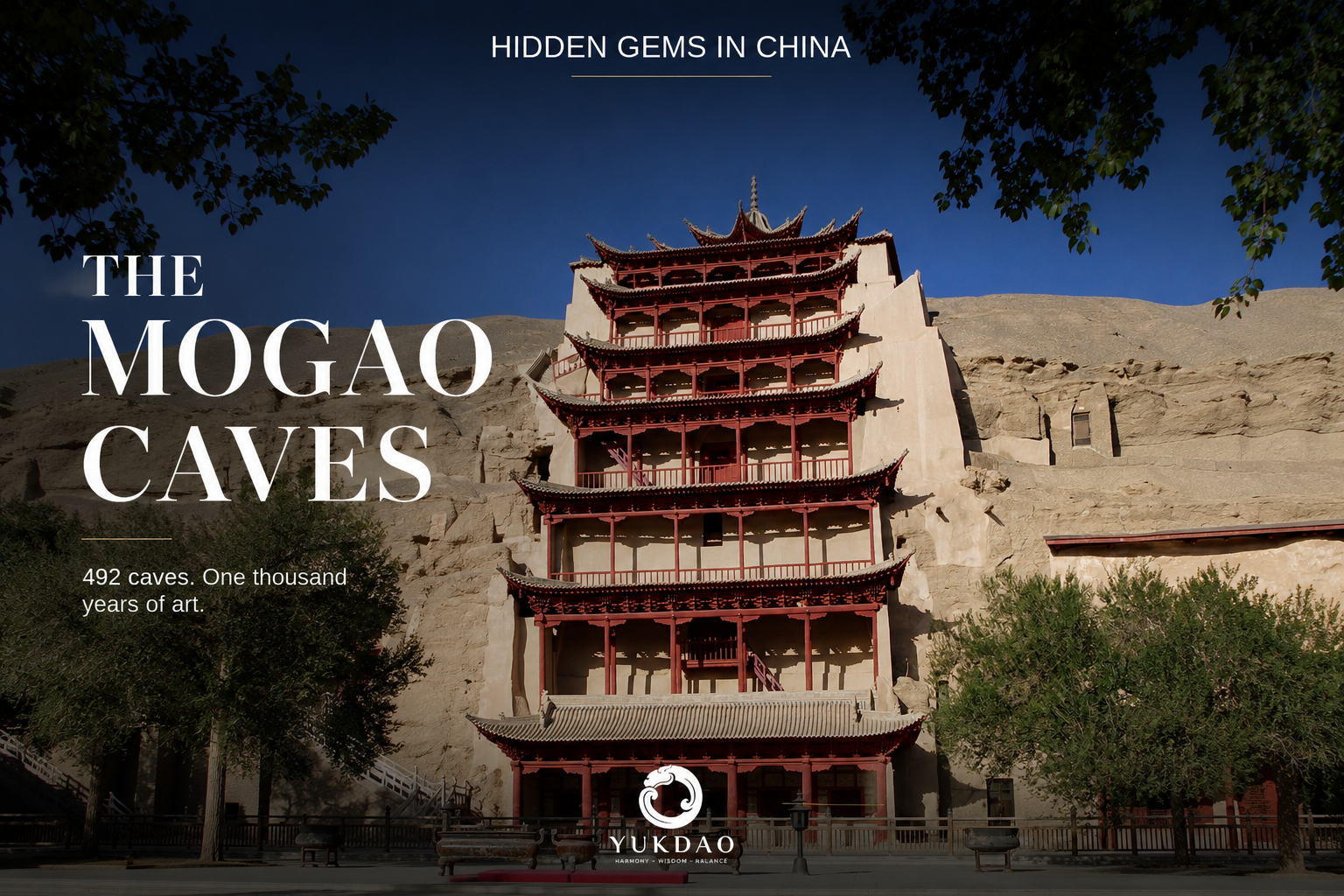
A glimpse inside one of China's most extraordinary Silk Road landmarks.
At the edge of the Gobi Desert, beyond the dunes and dry plains of northwestern China, a wall of sandstone rises beside the oasis city of Dunhuang.
From a distance, the cliffs appear almost empty. Look closer, however, and hundreds of openings begin to emerge.
Behind them lies one of the world's most extraordinary collections of Buddhist art.
Known as the Mogao Caves, or the Caves of the Thousand Buddhas, this complex contains 492 surviving cave temples filled with murals, painted sculptures and traces of the travellers who once crossed the Silk Road.
The caves are not simply an isolated religious monument. They are a record of how art, belief and culture moved across Asia for more than a thousand years.
An oasis at the crossroads
Dunhuang developed where major branches of the Silk Road met near the edge of the desert.
For travellers moving between China, Central Asia and lands farther west, the oasis offered water, food and protection before the next stage of a difficult journey.
Merchants passed through carrying silk, medicines, precious stones, metalwork, spices and textiles. Monks, diplomats, artists and pilgrims travelled alongside them.
Ideas moved with these people.
Buddhism had reached China from India through Central Asia, but it did not arrive as a fixed or uniform tradition. As it travelled, its stories, visual language and practices encountered different communities and artistic traditions.
Dunhuang became one of the places where those influences met.
The art of the Mogao Caves reflects this exchange. Chinese painting traditions appear beside forms influenced by India, Central Asia, Tibet and other cultures connected by the Silk Road.
A vision in the desert
According to tradition, the first cave was created in 366 CE.
A travelling monk named Yuezun was said to have seen a vision of radiant Buddhas in the cliffs near Dunhuang. Inspired by the experience, he began excavating a place for meditation and worship.
Other monks and patrons followed.
Over the centuries, rulers, merchants, officials, military families and religious communities sponsored new caves. Creating one was both a devotional act and a public expression of status, gratitude or hope.
Some caves were small chambers intended for meditation. Others became elaborate sanctuaries with painted ceilings, sculpted figures and walls covered by detailed narratives.
Construction continued across several dynasties, from the fourth century into the fourteenth century.
The result was not one monument created at a single moment, but a living archive shaped by generations.
Walls that became storybooks
The murals at Mogao cover approximately 45,000 square metres.
They depict Buddhas, bodhisattvas, celestial musicians, guardians and scenes drawn from Buddhist teachings. Some ceilings are filled with repeating geometric patterns. Others resemble fabric canopies suspended above the sacred space.
Many paintings were designed to communicate stories to visitors who could not read.
Scenes show moral parables, moments from the Buddha's previous lives and visions of Buddhist paradises. Through gesture, colour and composition, complex teachings became understandable images.
Yet the murals also reveal details that reach far beyond religion.
They show clothing, musical instruments, architecture, farming, hunting, dancing, travel and ceremonies. Caravans cross difficult landscapes. Musicians play instruments associated with different regions. Patrons appear in the clothing of their own periods.
These details make the caves a visual record of everyday life along the Silk Road.
The art of cultural exchange
The Mogao Caves are sometimes described as a museum of Buddhist art, but the word "museum" can make them sound static.
Their deeper importance lies in transformation.
The earliest paintings show strong connections to artistic traditions from India and Central Asia. Over time, figures, landscapes and compositions gradually absorbed more elements associated with Chinese painting.
Foreign influences were not simply copied. They were adapted.
Artists combined different visual languages to create something particular to Dunhuang. The caves demonstrate how culture changes when it moves between communities.
A motif could arrive from India, be reshaped in Central Asia and take on a new appearance in China. Music, clothing and architecture followed similar paths.
The murals therefore record not only what travelled along the Silk Road, but what happened after those ideas arrived.
The flying apsaras of Dunhuang
Among the most recognisable figures in Dunhuang art are the flying apsaras, known in Chinese as feitian.
These celestial beings appear to float across walls and ceilings, often carrying flowers or musical instruments. Unlike angels in many Western traditions, they do not require wings.
Their movement is expressed through long ribbons, curved bodies and flowing garments.
Across different periods, their appearance changed. Some early figures retain stronger Central Asian or Indian characteristics, while later examples display increasingly graceful lines and Chinese approaches to movement.
Today, the flying apsaras have become one of the defining visual symbols of Dunhuang.
Their appeal comes partly from the sense of freedom they convey. Although painted on stone walls, they appear weightless.
The Library Cave
One of the most important discoveries at Mogao occurred in 1900.
A Daoist caretaker named Wang Yuanlu discovered a sealed chamber that later became known as the Library Cave, or Cave 17.
Inside were tens of thousands of manuscripts, paintings, printed texts and other objects that had remained hidden for centuries.
The documents were written in several languages, including Chinese, Tibetan, Sanskrit, Sogdian, Khotanese and Uighur. They included Buddhist scriptures, but also contracts, letters, medical notes, poetry and administrative records — the everyday writing of a community that lived at the meeting point of many cultures.
Over the following decades, much of the collection was dispersed to institutions across the world. Today, scholars still study these materials to understand the languages, religions and daily life of the medieval Silk Road.
The Library Cave transformed Dunhuang from a remarkable site of Buddhist art into one of the most important archives of the premodern world.
Why the Mogao Caves still matter
It would be easy to remember Mogao only as a spectacular place hidden in the desert.
Its deeper significance lies elsewhere.
The caves show that religious devotion, artistic craft and cultural exchange are not separate stories. For a thousand years, they unfolded together in the same cliffs.
They record a world that was already connected long before the modern age — a world in which merchants, monks and painters carried objects and ideas across immense distances, and reshaped them along the way.
Standing before the murals, it becomes difficult to think of cultures as fixed or isolated. Dunhuang was made by movement.
The Mogao Caves remain compelling because they preserve the evidence of that movement in colour, stone and story — one chamber, one image, one language at a time.
- Hidden China
- Mogao Caves
- Dunhuang
- Silk Road
- Buddhist Cave Art
- Caves Of The Thousand Buddhas
Related Articles
The Hill With Two Sides: What Yin and Yang Actually Mean
Most people have encountered the symbol their entire lives — but few have been told where it actually comes from.
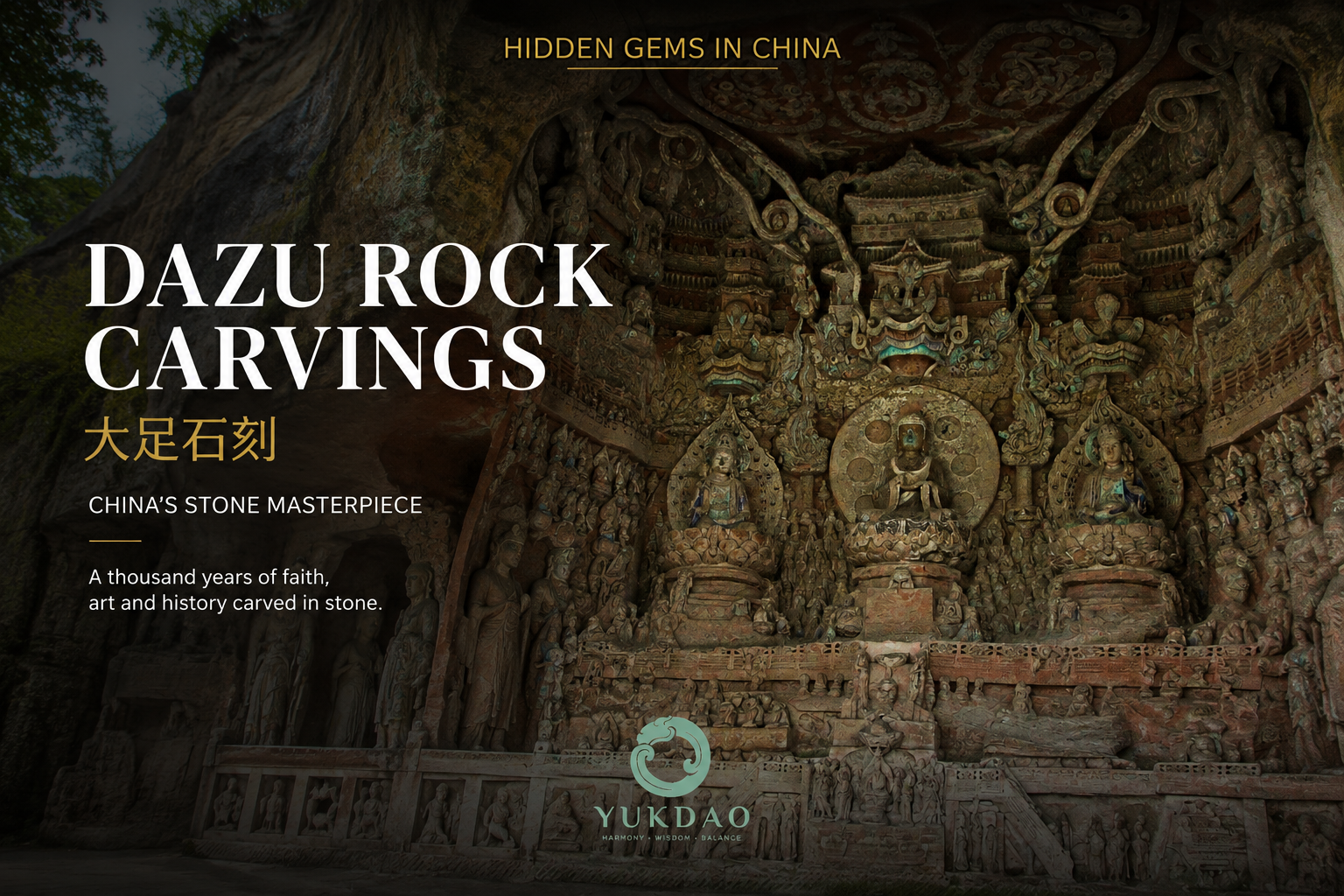
The Dazu Rock Carvings: A Thousand Years Carved in Stone
Across the hills of Chongqing, more than 50,000 carved figures reveal a world where Buddhist, Taoist and Confucian traditions met everyday life.
Wuyuan: Where Nature Meets Craftsmanship
Golden terraces, whitewashed villages and centuries-old carving traditions reveal a quieter side of China in Wuyuan.
Keep exploring China
Hidden places, cultural stories and thoughtful ideas, one letter at a time.