
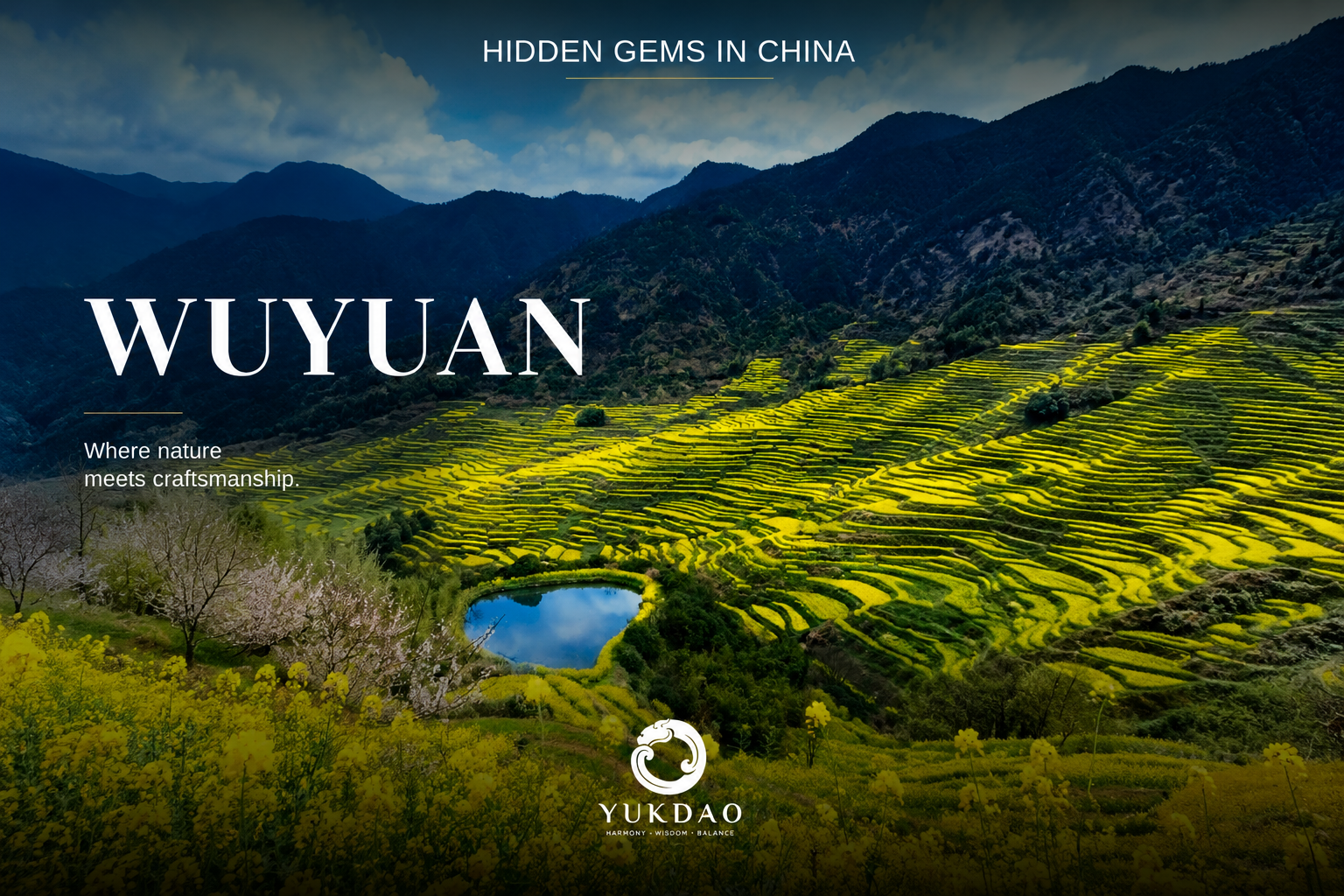
Terraced fields, historic villages and traditional craftsmanship in one of China's most distinctive rural landscapes.
In northeastern Jiangxi, close to the borders of Anhui and Zhejiang, mountains fold around a landscape of rivers, terraced fields and old villages.
This is Wuyuan.
It is often introduced through one unforgettable image: whitewashed houses with dark tiled roofs surrounded by brilliant yellow rapeseed flowers.
The scene is beautiful, but it tells only part of the story.
Wuyuan is not a single village. It is a wider county shaped by historic settlements, farming traditions, merchant culture and generations of craftspeople. Its landscape reveals how architecture and agriculture developed together, while its carved houses preserve the values and ambitions of the people who built them.
Here, nature does not simply form a background to human life.
It is part of the design.
A county between mountains
Wuyuan lies in the northeastern corner of Jiangxi Province.
Although it is part of Jiangxi today, it was historically one of the counties associated with the wider Huizhou cultural region. This connection remains visible in its architecture, clan traditions and decorative arts.
The land is predominantly mountainous. Villages developed in valleys, beside rivers or against hillsides where flat ground was limited.
Rather than overpowering the terrain, settlements often followed its contours.
Houses gather closely together. Narrow lanes curve between walls. Streams pass beneath bridges and beside courtyards. Fields rise in steps along the slopes.
The result is a landscape that appears carefully composed, although much of its beauty developed through practical decisions made over centuries.
Water was needed for farming.
Slopes had to be cultivated.
Homes required protection from weather and fire.
Paths followed the most workable routes between villages.
Beauty emerged from adaptation.
The golden terraces of spring
Wuyuan is most famous during spring, when rapeseed plants bloom across its fields.
From roughly mid-March into early April, depending on the weather and elevation, large areas of the countryside turn yellow.
On flat land, the flowers form broad fields around villages. Higher in the mountains, they follow the shapes of terraces cut into the slopes.
These terraces were not created primarily for tourism.
They made it possible to cultivate land that would otherwise have been too steep. Their layered structure helped retain soil and manage water while extending the amount of usable farmland.
When the rapeseed blooms, the agricultural system becomes a vast visual pattern.
Yellow fields curve around mountains.
White houses appear between them.
Dark tiled roofs form lines against green hills.
The landscape can look almost like a traditional Chinese painting, but it is also an active working environment.
Rapeseed has long been cultivated as a vegetable and as a source of oil. The flowers that attract visitors each spring are one stage in an agricultural cycle that continues after the photographs are taken.
Huangling above the valley
Among Wuyuan's best-known destinations is Huangling, a historic village built along a mountainside.
Its position created an immediate practical problem: there was little level ground.
Homes, pathways and agricultural spaces were therefore arranged across different elevations. Buildings appear to rise from one another, while terraces extend outward across the surrounding hills.
Huangling is known in spring for its fields of rapeseed flowers, but autumn brings another distinctive sight.
After the harvest, villagers traditionally spread crops such as red chilies, corn and tea leaves across rooftops and circular bamboo trays to dry in the sun.
This seasonal practice is known as shaiqiu.
From above, the village becomes a composition of color. Red, gold and brown harvests contrast with dark roofs and pale walls.
The display is now one of Huangling's most recognizable images, yet its origins are practical. In a mountain village with limited open land, rooftops and elevated platforms offered valuable access to sunlight.
Once again, necessity became visual identity.
More than one village
Huangling receives much of the attention, but Wuyuan's character is spread across many settlements.
Each village offers a different relationship between architecture, water, landscape and daily life.
Some are arranged beside rivers and crossed by old stone bridges.
Others sit among farmland or climb into the hills.
In places such as Wangkou, Likeng, Jiangwan and Sixi-Yancun, visitors encounter ancestral halls, merchant residences, courtyards, lanes and waterways associated with the historic culture of the region.
The appeal of these villages does not come from one monumental building.
It comes from continuity.
A carved doorway leads into a courtyard.
A lane narrows before opening beside a stream.
Rooflines repeat across a hillside.
Laundry, bicycles, farming tools and domestic life remain visible among the historic structures.
These are not empty architectural sets.
They are places shaped by both heritage and ordinary routines.
White walls and dark roofs
The most recognizable buildings in Wuyuan follow the Huizhou architectural tradition.
Their whitewashed walls and grey or black tiles create a restrained exterior appearance. Against green mountains or yellow fields, the contrast is especially striking.
Many roofs are framed by stepped gable walls often described as horse-head walls because of their distinctive shape.
These raised walls were not purely decorative. In closely packed settlements, they could help slow the spread of fire between neighboring wooden structures.
From outside, a traditional residence may seem almost severe.
The walls are high.
Windows can be limited.
The entrance is controlled.
Inside, however, the building often becomes more open and detailed.
Rooms are arranged around a central courtyard or light well. This interior opening brings sunlight and rain into the house while providing ventilation.
The architecture turns inward.
Public restraint surrounds private richness.
The world inside the house
The contrast between plain exteriors and elaborate interiors is one of the defining qualities of Huizhou-style homes.
Successful merchants often left the mountainous region to conduct business elsewhere. When they returned or sent wealth home, they invested in residences, ancestral halls and public buildings.
Limited land made it difficult simply to build larger houses.
Craftsmanship offered another way to express prosperity.
Beams, brackets, screens, windows and doorways became surfaces for ornament. Stories and symbols were carved into parts of the building that residents encountered every day.
The exterior maintained an image of discipline and modesty.
Inside, detail revealed education, social standing and family ambition.
A home could therefore communicate two values at once: restraint before the outside world and refinement within it.
The Three Carvings of Wuyuan
Wuyuan is particularly associated with three traditional forms of architectural decoration:
Wood carving.
Brick carving.
Stone carving.
Together, they are often known as the Three Carvings of Wuyuan.
Each material had its own architectural role.
Wood carving appeared on beams, window frames, partitions, doors, furniture and structural elements inside the house.
Brick carving was frequently used around entrances, gatehouses, windows and exterior decorative panels.
Stone carving appeared on column bases, walls, memorial structures, thresholds and other areas requiring durable material.
These crafts did more than beautify a building.
They gave its surfaces meaning.
Stories carved into timber
Wood carving became especially important because timber formed a central part of the building's structure.
Craftspeople worked decorative scenes into beams, brackets and window panels without separating ornament from architecture.
A single carved section might contain flowers, birds, landscapes, figures or scenes drawn from literature and folklore.
Some designs expressed wishes for longevity, learning, prosperity or harmony.
Others illustrated stories familiar to the household.
The meaning was rarely random.
A plant could represent resilience.
An animal might signal status or protection.
A scene of a scholar reading could express the family's respect for education.
Craftsmanship transformed the house into a visual language.
Even where residents did not consciously interpret every symbol, the carved environment surrounded daily life with cultural memory.
Brick and stone at the threshold
Brick carving often concentrated around the entrance.
This was where the household met the public world, making it an important place to communicate identity.
Relief scenes could be worked into gatehouses and wall panels with remarkable precision. Although the material appears solid and heavy, skilled carving created layers of depth, fine lines and delicate architectural details.
Stone served different purposes.
Its durability made it suitable for bases, steps, pillars, bridges and memorial structures. Carved stone elements often appear more grounded and structural than their wooden counterparts.
Together, the three materials created a hierarchy of decoration.
Stone supported.
Brick announced.
Wood surrounded.
The house became a collaborative work shaped by builders, carpenters, masons and carvers.
Craftsmanship as memory
Traditional craftsmanship is sometimes treated as though it belongs entirely to the past.
In Wuyuan, however, carving remains connected to preservation.
Craftspeople continue to study old techniques and restore damaged components of historic buildings. Their work requires more than copying a visible pattern.
They must understand the material, the tool marks, the structural role of each element and the visual logic of the original design.
Restoration also raises difficult questions.
Should every damaged surface be made to look new?
How much evidence of age should remain?
Can a traditional craft survive if it is used only for tourism?
The strongest preservation work does not freeze a village at one chosen historical moment.
It allows inherited skills to remain useful.
A craft survives when someone still knows how to practise it, teach it and adapt it responsibly.
The landscape as a design system
Wuyuan's villages are often praised for appearing harmonious with nature.
That harmony did not happen through decoration alone.
Settlement patterns responded to water, slope, sunlight, farming and transportation.
Streams supplied homes and fields.
Trees offered shade and protection.
Terraces converted mountainsides into productive land.
Courtyards managed air and light within dense residential areas.
Materials were selected according to availability and climate.
The landscape and the buildings formed one system.
This is why Wuyuan feels different from a place where historic houses have been moved into an artificial park.
The villages make sense in relation to their surroundings.
Remove the river, fields, mountains or paths, and part of the architecture's meaning disappears.
Beyond the perfect photograph
Wuyuan's popularity has brought opportunity as well as pressure.
Tourism supports guesthouses, restaurants, transport, restoration and craft businesses. It can encourage younger residents to return and create new livelihoods connected to local culture.
At the same time, the demand for picturesque experiences can simplify a complex place.
A village may be reduced to one seasonal image.
Daily life may be rearranged for visitors.
Restoration can become reconstruction.
Craft traditions may be reproduced as souvenirs without their original depth.
Responsible travel begins by recognizing that Wuyuan is not merely scenery.
Its terraces are farmland.
Its houses are part of family histories.
Its villages continue to change.
The goal should not be to search for a place untouched by time. Such a place does not exist.
The more meaningful question is how change can occur without erasing identity.
Visiting through the seasons
Spring is the most famous season in Wuyuan.
The rapeseed flowers create the golden landscape seen in countless photographs, especially around Jiangling and Huangling. It is also one of the busiest times to visit.
Summer brings deeper greens, flowing water and a quieter relationship with the mountain landscape.
Autumn reveals harvest traditions, particularly the rooftop drying displays associated with Huangling.
Winter removes much of the color and exposes the architecture more clearly. White walls, dark roofs and bare branches create a restrained atmosphere that may appeal to visitors more interested in buildings than flowers.
No single season tells the complete story.
Spring shows agriculture in bloom.
Autumn shows the harvest.
Winter reveals structure.
How to look at Wuyuan
It is easy to arrive in Wuyuan looking for a famous viewpoint.
The most rewarding details are often smaller.
Notice how a lane changes width.
Look at where rainwater leaves a roof.
Compare the plain outer wall with the carving inside.
Watch how a village meets the edge of a field.
Observe which structures are still used and which have become displays.
Listen for water before you see it.
The deeper character of Wuyuan lies in these relationships.
Nature and craftsmanship are not separate attractions placed beside one another.
The terraces, villages and carved homes are all products of people responding to a particular landscape.
A different image of rural China
Wuyuan offers an image of China far removed from megacities and imperial monuments.
Its history is written through villages rather than palaces.
Its most powerful structures are often homes, bridges and ancestral halls.
Its artistic achievements are carved into beams and thresholds rather than displayed in galleries.
The landscape is memorable because it combines human discipline with natural form.
Terraces follow mountains.
Villages gather beside water.
Craftspeople turn structural materials into stories.
Wuyuan is not simply where nature meets craftsmanship.
It is where each has shaped the other.
“In Wuyuan, craftsmanship does not sit apart from the landscape. It grows from the same mountains, fields and villages.”
- Hidden China
- Wuyuan
- Jiangxi
- Huizhou Architecture
- Wuyuan Rapeseed Flowers
- Huangling Village
- Wuyuan Wood Carving
- Chinese Villages
Related Articles
What Is Chalcedony? The Stone Behind Chinese Craftsmanship
Often mistaken for jade, chalcedony has been treasured in Chinese craftsmanship for centuries for its beauty, durability and remarkable variety of colors.
What Is Pixiu (貔貅)? The Guardian Beast of Chinese Craft
Winged, fierce and famously without an exit, Pixiu has guarded Chinese homes, tombs and treasuries for two thousand years — and it remains one of the most carved figures in Chinese craft.
Hongcun: The Ancient Chinese Village Designed Around Water
At the foot of the mountains in southern Anhui, white-walled houses gather around ponds, canals and narrow stone lanes. Hongcun is more than a picturesque village. Its architecture, water system and carefully composed landscape reveal how an entire community was designed around the relationship between people and nature.
Keep exploring China
Hidden places, cultural stories and thoughtful ideas, one letter at a time.