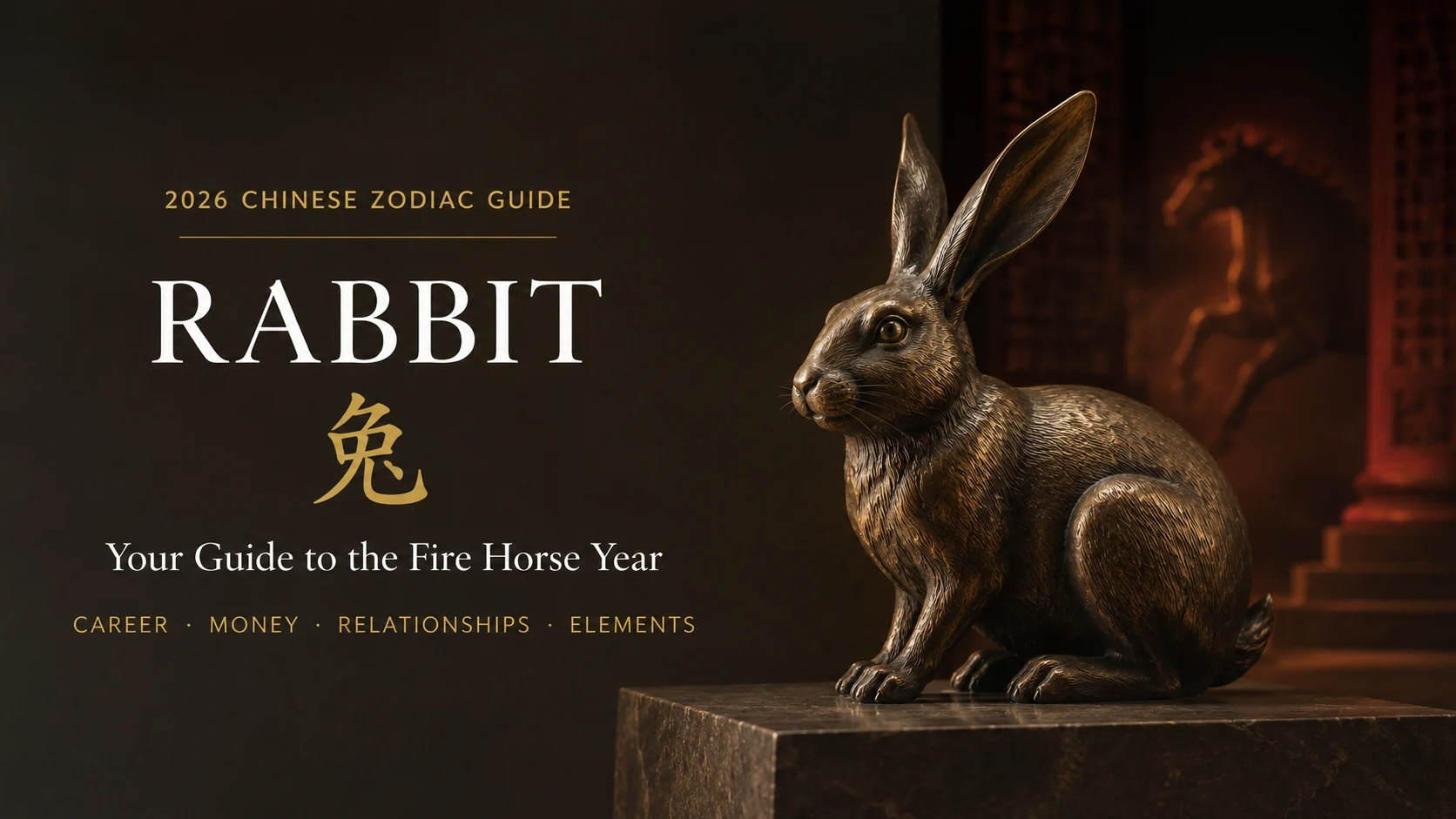
2026 Rabbit Chinese Zodiac: Your Guide to the Fire Horse Year
For the Rabbit, 2026 carries a traditional relationship that is easy to misread and easy to over-dramatise.
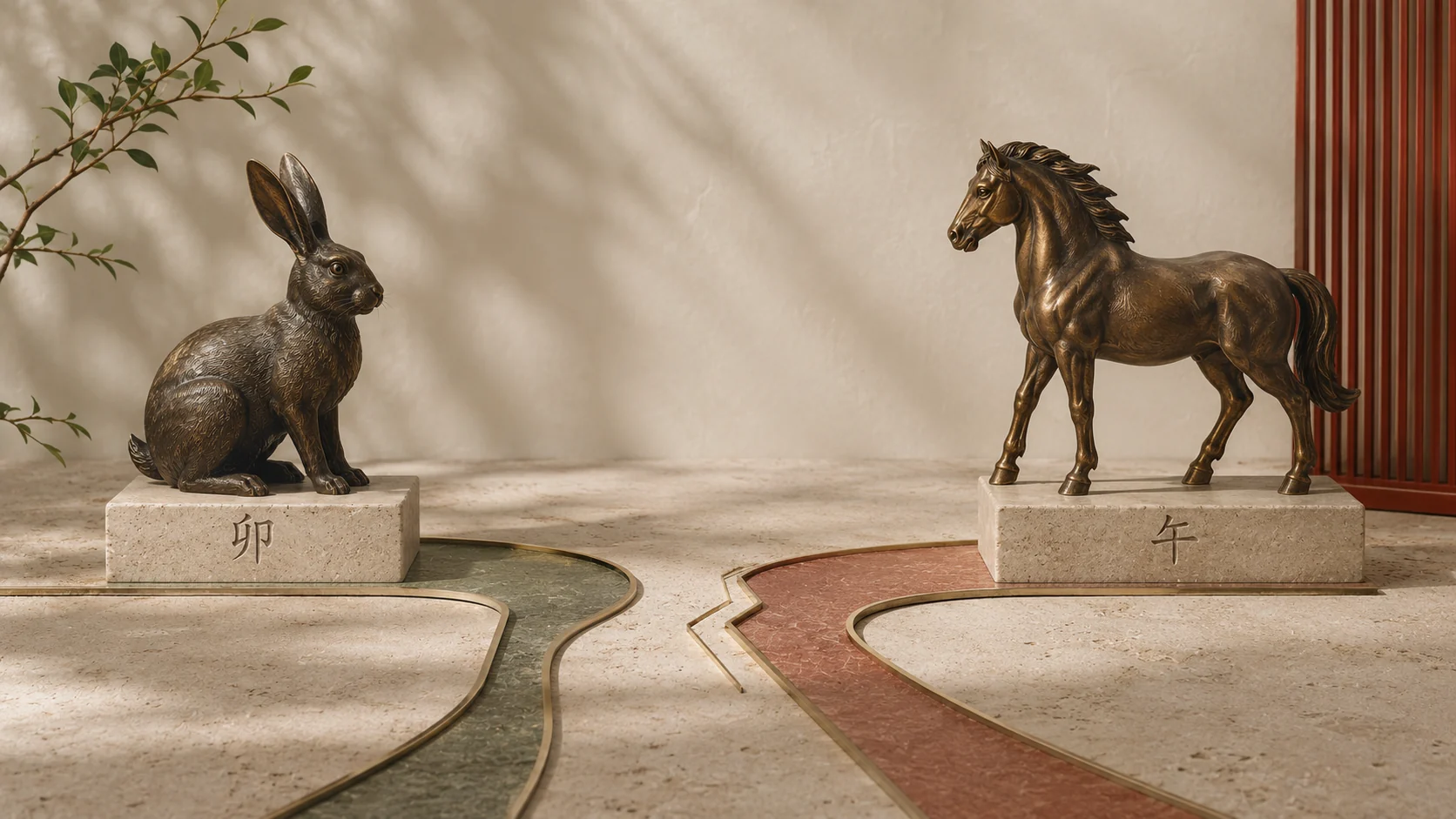
The Rabbit corresponds to the Earthly Branch 卯 (Mao). The Horse corresponds to 午 (Wu). Between them, traditional branch theory describes 卯午破 — a relationship usually translated as “break”.
Popular horoscopes turn that single character into alarm. That is not how YukDao reads it. 破 is a milder relationship than 冲 (clash) and 害 (harm). It describes plans, timing and arrangements coming apart — not people opposing one another, and not misfortune arriving on schedule.
Most of what 破 describes is ordinary: a date that moves, a project that is restructured, an agreement that has to be renegotiated, a role that changes shape halfway through the year.
So the practical question for the Rabbit in 2026 is not “what will go wrong?” It is: where in my life would a change of plan actually hurt, and what can I do now to make that part more flexible?
Why 2026 Is Different for the Rabbit
2026 is 丙午 (Bing-Wu), the Fire Horse year. 丙 is the Heavenly Stem and 午 is the Earthly Branch, corresponding to the Horse.
Where Rat 子 forms a direct opposition with 午 — 子午相冲 — and Ox 丑 forms 丑午相害, and Tiger 寅 forms a combination, 寅午半合, the Rabbit's 卯 forms 卯午破.
These are genuinely different categories within the traditional system. 冲 describes opposition. 害 describes complication between people. 合 describes things coming together. 破 describes structure loosening — the shape of a plan no longer holding.
That distinction matters, because the response is different. A year of 破 does not ask the Rabbit to brace for conflict. It asks the Rabbit to stop depending on plans that cannot bend.
What 卯午破 Actually Means
破 (pò) belongs to a group of secondary branch relationships in traditional Chinese metaphysics. It is consistently described as weaker in effect than 冲, and is associated with breakage, interruption and the undoing of arrangements.
Read as description rather than prophecy, the traditional themes are recognisable:
- Timelines shifting after they were agreed.
- Projects restructured, paused or handed to someone else.
- Plans that require several people to align becoming harder to hold together.
- Details that were assumed rather than confirmed turning out differently.
- Commitments needing to be renegotiated rather than abandoned.
None of that is catastrophic, and none of it is unusual. What makes 破 uncomfortable is not the change itself but the assumption that a plan, once made, will hold.
That gives the Rabbit the central lesson of 2026: flexibility is a form of preparation.
Adaptability Is the Skill of the Year
Rabbits are traditionally described in cultural terms as careful, diplomatic and attentive to atmosphere. Those qualities are genuinely useful in a year where arrangements move.
The pressure point is elsewhere: a preference for harmony can make it tempting to accept a change quietly rather than to renegotiate it properly.
A practical filter when something in 2026 shifts:
- What exactly changed — the deadline, the scope, the people, or the money?
- Which part of this still needs to be true for the outcome to work?
- What would I ask for if I were not worried about seeming difficult?
- Is this a change I should absorb, or a change I should re-price?
- Have we written the new arrangement down?
Traditional symbolism cannot answer those questions. It can, usefully, remind you to ask them early rather than late.

Career and Work in 2026
For the Rabbit, the most useful career question in 2026 is not “will my plans hold?” It is: which parts of my work depend on nothing changing?
Design plans that can be rewritten
Long single-track plans are fragile. Break large commitments into stages with review points, so that a change of timing costs a revision rather than the whole project.
Put agreements in writing
Scope, deadlines, responsibilities, payment terms and what happens if the date moves. A year traditionally associated with 破 is a poor year for verbal-only understandings — not because people are dishonest, but because memory of an unwritten agreement drifts.
Protect capacity for the unexpected
A calendar with no slack turns a small delay into a chain of failures. Leave genuine margin between commitments.
- Keep one clear day a week where nothing is scheduled.
- Add buffer to any timeline that depends on another person.
- Decide in advance what gets dropped if a week goes wrong.
Money and Financial Decisions
The financial theme for a 破 year is not loss. It is timing — income arriving later than expected, costs arriving earlier, and plans that assumed a particular schedule.
Assume slower, not smaller
When budgeting a project or a year, plan for payments and outcomes landing later than promised. That single adjustment removes most of the stress a 破 year is traditionally associated with.
Read the terms before the change happens
Cancellation clauses, deposits, notice periods and renewal dates matter most in a year where arrangements move. Knowing them in advance is ordinary prudence.
Keep a reserve that covers disruption
A reserve is what turns a delayed payment into an inconvenience rather than a crisis.
This is ordinary financial prudence. It is not a prediction that the Rabbit will lose money in 2026.
Relationships and Family
破 is traditionally associated with arrangements rather than affection. In practice, that most often shows up as logistics: plans rescheduled, visits postponed, shared calendars that no longer match.
The practical caution is that repeated small disruptions can be read as indifference. A changed plan is not usually a changed feeling. Saying so directly prevents most of the friction a year like this can create.
For those in a partnership, the useful habit is to reschedule rather than cancel. Naming the next date turns a break into a delay.
For single Rabbit readers, 2026 does not forbid romance. New relationships are still best evaluated through communication, behaviour and consistency rather than zodiac symbolism.
A Practical 2026 Checklist for the Rabbit
Do
- Build margin into every timeline.
- Confirm agreements in writing.
- Break large plans into reviewable stages.
- Reschedule rather than cancel.
- Ask directly when something changes.
- Keep a financial reserve for delays.
- Protect rest, since disruption is tiring.
- Review your commitments each quarter.
Don’t
- Treat 卯午破 as a forecast of misfortune.
- Depend on a plan that cannot bend.
- Leave scope or payment terms unspoken.
- Absorb every change silently to keep the peace.
- Fill the calendar with no slack at all.
- Read a moved date as a personal rejection.
- Buy an object because someone promises it will neutralise a 破 year.
Rabbit Birth Years Are Not All the Same
Calling someone a “Rabbit” identifies the Earthly Branch of their birth year. It does not mean every Rabbit shares the same complete Year Pillar — the Heavenly Stem changes.
Recent Rabbit year combinations include:
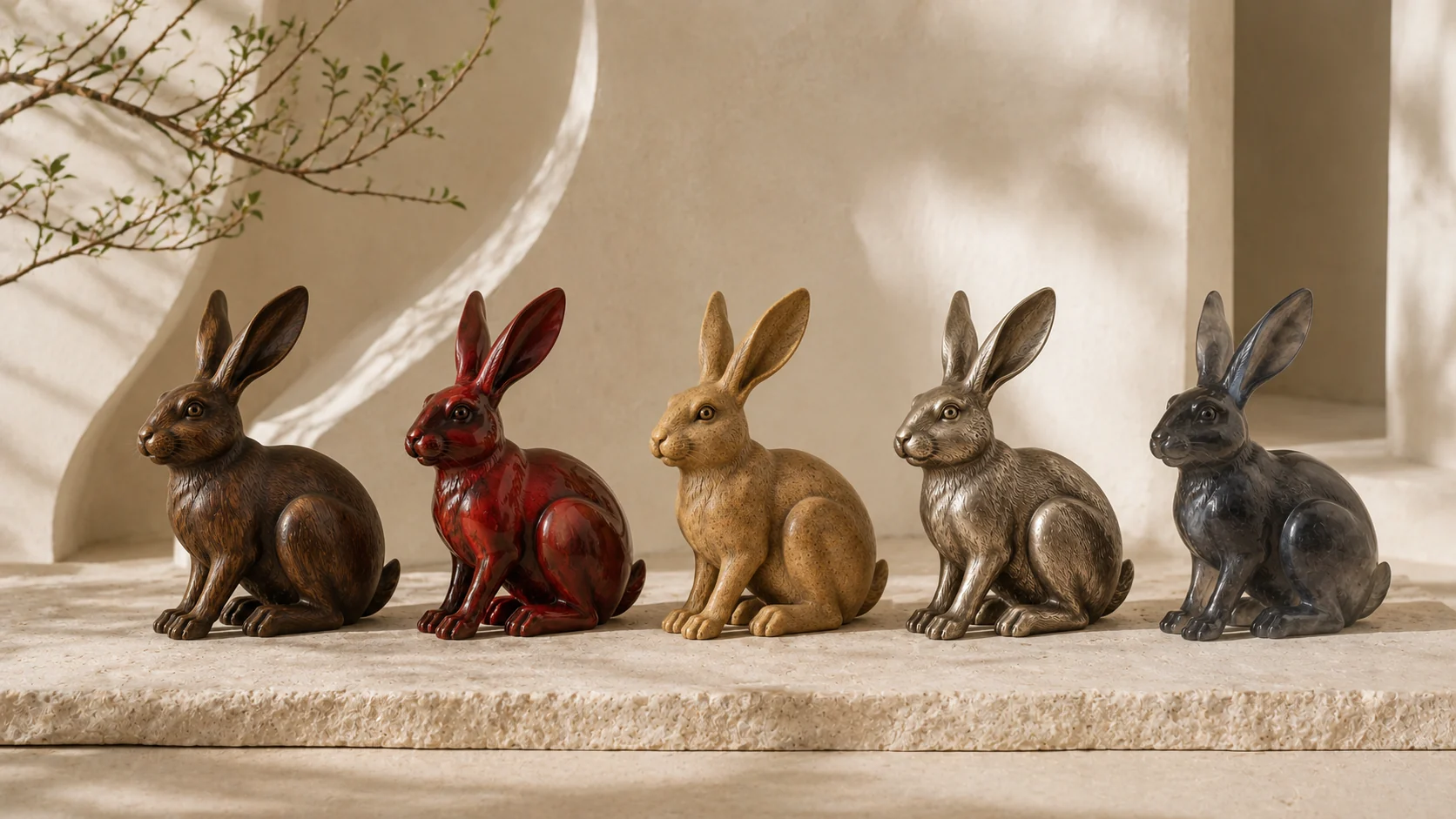
- 1963 — 癸卯 — Water Rabbit
- 1975 — 乙卯 — Wood Rabbit
- 1987 — 丁卯 — Fire Rabbit
- 1999 — 己卯 — Earth Rabbit
- 2011 — 辛卯 — Metal Rabbit
- 2023 — 癸卯 — Water Rabbit
These Gregorian years are convenient references only. Chinese zodiac boundaries do not follow January 1. Popular zodiac calendars commonly change the animal at Lunar New Year, while BaZi year-pillar calculations commonly use Li Chun (立春), the Beginning of Spring. If you were born in January or early February, your exact birth date, time and the system being used may matter.
Not sure if you are a Rabbit? Find your Chinese zodiac sign.
1963 · 癸卯 · Water Rabbit
Someone born in 1963 is around 63 in 2026. Plans at this stage often involve retirement timing, property, health appointments and family arrangements — precisely the areas where a change of schedule is most inconvenient.
Confirming dates, keeping documents organised and leaving room between commitments removes most of the friction.
1975 · 乙卯 · Wood Rabbit
Someone born in 1975 is around 51 in 2026. Professional life at this stage frequently involves other people's timelines: teams, clients, budgets and approvals.
The useful discipline is written clarity — scope, dates and responsibilities — so that a restructure becomes a revision rather than a dispute.
1987 · 丁卯 · Fire Rabbit
Someone born in 1987 is around 39 in 2026. Career, family and financial commitments often peak together here, which means very little slack in the week.
In a year traditionally associated with disruption, deliberately protected margin is worth more than an additional commitment.
1999 · 己卯 · Earth Rabbit
Someone born in 1999 is around 27 in 2026. This is often a period of changing roles, moves between cities, and first significant financial decisions.
Plans changing at this stage is normal rather than ominous. Keeping a small reserve and reading agreements before signing them covers most of it.
2011 · 辛卯 · Metal Rabbit
Someone born in 2011 is around 15 in 2026. The relevant context at this age is school, examinations, friendships, sport, creative work and growing independence.
The theme translates simply: timetables, teams and group plans may change more than expected, and being able to adjust without taking it personally is a genuinely useful skill.
2023 · 癸卯 · Water Rabbit
Someone born in 2023 is around three years old in 2026. Broad annual zodiac interpretations have very little practical relevance to a young child.
Parents who enjoy the tradition can use the year as an occasion to notice ordinary developmental changes — routines, language, nursery transitions — rather than reading them as zodiac outcomes.

Wood, Fire and the Five Elements
The Rabbit's Earthly Branch 卯 is primarily associated with Wood within traditional Five Element correspondence. 2026, 丙午, carries strong Fire associations.
In the generating cycle, Wood produces Fire — traditionally expressed as 木生火. Read symbolically, this describes output: something is being given so that something else can burn brightly.
Placed beside the branch-level 卯午破, the reading becomes coherent rather than contradictory. The elemental layer suggests a year that draws energy outward; the branch layer suggests that the structures carrying that energy may need rebuilding along the way. Both point to the same practical advice: pace yourself and protect rest.
This is why reducing Chinese metaphysics to “Rabbit has a bad year in 2026” loses most of the structure. Several relationships operate at once, and a complete BaZi chart contains far more information than the birth-year animal alone.
What About Lucky Colors?
Search for “Rabbit lucky colors 2026” and you will find many contradictory answers — green, red, gold, blue, depending on the source.
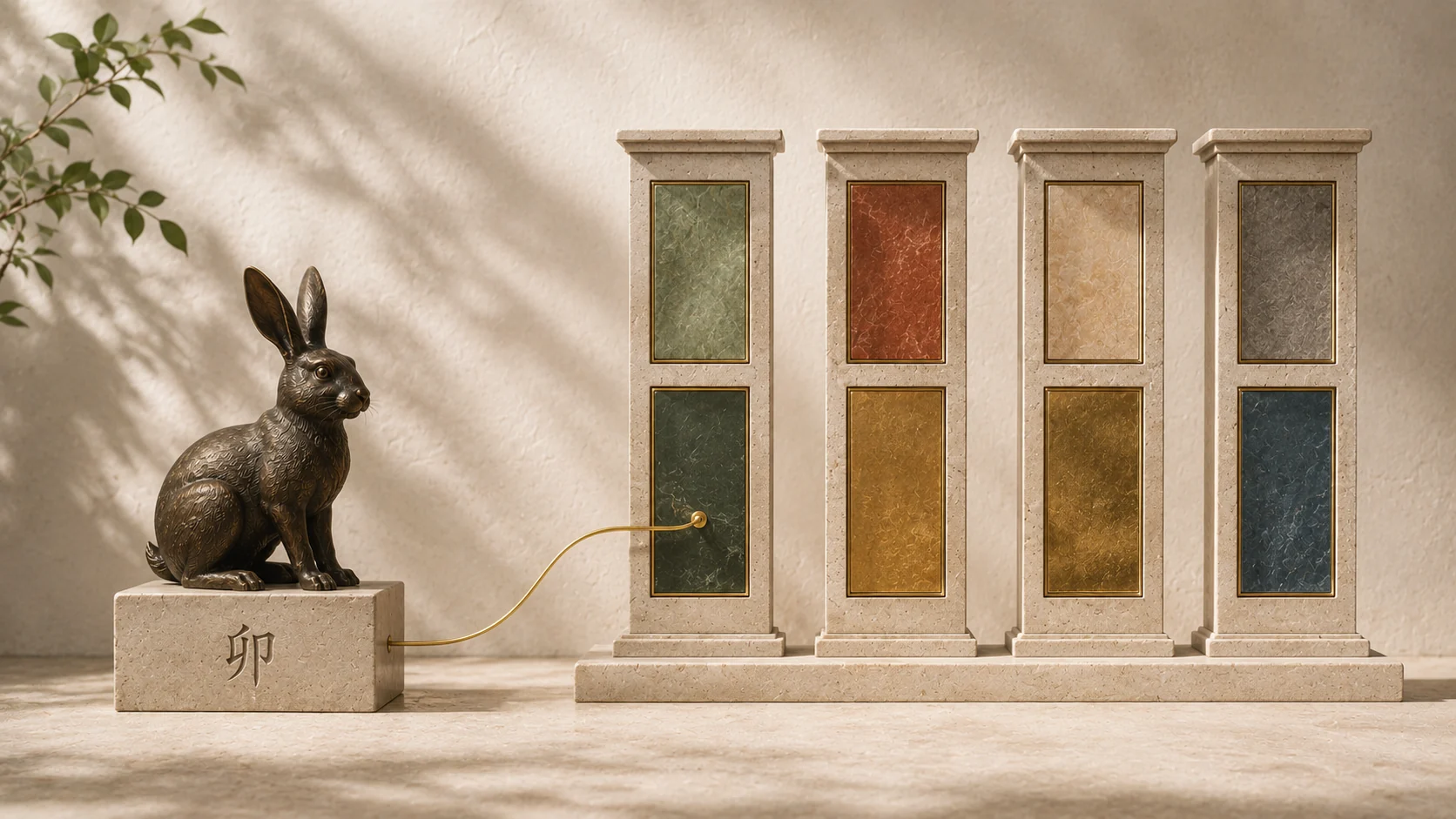
It is more useful to explain the underlying associations. Broad Five Element correspondences connect Wood with green tones, Fire with red and vermilion, and Water with blue and black. Rabbit's 卯 relates to Wood; 2026's 丙午 relates to Fire.
Wearing a particular color does not guarantee protection, wealth or success. These are best understood as part of a symbolic tradition explored through clothing, interiors, design and objects — not as supernatural guarantees.
Our guides to the Five Phases and color in Chinese culture explain where these correspondences come from.
Your Rabbit Sign Is Only One Part of the Picture
When someone says “I am a Rabbit,” they are identifying their birth year's Earthly Branch.
In BaZi, the birth chart contains four pillars: Year, Month, Day and Hour. Each pillar contains one Heavenly Stem and one Earthly Branch. Together these form the Eight Characters · 八字.
Your Rabbit sign therefore represents only the Earthly Branch of the Year Pillar. It does not describe the complete chart.
Two people born in the same Rabbit year may have different Month Pillars, Day Pillars, Hour Pillars, Day Masters, elemental structures and relationships with the 2026 丙午 year. Broad zodiac guides are useful for understanding traditional cultural relationships, but they are not personalized BaZi readings.
Are You Actually a Rabbit?
Chinese zodiac boundaries do not follow January 1, and BaZi year-pillar calculations commonly use Li Chun. If you were born around January or early February, check your exact birth information rather than relying only on the Gregorian year.
Find My Chinese ZodiacYour Zodiac Is Only the Beginning
Your birth-year animal represents one part of the traditional Four Pillars system. Explore how your Year, Month, Day and Hour combine in a complete BaZi chart.
Explore My BaZiFrequently Asked Questions
Is 2026 a good year for the Rabbit?
Traditional Chinese zodiac interpretation does not reduce a year to good or bad. Rabbit 卯 and Horse 午 form 卯午破, a traditional 'break' relationship associated with disruption to plans, timing and arrangements rather than direct conflict. The practical response is to build flexibility into schedules and agreements rather than to expect misfortune.
What is 卯午破?
Rabbit corresponds to the Earthly Branch 卯 and Horse to 午. In traditional branch relationships they form 破 (pò), usually translated as 'break' or 'destruction'. It is a milder relationship than 冲 (clash) and describes plans, timing and arrangements coming apart rather than direct opposition.
Does 卯午破 mean the Rabbit will have a bad year in 2026?
No. 破 is traditionally read as instability in arrangements, not as guaranteed loss. Many things described by 破 are ordinary: a delayed project, a changed schedule, a role that shifts, a plan that has to be rewritten. Adaptability is a more useful response than worry.
Should the Rabbit make big decisions in 2026?
A zodiac relationship cannot decide that. If a decision rests on a firm foundation—clear finances, a written agreement, a realistic timeline—it can proceed. In a year traditionally associated with 破, the sensible discipline is to confirm details in writing and to leave margin for changes of timing.
What are the risks for the Rabbit in 2026?
The common practical risks in a 破 year are over-scheduling, verbal-only agreements, plans with no contingency, and taking changes personally. None of these are supernatural; all of them are manageable with preparation.
What colors are traditionally associated with the Rabbit in 2026?
Rabbit's branch 卯 is primarily associated with Wood, while 2026 丙午 carries strong Fire symbolism. Traditional Five Element correspondence connects Wood with green tones and Fire with red and vermilion. These are symbolic cultural associations, not colors that guarantee luck.
Which years are Rabbit years?
Recent Rabbit years include 1963, 1975, 1987, 1999, 2011 and 2023. Chinese zodiac boundaries do not follow January 1. Popular zodiac calendars often change the animal at Lunar New Year while BaZi year-pillar calculations commonly use Li Chun, so people born in January or early February should verify their exact sign.
Are all Rabbit people affected the same way in 2026?
No. The Year Pillar alone varies between Water, Wood, Fire, Earth and Metal Rabbit combinations, and a complete BaZi chart also includes the Month, Day and Hour Pillars. People who share the Rabbit zodiac can have very different charts.
- Chinese Zodiac
- Rabbit Zodiac
- Fire Horse
- 2026
- Mao Wu Po
- Five Elements
- BaZi
- Chinese Wisdom
Related Articles
Tiger in 2026: A Practical Guide to the Fire Horse Year
A grounded guide to 寅午半合 in 2026—why a year of momentum and cooperation still asks the Tiger to choose a direction first.
Ox in 2026: A Practical Guide to the Fire Horse Year
A grounded guide to 丑午相害 in 2026—what friction and misunderstanding can mean for Ox years, and why clarity matters more than superstition.
Rat in 2026: A Practical Guide to the Fire Horse Year
A grounded guide to 子午相冲 in 2026—what change may mean for Rat years, how to prepare, and why your birth-year animal is only one part of BaZi.