Tiger in 2026: A Practical Guide to the Fire Horse Year
For the Tiger, 2026 arrives with a traditional relationship quite unlike the one carried by the Rat or the Ox.
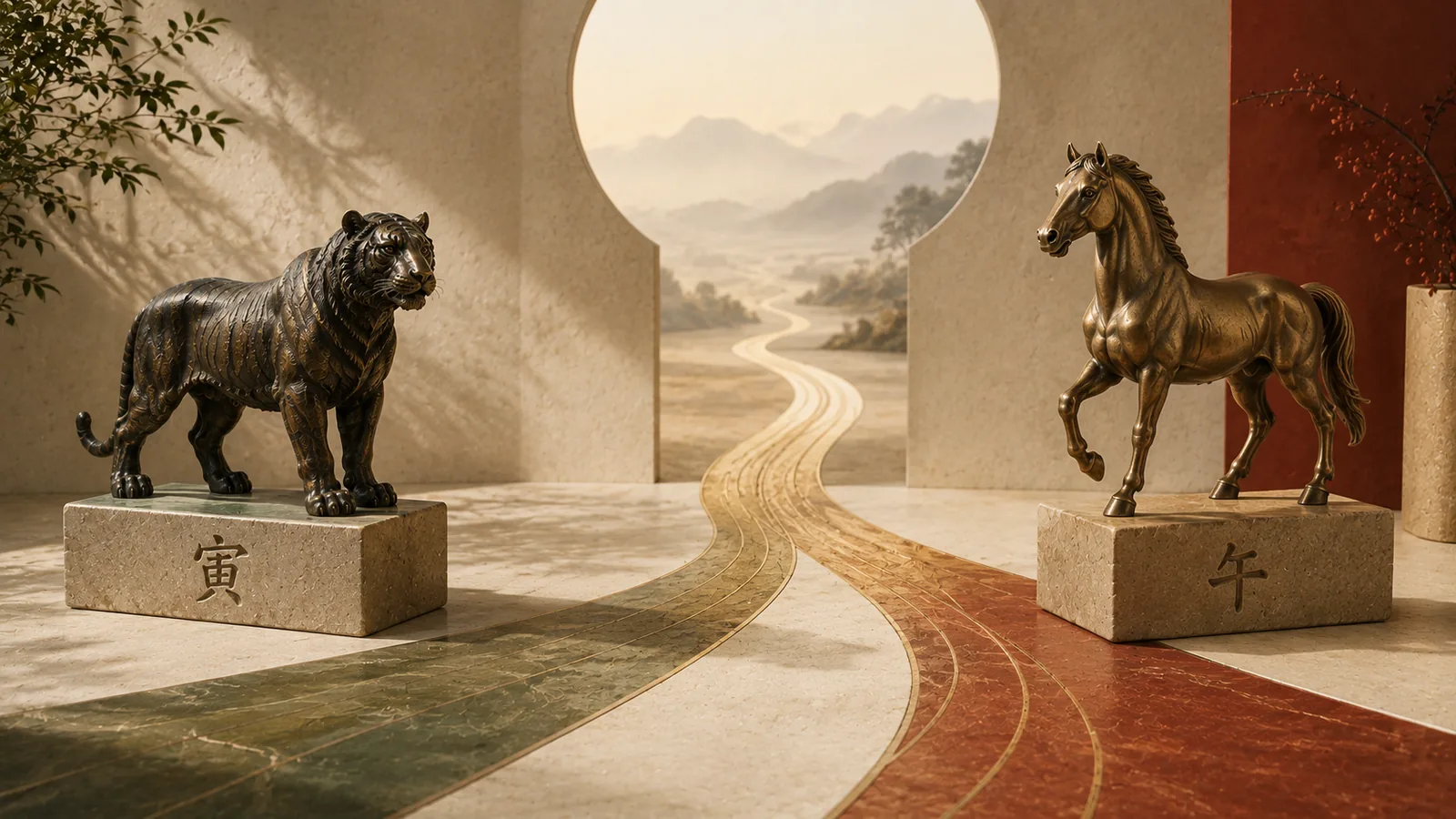
The Tiger corresponds to the Earthly Branch 寅 (Yin). The Horse corresponds to 午 (Wu). Together with the Dog, 戌, they form one of the traditional Three Harmony groups: 寅午戌. When only two of the three are present—as in a Horse year for a Tiger—the relationship is described as a half-combination, 寅午半合.
Popular horoscopes usually translate that into a single word: lucky. That is not how YukDao reads it. Traditional harmony relationships are more usefully understood through themes such as cooperation, alignment, acceleration and momentum—things moving more easily than they did before.
Momentum, however, is not the same as progress. A year in which things move quickly is only valuable if you have decided where you are going.
So the practical question for the Tiger in 2026 is not “will this be a good year?” It is: if things start moving faster, what exactly am I building?
Why 2026 Is Different for the Tiger
2026 is 丙午 (Bing-Wu), the Fire Horse year. 丙 is the Heavenly Stem and 午 is the Earthly Branch, corresponding to the Horse.
Where Rat 子 forms a direct opposition with 午—子午相冲—and Ox 丑 forms 丑午相害, Tiger 寅 forms a combination with 午.
This is a genuinely different category of relationship within the traditional system. 冲 describes opposition. 害 describes complication. 合 describes things coming together.
For the Tiger in 2026, the relevant relationship is 寅午半合—and that changes the kind of question worth asking.
What 寅午半合 Actually Means
The traditional Three Harmony group 寅午戌 is associated in classical practice with Fire. Tiger, Horse and Dog together are described as forming a Fire combination. When only Tiger and Horse are present, the traditional description is a partial or half combination: 半合.
Rather than reading that as a promise of good fortune, it is more useful to read it as a description of tendency. Traditional interpretations commonly associate combination relationships with:
- Cooperation arriving more easily than expected.
- Introductions, invitations and opportunities appearing in clusters.
- Projects that had been stalled beginning to move again.
- Ideas gaining supporters, collaborators or visibility.
- Decisions being made faster than they otherwise would be.
Every one of those can be genuinely valuable. Every one of them can also carry you somewhere you did not intend to go.
That gives the Tiger the central lesson of 2026: momentum needs direction.
Momentum Is Not the Same as Direction
In a year where things move, the constraint is rarely energy. It is attention.
Tigers are traditionally described in cultural terms as decisive and willing to begin. In a year associated with acceleration, that quality can compound in either direction. Ten opportunities in a year is not better than three if the three were the right ones.
A practical filter before agreeing to anything significant in 2026:
- Does this move me toward something I have already decided matters?
- Do I have the time this will actually require—not the time I hope it will require?
- What would I have to stop doing to do this properly?
- If this succeeds, do I want the life that comes with it?
- Am I saying yes because it is right, or because it is available?
Traditional symbolism cannot answer those questions. It can, usefully, remind you to ask them.

Career and Work in 2026
For the Tiger, the most useful career question in 2026 is not “will opportunities appear?” It is: which opportunities deserve my capacity?
Choose depth over breadth
A year of cooperation tends to produce more invitations than one person can honour. Three commitments delivered excellently will build more than eight delivered partially. Before adding something, decide what it replaces.
Use cooperation deliberately
If collaboration comes more easily, be specific about what you want from it. Define the outcome, the contribution of each party, the timeline and the point at which you will review whether it is working.
Watch the pace of expansion
Hiring, new offices, new product lines and new markets are easier to begin than to sustain. Growth that outruns systems, cash flow or attention creates fragility rather than progress.
- Expand where demand is already proven.
- Keep fixed costs behind revenue, not ahead of it.
- Add complexity only when the current work is stable.
Money and Financial Decisions
The financial theme for a momentum year is different from the financial theme for a friction year. The risk is rarely being deceived. It is spending, committing and investing at the speed of your optimism.
Separate income from confidence
A promising year can encourage commitments—larger housing, larger overheads, larger obligations—based on income that has not yet arrived. Commit against what you have received, not what you expect.
Slow down large decisions deliberately
If a decision is significant and irreversible, introduce a deliberate delay. A week of consideration costs very little. A rushed commitment can cost years.
Keep a reserve while you build
Momentum years are when reserves feel least necessary and are most valuable. Maintaining a cash buffer is what allows you to take a genuine opportunity later without borrowing against a bad moment.
This is ordinary financial prudence. It is not a prediction that the Tiger will lose money in 2026.
Relationships and Family
Traditional combination relationships are commonly associated with connection—new introductions, warmer cooperation, and social life expanding.
The practical caution is the same as everywhere else in this year: a fast beginning is not the same as a good foundation. Ease of connection can accelerate a relationship past the point where two people have actually discussed what they want.
For those already in a partnership, the risk in a busy year is quieter: attention going to projects, and the relationship receiving whatever is left. Time with people is a commitment like any other, and in a momentum year it needs to be scheduled rather than assumed.
For single Tiger readers, 2026 does not guarantee romance. New relationships are still best evaluated through communication, behaviour and compatibility rather than zodiac symbolism.
A Practical 2026 Checklist for the Tiger
Do
- Decide your priorities before the year gets busy.
- Choose fewer commitments and finish them.
- Define what each collaboration is for.
- Protect time for the work that compounds.
- Keep a financial reserve while expanding.
- Introduce a deliberate delay before large decisions.
- Schedule time for the people who matter.
- Review quarterly whether you are still on course.
Don’t
- Treat 寅午半合 as a guarantee of success.
- Say yes to everything because the year feels open.
- Expand fixed costs ahead of proven revenue.
- Confuse activity with progress.
- Let a fast start replace a real conversation.
- Start what you have no capacity to finish.
- Buy an object because someone promises it will amplify a harmony year.
Tiger Birth Years Are Not All the Same
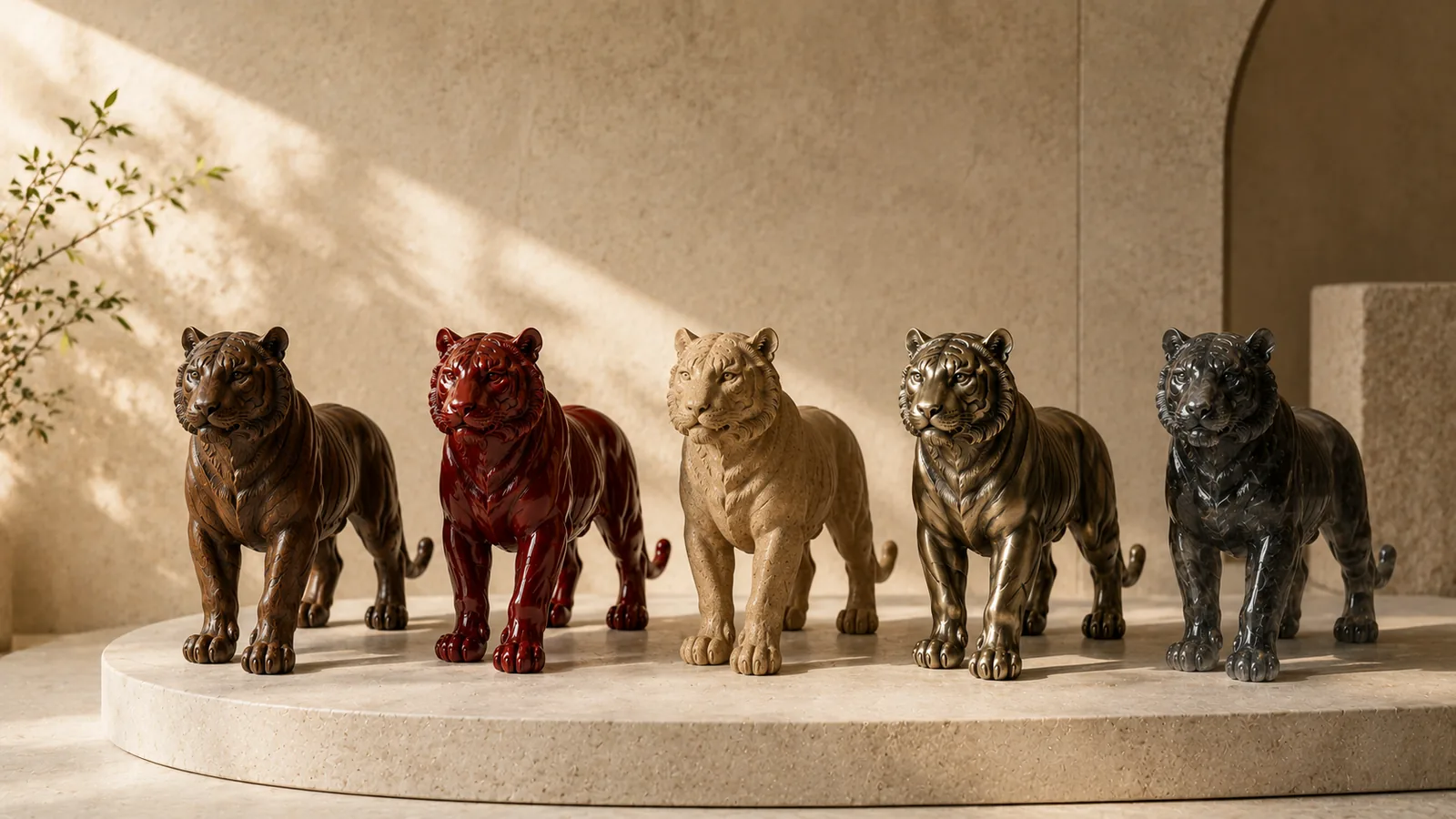
Calling someone a “Tiger” identifies the Earthly Branch of their birth year. It does not mean every Tiger shares the same complete Year Pillar—the Heavenly Stem changes.
Recent Tiger year combinations include:
- 1962 — 壬寅 — Water Tiger
- 1974 — 甲寅 — Wood Tiger
- 1986 — 丙寅 — Fire Tiger
- 1998 — 戊寅 — Earth Tiger
- 2010 — 庚寅 — Metal Tiger
- 2022 — 壬寅 — Water Tiger
These Gregorian years are convenient references only. Chinese zodiac boundaries do not follow January 1. Popular zodiac calendars commonly change the animal at Lunar New Year, while BaZi year-pillar calculations commonly use Li Chun (立春), the Beginning of Spring. If you were born in January or early February, your exact birth date, time and the system being used may matter.
Not sure if you are a Tiger? Find your Chinese zodiac sign.
1962 · 壬寅 · Water Tiger
Someone born in 1962 is around 64 in 2026. A year associated with movement can be useful here for transitions rather than expansion—retirement planning, handing over responsibilities, travel, or a long-postponed project finally beginning.
The useful discipline is choosing which of those to actually pursue, rather than agreeing to all of them at once.
1974 · 甲寅 · Wood Tiger
Someone born in 1974 is around 52 in 2026. Professional seniority often means more invitations than time: advisory roles, board positions, side ventures, mentoring.
This is the stage where saying no is the more valuable skill. Protect the two or three commitments that genuinely matter and decline the rest gracefully.
1986 · 丙寅 · Fire Tiger
Someone born in 1986 is around 40 in 2026. Career, family and financial commitments frequently peak together at this stage, which makes capacity—not opportunity—the real constraint.
If a genuine opportunity appears, be honest about what it displaces. Momentum is only an advantage if something else is set down.
1998 · 戊寅 · Earth Tiger
Someone born in 1998 is around 28 in 2026. This is often a period of accelerating career choices, first significant financial decisions and long-term relationships forming.
A year of easy momentum can be genuinely productive here—provided the direction is chosen deliberately. Building depth in one field usually compounds further than sampling several.
2010 · 庚寅 · Metal Tiger
Someone born in 2010 is around 16 in 2026. The useful context at this age is education, examinations, friendships, sport, creative work, first jobs and growing independence.
The momentum theme translates simply: enthusiasm is a strength, and choosing a smaller number of activities to do well is usually more rewarding than joining everything at once.
2022 · 壬寅 · Water Tiger
Someone born in 2022 is around four years old in 2026. Broad annual zodiac interpretations have very little practical relevance to a young child.
Parents who enjoy the tradition can use the year as an occasion to notice ordinary developmental changes—language, routines, friendships, new activities—rather than reading them as zodiac outcomes.

Wood, Fire and the Five Elements
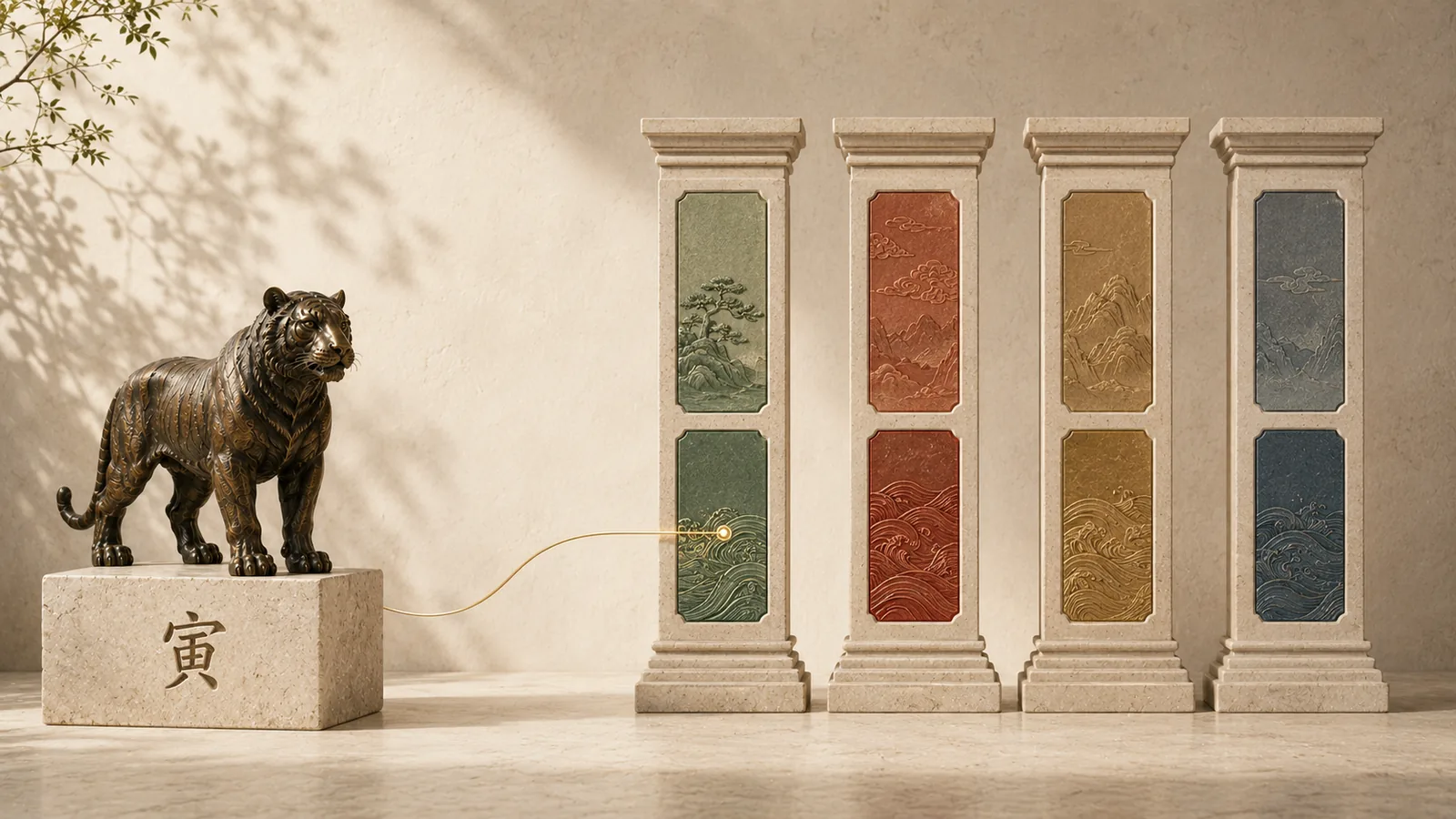
The Tiger’s Earthly Branch 寅 is primarily associated with Wood within traditional Five Element correspondence. 2026, 丙午, carries strong Fire associations.
In the generating cycle, Wood produces Fire—traditionally expressed as 木生火. Read symbolically, this describes output: something is being given in order for something else to burn brightly.
That reading pairs naturally with the branch-level 寅午半合. Both point toward activity and expression rather than opposition. Both also imply expenditure. A year that produces easily is a year in which rest, health and capacity deserve deliberate attention.
This is why reducing Chinese metaphysics to “Tiger is lucky in 2026” loses most of the structure. Several relationships operate at once, and a complete BaZi chart contains far more information than the birth-year animal alone.
What About Lucky Colors?
Search for “Tiger lucky colors 2026” and you will find many contradictory answers—green, red, gold, blue, depending on the source.
It is more useful to explain the underlying associations. Broad Five Element correspondences connect Wood with green tones, Fire with red and vermilion, and Water with blue and black. Tiger’s 寅 relates to Wood; 2026’s 丙午 relates to Fire.
Wearing a particular color does not guarantee wealth, protection or success. These are best understood as part of a symbolic tradition explored through clothing, interiors, design and objects—not as supernatural guarantees.
Our guides to the Five Phases and color in Chinese culture explain where these correspondences come from.
Your Tiger Sign Is Only One Part of the Picture
When someone says “I am a Tiger,” they are identifying their birth year’s Earthly Branch.
In BaZi, the birth chart contains four pillars: Year, Month, Day and Hour. Each pillar contains one Heavenly Stem and one Earthly Branch. Together these form the Eight Characters · 八字.
Your Tiger sign therefore represents only the Earthly Branch of the Year Pillar. It does not describe the complete chart.
Two people born in the same Tiger year may have different Month Pillars, Day Pillars, Hour Pillars, Day Masters, elemental structures and relationships with the 2026 丙午 year. Broad zodiac guides are useful for understanding traditional cultural relationships, but they are not personalized BaZi readings.
Are You Actually a Tiger?
Chinese zodiac boundaries do not follow January 1, and BaZi year-pillar calculations commonly use Li Chun. If you were born around January or early February, check your exact birth information rather than relying only on the Gregorian year.
Find My Chinese ZodiacYour Zodiac Is Only the Beginning
Your birth-year animal represents one part of the traditional Four Pillars system. Explore how your Year, Month, Day and Hour combine in a complete BaZi chart.
Explore My BaZiFrequently Asked Questions
Is 2026 a good year for the Tiger?
Traditional Chinese zodiac interpretation does not reduce 2026 to simply good or bad. Tiger 寅 and Horse 午 form 寅午半合, a partial Three Harmony relationship traditionally associated with cooperation, momentum and things moving quickly. Momentum is useful only when it has direction, so the practical response is to decide what you actually want to build before saying yes to everything.
What is 寅午半合?
Tiger corresponds to the Earthly Branch 寅 and Horse to 午. Together with Dog 戌 they form the traditional Three Harmony group 寅午戌. When only two of the three branches are present, as in a Horse year for a Tiger, it is described as a half-combination, 半合.
Does 寅午半合 mean the Tiger will be lucky in 2026?
No. Traditional harmony relationships are commonly associated with cooperation and things gaining speed, not with guaranteed success. Speed can accelerate a good decision or a poor one. The traditional symbolism is better used as a prompt to choose direction carefully.
Should Tiger start a business in 2026?
A zodiac relationship cannot decide that. If a business idea already has a market, a plan and a realistic financial runway, 2026 traditional symbolism simply suggests you may find cooperation and momentum easier. If the idea is untested, momentum can also help you commit too quickly.
What are the risks for Tiger in 2026?
The most common practical risk in a momentum year is overcommitment: too many projects, too many yeses, and spending that grows faster than income. Traditional interpretations of a harmony year rarely warn about opposition; they invite you to watch your own pace.
What colors are traditionally associated with Tiger in 2026?
Tiger's branch 寅 is primarily associated with Wood, while 2026 丙午 carries strong Fire symbolism. Traditional Five Element correspondence connects Wood with green tones and Fire with red and vermilion. These are symbolic cultural associations, not colors that guarantee luck.
Which years are Tiger years?
Recent Tiger years include 1962, 1974, 1986, 1998, 2010 and 2022. Chinese zodiac boundaries do not follow January 1. Popular zodiac calendars often change the animal at Lunar New Year while BaZi year-pillar calculations commonly use Li Chun, so people born in January or early February should verify their exact sign.
Are all Tiger people affected the same way in 2026?
No. The Year Pillar alone varies between Metal, Water, Wood, Fire and Earth Tiger combinations, and a complete BaZi chart also includes the Month, Day and Hour Pillars. People who share the Tiger zodiac can have very different charts.
- Chinese Zodiac
- Tiger Zodiac
- Fire Horse
- 2026
- Yin Wu Half Harmony
- Five Elements
- BaZi
- Chinese Wisdom
Related Articles
Ox in 2026: A Practical Guide to the Fire Horse Year
A grounded guide to 丑午相害 in 2026—what friction and misunderstanding can mean for Ox years, and why clarity matters more than superstition.
Rat in 2026: A Practical Guide to the Fire Horse Year
A grounded guide to 子午相冲 in 2026—what change may mean for Rat years, how to prepare, and why your birth-year animal is only one part of BaZi.
2026 Year of the Fire Horse: What 丙午 Means in the Chinese Zodiac
2026 is not simply a Year of the Horse. In the traditional Chinese calendar it is 丙午, Bǐng Wǔ — a Yang Fire Horse year that returns only once every sixty years.